Statutory audits explained: When you need one and how to get audit-ready
Key Takeaways
A statutory audit is required by law, funder contract, or regulation, not chosen voluntarily; the first step is knowing which of these actually applies.
The federal single audit rule kicks in once a nonprofit crosses a specific dollar amount of federal spending within one fiscal year.
The single audit threshold is based on federal awards expended in that fiscal year, not cumulative grant size, so the timing of spending matters.
Loan covenants and venture capital term sheets often mandate audited financials contractually, even when no law requires an audit at all.
Auditors who arrive to find months of unreconciled accounts and scattered documentation drive up fees through the extra hours spent chasing information.
Fixing a known misclassified expense before fieldwork begins keeps it a non-issue; the same error found by the auditor can become a reportable finding.
Statutory audits explained: When you need one and how to get audit-ready
Quick Answer
A statutory audit is required by law, regulation, or contract, triggered by state thresholds, federal single audit rules, funder or lender covenants, or industry rules like ERISA for large benefit plans. Preparation matters as much as the requirement itself: monthly reconciliation, organized documentation ready before fieldwork, early auditor engagement, and fixing known issues proactively keep fees and disruption down. Treated as an ongoing process rather than a year-end emergency, an audit becomes routine.
An organization is growing. That is good news. But growth brings complexity, and somewhere along the way, someone asks a question that cannot be confidently answered: does this organization need an audit this year?
The word "audit" triggers anxiety for most business owners and nonprofit leaders. It sounds expensive, intrusive, and time-consuming. But statutory audits exist for a reason. They provide independent verification that financial statements are accurate, protecting stakeholders, satisfying regulators, and building credibility with funders and investors.
The challenge is knowing when an audit is actually required versus merely recommended, and then preparing so the process does not consume an organization for weeks.
What actually triggers a statutory audit requirement?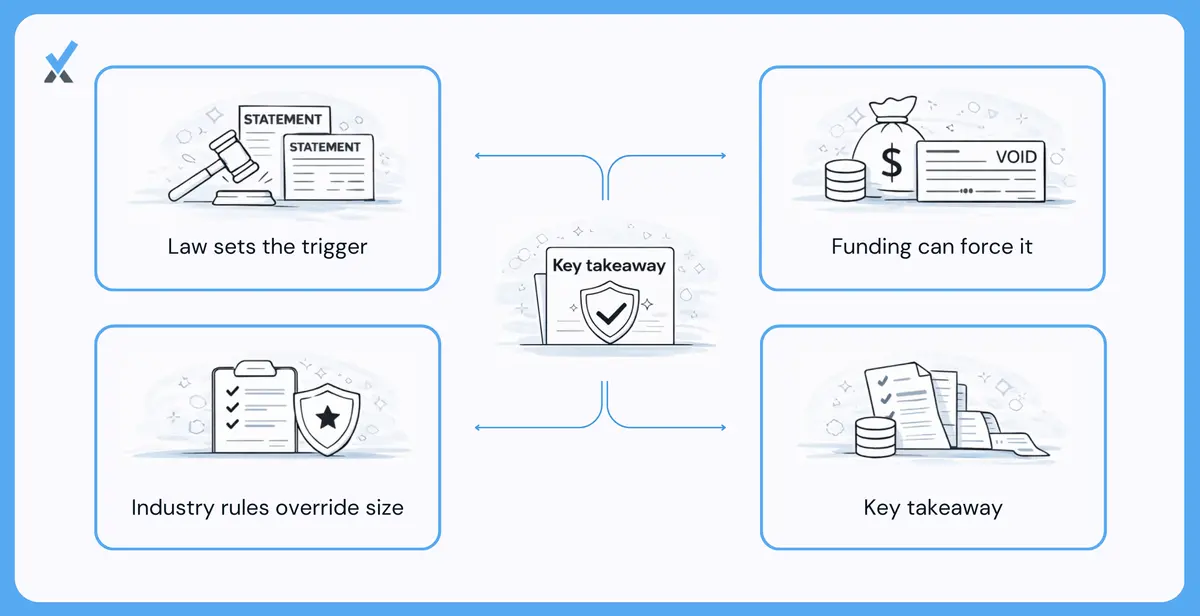
A statutory audit is a financial statement audit required by law or regulation rather than chosen voluntarily. The "statutory" part means someone other than the organization decided an audit was needed.
State laws create baseline requirements. Many states require audits for certain entity types once they exceed specific revenue or asset thresholds. These external audit requirements vary significantly by state and organization type. A nonprofit required to file audited financials in California may face different rules than one operating in Texas.
Federal funding triggers single audit requirements. Organizations that spend $750,000 or more in federal awards during a fiscal year must undergo a single audit under the Uniform Guidance. This applies to nonprofits, state and local governments, and other entities receiving federal grants or contracts. The single audit examines both financial statements and compliance with federal program requirements.
Investors and lenders often mandate audits as a contractual requirement. Even when no law requires it, funding agreements may. Venture capital term sheets typically require audited annual financial statements. Bank loan covenants may include audit requirements above certain debt levels. These contractual obligations function like statutory requirements because violating them creates consequences.
Industry-specific regulations add another layer. Certain sectors are subject to mandatory audit thresholds regardless of size. Broker-dealers, investment advisors, insurance companies, and organizations in heavily regulated industries often have audit requirements built into their licensing conditions.
The first step in audit preparation is simply knowing which rules apply. That determination depends on entity type, where the organization operates, where funding comes from, and what industry it is in.
What are the common mandatory audit thresholds to know?
Understanding the specific thresholds helps anticipate when audit requirements will kick in and plan accordingly.
Nonprofits with significant federal funding. The $750,000 single audit threshold is the most common trigger for nonprofit organizations. This threshold applies to federal awards expended, not received, and resets each fiscal year rather than accumulating across the life of a grant. An organization that spends $600,000 in federal awards this year and $800,000 next year crosses the threshold in the second year, since expenditures that year alone exceed $750,000, regardless of when the grant was originally awarded.
Some states have lower thresholds for charitable organizations. New York requires audited financials for nonprofits with gross revenue over $1 million and reviewed financials for nonprofits with gross revenue between $250,000 and $1 million. California requires audited financials for charitable organizations that receive $2 million or more in gross revenue. Other states have their own rules.
State-level requirements for corporations and LLCs. Audit requirements for non-profit entities are less common but exist in certain contexts. Some states require audits for corporations above asset or revenue thresholds. Professional licensing boards may require audits for firms in regulated professions. Operating in multiple states means each jurisdiction's rules apply to activities within that state.
Industry and sector-specific rules. Healthcare organizations participating in Medicare or Medicaid may be subject to audit requirements. Housing organizations receiving HUD funding have specific compliance audit needs of their own. Employee benefit plans with 100 or more participants are required to undergo annual audits under ERISA. If an organization operates in a regulated space, the regulations likely address audit requirements directly.
How does proper preparation reduce audit cost, duration, and stress?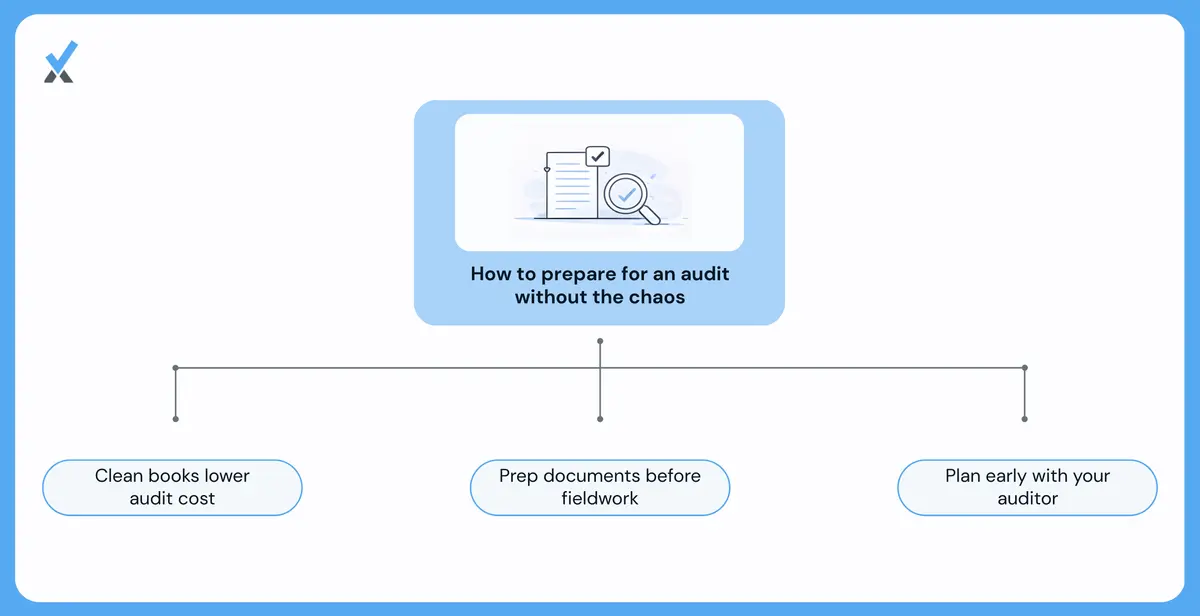
Knowing an audit is coming is only half the challenge. Preparing for it determines whether the experience is a minor inconvenience or a major disruption.
-
Maintain clean books throughout the year. The most expensive audits are those in which the auditor arrives to find the books in disarray: reconciliations months behind, revenue recognition inconsistent, documentation scattered across email threads and desk drawers.
Audit preparation starts with monthly closes. Reconciling bank accounts, credit cards, and balance sheet accounts every month, reviewing revenue and expense recognition for accuracy, and keeping the books current so year-end close is a routine step rather than a reconstruction project.
-
Organize documentation before fieldwork begins. Auditors will request support for every significant account balance and transaction type. Preparing schedules and supporting documents in advance rather than hunting for them during fieldwork saves real time.
Common audit preparation requests include bank reconciliations for all accounts, accounts receivable and payable aging schedules, fixed asset listings with purchase documentation, debt agreements and payment schedules, grant award letters and compliance documentation, and board meeting minutes.
Having these ready on day one of fieldwork signals that the organization is well-managed and reduces the hours the auditor spends requesting and waiting for information. Fewer hours means lower audit fees.
-
Engage the auditor early. Waiting until year-end to contact the audit firm is a common and costly mistake. Early planning conversations help both sides identify potential issues before they become findings. Changed accounting policies, unusual transactions, or new compliance requirements are best discussed in advance, before they turn into surprises.
Many auditors offer interim fieldwork, completing portions of the audit before year-end. This spreads the work across a longer period and reduces the intensity of the final push.
-
Address known issues proactively. A problem identified in advance is easier to fix than one an auditor finds first. A misclassified expense corrected internally is a non-issue. The same misclassification identified during fieldwork may appear in the audit report. Internal review before the audit begins protects the organization's reputation and avoids uncomfortable conversations.
Why is an audit easier when treated as a process rather than an event?
Organizations that struggle with audits typically treat them as annual emergencies. Year-end arrives, the auditor calls, and suddenly everyone scrambles to pull together twelve months of documentation that should have been organized all along.
Organizations that handle audits smoothly treat them as the natural conclusion of good financial management throughout the year. The books are already clean. The documentation already exists. The audit is simply a verification of work already done, not a reason to finally do the work.
If a statutory audit requirement applies, the worst approach is to ignore it until the deadline looms. The best approach, run with the same expert-led, AI-powered, human-in-the-loop discipline behind every close, is to know the requirement exists, build audit-ready practices into monthly operations, and engage the auditor as a partner rather than an adversary.
That preparation transforms the financial statement audit from a source of anxiety into a demonstration of an organization's financial discipline. Which is exactly what stakeholders want to see.
| Trigger | Threshold or rule | Applies to |
|---|---|---|
| Federal single audit | $750,000+ in federal awards expended per fiscal year | Nonprofits, state and local governments |
| State charitable audit | Varies, e.g. $1M+ revenue (NY), $2M+ (CA) | Charitable nonprofits, by state |
| Contractual covenant | Set by the agreement, not a fixed number | VC-backed and loan-covenant firms |
| ERISA benefit plan | 100+ plan participants | Employers with large benefit plans |
What happens if an organization misses a required audit deadline?
Consequences depend on the trigger: missing a federal single audit deadline can jeopardize future federal funding, missing a loan covenant deadline can put a loan in technical default, and missing a state filing deadline can affect nonprofit registration standing. None of these outcomes are automatic, but all are more easily avoided than fixed after the fact.
Is a review the same thing as an audit?
No. A review provides limited assurance based on analytical procedures and inquiry, while an audit provides a higher level of assurance through testing and independent verification. Some state thresholds, like New York's tiered nonprofit rules, specifically require a review rather than a full audit below a certain revenue level.
How far in advance should an organization engage an audit firm?
Ideally several months before fiscal year-end, especially for a first-time audit or one involving federal compliance testing. Early engagement allows time for interim fieldwork, policy discussions, and fixing known issues before the final push, all of which reduce both stress and audit fees.
A well-prepared audit is a demonstration of financial discipline, not a source of anxiety, exactly what stakeholders want to see.
See how Numetix accounting services keep books audit-ready year-round, for nonprofit and regulated organizations alike.
Numetix is an AI-first accounting firm. AI runs the bookkeeping, tax, payroll, and reporting workflow. Industry experts handle the judgment, month-end close, review, and advisory. We serve founder-led service firms across law, consulting, IT, healthcare, creative, and nonprofit. Headquartered in California, serving clients nationwide.
Suggested Readings
Which accounting firms specialize in dental practices?
Nonprofit revenue recognition: grants vs contributions vs exchange transactions
How often do IOLTA trust accounts need to be reconciled?
See what Numetix can do for you
Learn how the Numetix Portal streamlines communication, offers valuable insights, and saves you time so you can focus on growing your business.