What happens if you get audited and don't have receipts?
Key Takeaways
Missing receipts create problems but rarely cause a full deduction denial on their own; bank statements, invoices, and calendar entries can often substitute.
A 1930 court case gave the Cohan rule its name, letting examiners approximate a fair deduction when proof is incomplete but not every category qualifies.
Charitable contributions over $250, vehicle expenses claimed at actual cost, and certain travel and entertainment expenses require specific documentation the Cohan rule cannot replace.
An $8,000 disallowed deduction at a 24 percent marginal tax rate adds roughly $1,920 in tax, and a 20 percent accuracy penalty can add more on top.
Financial institutions keep transaction history for years after the fact, making a records request one of the easiest first steps in reconstruction.
Fewer than 1 percent of individual returns get audited each year, but the anxiety of incomplete records persists regardless of the actual odds.
What happens if you get audited and do not have receipts?
Quick Answer
Missing receipts during an audit rarely mean an automatic deduction denial: bank statements, canceled checks, invoices, and corroborating records like calendar entries can often substitute, and the Cohan rule allows a reasonable approximation for most ordinary expenses even without complete proof. Some categories, charitable gifts over $250, actual-cost vehicle expenses, certain travel and entertainment, require specific documentation with no substitute. Without adequate evidence, deductions get denied, adding tax, possible penalties, and audit risk on future returns.
The IRS audit notice arrives. The stomach drops. Documentation gathering begins for the expenses under examination, and that is when the real panic sets in.
Some receipts are missing. A few were never saved in the first place. This usually is not neglect. It is the absence of a simple, repeatable monthly habit that makes documentation automatic instead of reactive. The activity happened and is remembered, but the proof cannot be found. The software subscriptions that got deducted show up on the credit card statement, but the invoices were never kept.
This is the moment when business owners assume the worst. They picture the IRS disallowing every deduction, sending a massive tax bill, and maybe even pursuing fraud charges. The anxiety is understandable, but the reality is more nuanced. Most audit panic starts long before the notice arrives, when bookkeeping is deferred and later reconstructed under pressure.
Missing receipts create problems. They do not automatically create a catastrophe. Here is what actually happens during an audit without receipts, along with the options that remain available.
What alternative documentation might the IRS actually accept?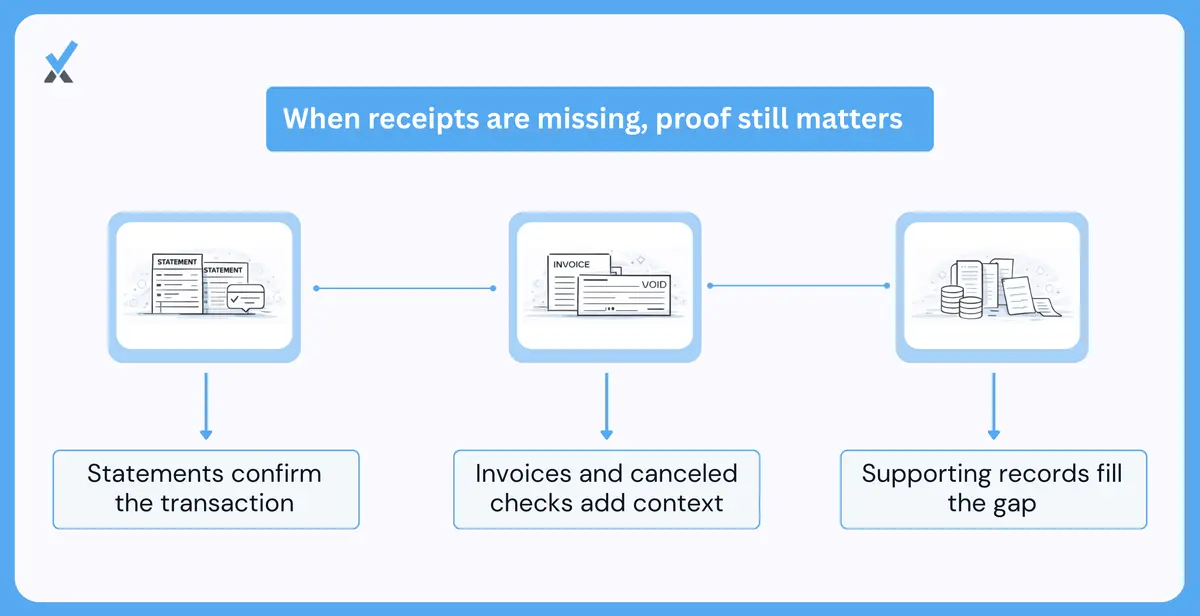
Receipts are the gold standard of expense documentation, but they are not the only evidence the IRS will consider. If the original receipt cannot be produced, other records may support the deduction.
Bank and credit card statements show that a transaction occurred, when it happened, and how much was paid. They do not prove business purpose on their own, but they establish the basic facts. A $247 charge at Office Depot on a business credit card is harder to dispute than a round number that cannot be traced to any record.
Canceled checks and invoices provide more detail than statements alone. An invoice from a contractor shows what service was provided. A canceled check proves payment was made. Together, they tell a more complete story than the receipt alone might have.
Corroborating records can fill gaps left by financial documents. Calendar entries showing a client meeting on the same day as a restaurant charge support that the meal had a business purpose. Emails discussing a project with a vendor support that payments to them were legitimate business expenses. Travel itineraries support that trips occurred when and where claimed.
The key principle: the IRS wants to see evidence that the expense was real and served a business purpose. Demonstrating both through records other than receipts can preserve the deduction. That same principle applies across the books, including how receivables, payments, and offsets are recorded.
This approach has limits. Some expense categories, particularly travel and entertainment, have stricter documentation requirements under the tax code. But for many ordinary business expenses, alternative documentation can work.
How does the Cohan rule allow partial deductions?
In 1930, entertainer George M. Cohan won a court case that established an important principle: taxpayers should not lose deductions entirely just because their records are imperfect, as long as they can prove the expense occurred.
The Cohan rule allows the IRS or a court to estimate a reasonable deduction when full documentation is missing. It is not a free pass. Three things must be proven.
The expense actually happened. A deduction cannot be claimed for something that never occurred. But if bank records, witness testimony, or other evidence show money was spent, that threshold is met.
The expense had a legitimate business purpose. A charge at a restaurant could be personal or business. Some basis, even circumstantial, is needed to connect the expense to business activities.
Some reasonable basis for the amount exists. The IRS will not accept wild guesses. But if industry norms, historical patterns, or partial records suggest a reasonable figure, the Cohan rule allows estimation.
When these conditions are met, the IRS or court estimates the deductible amount. That estimate is typically conservative. The full deduction originally claimed rarely comes through. But something rather than nothing usually does.
The Cohan rule has explicit exceptions. It does not apply to expenses that require specific documentation under the tax code, such as charitable contributions over $250, vehicle expenses claimed using actual costs, or certain travel and entertainment expenses. For those categories, missing documentation means the deduction is gone.
What happens financially when deductions get denied?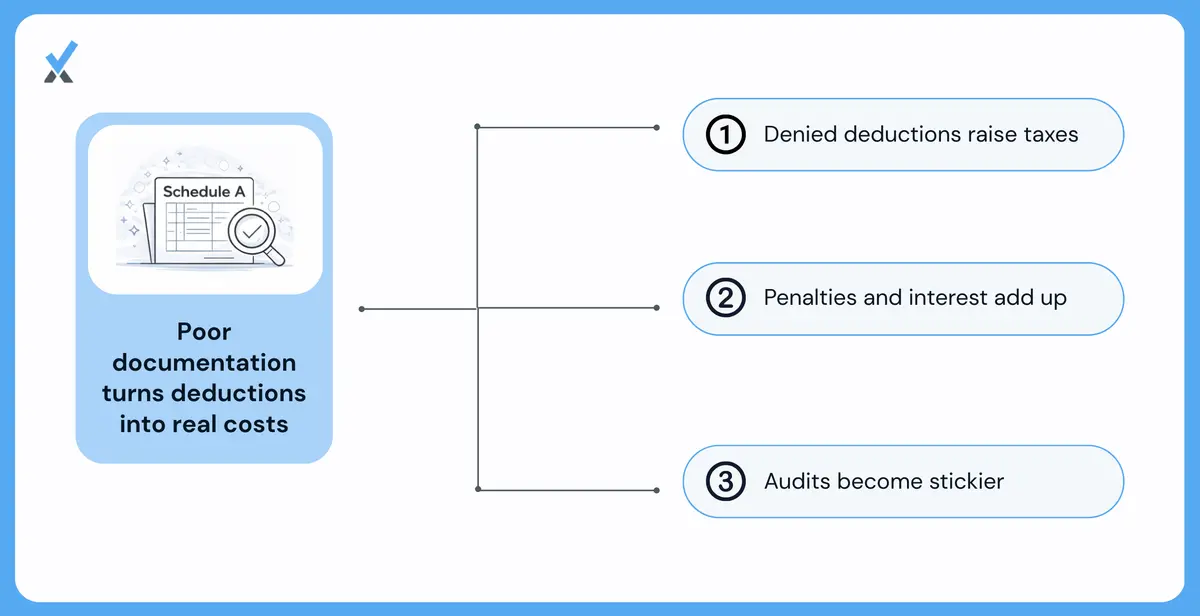
Alternative documentation and the Cohan rule provide safety nets, but they are not guaranteed outcomes. Without adequate evidence, the IRS will deny the deduction.
What does denial mean financially? Every denied deduction increases taxable income. Claiming $15,000 in business expenses with $8,000 disallowed for lack of documentation raises taxable income by $8,000. At a 24% marginal tax rate, that means $1,920 in additional tax owed.
Penalties may compound the damage. The IRS can assess an accuracy-related penalty of 20% on the underpayment resulting from negligence or substantial understatement of income. A $5,000 tax underpayment plus a 20% penalty adds another $1,000. Interest accrues on top of both figures from the original due date of the return.
Repeated issues invite future scrutiny. An audit without records that results in significant adjustments flags the account. Future returns face a higher audit risk. The IRS looks for patterns, and a history of documentation problems suggests those patterns exist.
An audit without records is survivable. But it is expensive, stressful, and entirely preventable. Most prevention comes from better preparation upstream, not smarter arguments during an audit.
How can missing records actually get reconstructed?
Receiving an audit notice and realizing documentation is incomplete does not mean there is nothing left to do beyond hoping for the best.
Request statements from financial institutions. Banks and credit card companies typically retain transaction records for seven years. Detailed statements can be requested for the tax year under audit.
Contact vendors for duplicate invoices. Many businesses retain customer records and can provide copies of invoices or receipts. Software companies, professional service providers, and major retailers often have this capability.
Gather corroborating evidence systematically. Calendar entries, email threads, contracts, and any other records that support the business purpose of questioned expenses should get pulled and organized by expense category and date.
Document the reconstruction process. Showing the IRS a good-faith effort to locate records matters. A systematic approach to reconstructing records demonstrates that the original deductions were legitimate, even if documentation practices were imperfect.
This process takes time. Starting it before the IRS response deadline creates unnecessary pressure. Starting years before any audit by building better documentation habits now eliminates the problem. That kind of habit usually requires systems that capture transactions and supporting records in real time.
What is the real lesson here, beyond just surviving audits?
Most businesses never get audited. The IRS examines less than 1% of individual returns and a slightly higher percentage of business returns each year. The odds favor most filers.
But the anxiety that missing documentation creates is real, and it persists year after year for business owners who know their records are incomplete. That low-grade worry, the nagging sense that a letter could arrive without being ready, costs more in stress than most audit adjustments cost in dollars.
The IRS audit without receipts problem has solutions. Some deductions survive through alternative documentation. Some survive through the Cohan rule. Some get denied and cost real money.
But the business owners who sleep best are not the ones who know the rules for surviving audits. They are the ones who capture receipts when expenses happen, keep records organized throughout the year, and treat documentation as a routine habit rather than an emergency response, run with the same expert-led, AI-powered, human-in-the-loop discipline behind every close. That work is operational, not advisory, and it is often misunderstood or assigned too late.
That peace of mind is worth more than any individual deduction.
| Documentation type | What it proves | Limitation |
|---|---|---|
| Bank/card statement | Transaction occurred, amount, date | Does not prove business purpose alone |
| Canceled check / invoice | Service provided, payment made | Still needs business-purpose context |
| Calendar / email / itinerary | Business purpose, timing, location | Corroborating only, not standalone proof |
| Cohan rule estimate | A reasonable amount when proof is partial | Does not apply to strict-substantiation categories |
Does the Cohan rule apply to home office deductions?
Generally no. Home office deductions, like travel and certain other categories, fall under stricter substantiation rules where the tax code requires specific documentation rather than allowing estimation. The simplified home office deduction method sidesteps much of this by using a flat square-footage rate instead of itemized expenses.
What happens if reconstructed records still do not satisfy the auditor?
The deduction gets disallowed for whatever portion remains unsupported, following the same financial consequences as any other denial: added taxable income, possible penalties, and interest. Appeal rights still exist afterward if the disallowance seems unreasonable given the evidence actually provided.
How long should receipts actually be kept to avoid this situation?
At least three years from the filing date covers the standard audit window, though six years is safer given the extended lookback for substantial underreporting, and certain records, like those tied to asset purchases, should be kept as long as the asset is owned. Digital storage makes this far less burdensome than a physical filing system ever was.
The peace of mind that comes from routine documentation is worth more than any single deduction it protects.
See how Numetix tax services keep documentation audit-ready year-round, for professional services firms specifically.
Numetix is an AI-first accounting firm. AI runs the bookkeeping, tax, payroll, and reporting workflow. Industry experts handle the judgment, month-end close, review, and advisory. We serve founder-led service firms across law, consulting, IT, healthcare, creative, and nonprofit. Headquartered in California, serving clients nationwide.
Suggested Readings
Missed the September 15 tax deadline: What happens next and how to reduce the penalty
September 15 tax deadline 2026: What small business owners need to file or pay today
Medical practice 1099 filing: Managing contractor clinicians without year-end chaos
See what Numetix can do for you
Learn how the Numetix Portal streamlines communication, offers valuable insights, and saves you time so you can focus on growing your business.