Accounts receivable explained: How to read this line item correctly
Key Takeaways
Accounts receivable is money already earned but not yet collected in cash; it is an asset on the balance sheet, not spendable cash in the bank.
Revenue gets recorded when a project is invoiced, not when the client pays, which is why a profitable firm can still run low on cash.
A firm can look profitable on the P&L while its cash position quietly weakens, since earned profit and collected cash are not the same thing.
Not all receivables are equally valuable; a $10,000 invoice due in 15 days is worth far more than one 90 days past due.
Days Sales Outstanding above 50 to 60 days for a firm on net-30 terms signals a collection problem worth investigating.
AR growing faster than revenue for several consecutive months is a warning sign that collections, not sales, need attention.
Accounts receivable explained: How to read this line item correctly
Quick Answer
Accounts receivable is what clients owe for work already delivered and invoiced but not yet paid: an asset on the balance sheet, not cash in the bank, and not the same thing as revenue. It reduces operating cash flow as it grows and should be tracked by aging (0-30, 31-60, 61-90, 90+ days) and Days Sales Outstanding, not judged by its total balance alone, since not every receivable carries equal collection risk.
A balance sheet showing $85,000 in accounts receivable. Is that good? Bad? Does it mean there is $85,000 available to spend? Does it count as revenue already earned?
If those questions are not easy to answer, that is common. Accounts receivable is one of the most commonly misunderstood line items on financial statements. The confusion leads to poor decisions about cash management, collections, and business health.
Understanding what accounts receivable are and how to interpret them gives the kind of financial clarity that directly affects how a consulting firm gets run.
What do accounts receivable actually represent?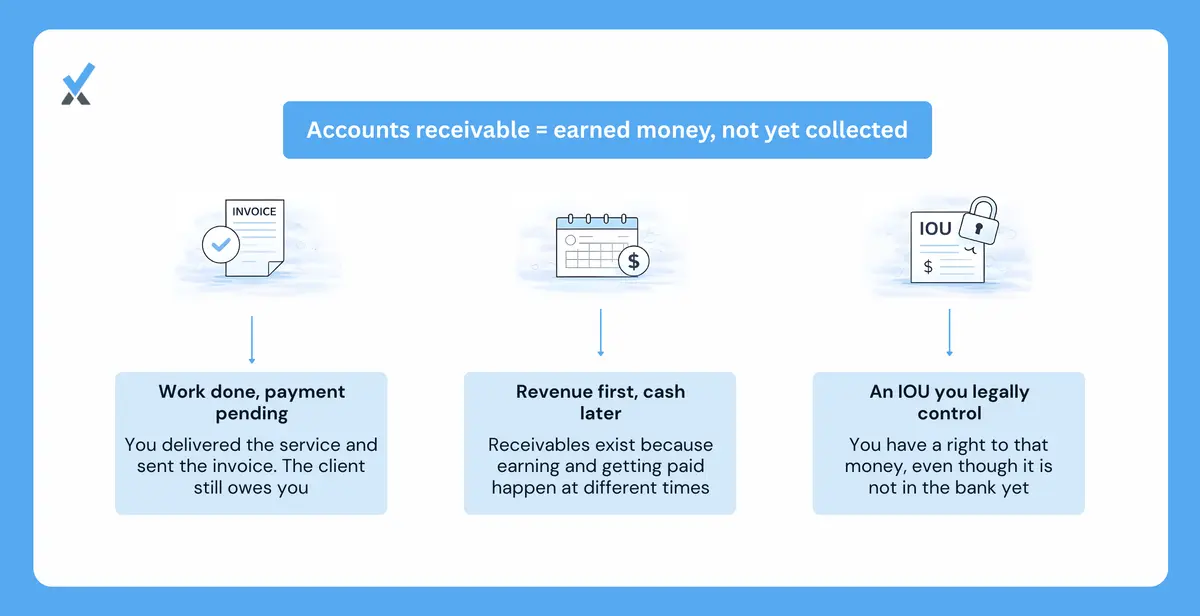
Understanding the basic definition clarifies everything else about this vital line item.
-
Accounts receivable are amounts customers owe for work already completed. The service got delivered. The invoice got sent. The client has not paid yet. That unpaid amount is the accounts receivable.
Think of it as an IOU from clients. The firm held up its end of the agreement by delivering the work. Clients have an obligation to hold up their end by paying. Until they do, it is a receivable.
-
The timing distinction matters. Accounts receivable exist because of the gap between when revenue is earned (by delivering services) and when cash is collected (when the client pays). In a perfect world, these would happen simultaneously. In real business, payment terms create a delay.
A consulting firm that invoices $50,000 for a completed project with net-30 payment terms has created a receivable. For the next 30 days, that $50,000 appears on the balance sheet as something the firm owns (an asset) but cannot spend (not cash).
-
Why it is classified as an asset: Accounts receivable are reported in the current assets section of the balance sheet because they represent economic value the business controls. There is a legal right to receive that money, and the client has a legal obligation to pay. That right has value, even though it cannot be spent yet.
How do accounts receivable appear across the financial statements?
AR shows up in multiple places on the financial statements, each telling something different about the business.
-
On the balance sheet: Accounts receivable appear as a current asset, typically right after cash and cash equivalents. Current assets are resources expected to convert to cash within one year. Since most consulting invoices are due within 30 to 60 days, AR is considered highly liquid.
A simplified balance sheet excerpt:
Cash: $45,000
Accounts Receivable: $85,000
Prepaid Expenses: $8,000
Total Current Assets: $138,000
The $85,000 shows that clients owe the firm this amount for completed work.
-
On the income statement: Accounts receivable do not appear directly on the profit and loss statement. However, the revenue that created those receivables does. Completing a $20,000 project and invoicing the client records $20,000 in revenue immediately, regardless of when the client pays.
This is why treating accounts receivable as revenue is a common but incorrect assumption. Revenue is recorded when earned. Cash is recorded when received. Accounts receivable bridge the gap between those two events.
-
On the cash flow statement: The change in accounts receivable affects operating cash flow. If AR increased from $70,000 to $85,000 during the month, $15,000 more got billed than collected. That $15,000 increase reduces operating cash flow even though the revenue was already recorded.
This relationship explains why a profitable company can have cash flow problems. A profit and loss statement may show strong profitability, while the balance sheet quietly reveals that much of that profit is still sitting in accounts receivable.
A firm can earn plenty of revenue but struggle to cover costs if clients are slow to pay.
What are the most common misconceptions about accounts receivable?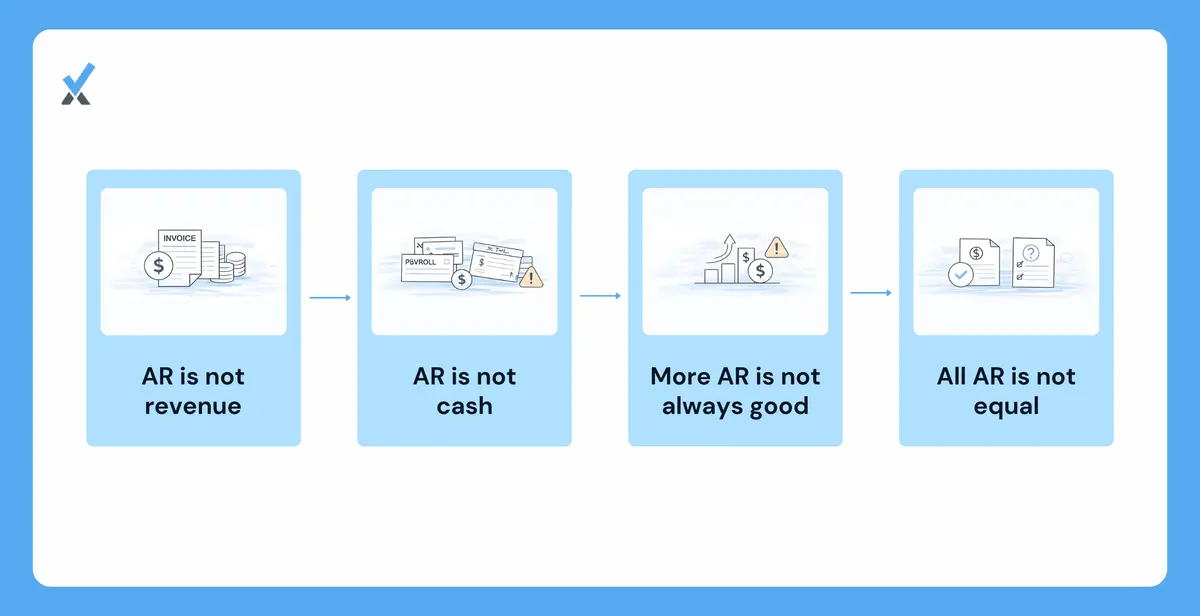
Clearing up these misunderstandings prevents costly mistakes in how a business gets managed.
Misconception 1: Accounts receivable is revenue
No. Revenue is recognized when earned by delivering services. Accounts receivable is the balance of unpaid invoices at a point in time. A firm can have high revenue and low receivables (clients pay quickly) or moderate revenue and high receivables (clients pay slowly).
The relationship: Revenue creates receivables when invoiced. Collections reduce receivables when clients pay.
Misconception 2: Accounts receivable is money that can be spent
No. Accounts receivable represents money owed, not money in the bank account. Rent cannot be paid with receivables. Payroll cannot be made with receivables. Until clients pay, that money exists only as a claim.
This distinction matters enormously for cash management. A firm with $100,000 in AR and $5,000 in cash has liquidity problems regardless of how healthy the receivables balance looks.
Misconception 3: More receivables means a better business
Not necessarily. Growing receivables can indicate growing revenue, which is positive. But they can also indicate collection problems, clients disputing invoices, or deteriorating payment behavior, all negative signals.
Context determines interpretation. Receivables growing in proportion to revenue growth is normal. Receivables growing faster than revenue suggests collection issues requiring attention.
Misconception 4: All receivables are equally valuable
Definitely not. A $10,000 receivable due in 15 days from a reliable client is far more valuable than a $10,000 receivable that is 90 days past due from a client who is not returning calls. The reported balance treats them identically, but their actual collection likelihoods differ dramatically.
How should a firm analyze accounts receivable health?
The number alone is not enough to assess whether AR represents a healthy asset or a growing problem. Quality and trends matter more than the absolute balance. In many cases, understanding a firm's true financial health is easier with external support, like a part-time CFO.
Aging analysis breaks receivables into categories based on how long invoices have been outstanding:
Current (0 to 30 days): normal, healthy receivables within payment terms
31 to 60 days: starting to age; may need follow-up
61 to 90 days: concerning, active collection efforts needed
Over 90 days: high risk; a significant portion may be uncollectible
A firm with $85,000 in AR distributed as $70,000 current and $15,000 over 30 days is healthier than one with $50,000 current and $35,000 over 60 days, even though the second firm has lower total receivables.
Days Sales Outstanding (DSO) measures average collection time. It is calculated by dividing average accounts receivable by average daily revenue. A DSO of 45 means it takes, on average, 45 days to collect payment after invoicing.
For consulting firms with net-30 terms, a DSO of 35 to 45 days is typical. DSO consistently above 50 to 60 days signals a collection inefficiency worth addressing.
Trend analysis reveals whether AR health is improving or deteriorating. Tracking these metrics monthly matters:
Total AR balance relative to revenue
Percentage of AR over 60 days
DSO movement over time
Write-offs or bad debt as a percentage of revenue
Stable or improving trends indicate healthy collection practices. Deteriorating trends require investigation and action.
Warning signs that suggest AR problems:
AR growing faster than revenue for multiple consecutive months
Increasing percentage of aged receivables
Specific clients with balances that never seem to clear
Rising DSO without corresponding changes in payment terms
What should a firm actually do with this understanding?
Accounts receivable is not just an accounting line item. It represents the lifeblood of a consulting firm's cash flow. Every dollar sitting in AR is a dollar already earned but not yet usable.
Review the AR aging report monthly. Know which clients owe what and for how long. Follow up on aging invoices before they become collection problems. Reconsider payment terms if they are not serving cash flow needs.
The financial clarity gained from understanding accounts receivable, tracked with the same expert-led, AI-powered, human-in-the-loop discipline behind every close, supports better decisions about growth, spending, and collections. That clarity is not just helpful in reading financial statements. It is essential for running a healthy consulting business.
| Aging bucket | Status | Action needed |
|---|---|---|
| 0 to 30 days | Current, healthy | None, within normal terms |
| 31 to 60 days | Starting to age | Light follow-up |
| 61 to 90 days | Concerning | Active collection effort |
| 90+ days | High risk | Escalation, possible write-off review |
What is considered a bad debt write-off, and how should it be handled?
A receivable typically becomes a bad debt write-off once collection is deemed unlikely, often after 90 or more days with no response despite active follow-up. It gets removed from AR and recorded as an expense, and most firms set a formal threshold, such as 120 days past due, for when write-off gets considered.
Does a high DSO always mean clients are bad payers?
Not always. A rising DSO can also reflect a shift toward clients with longer standard payment terms, a change in invoicing timing, or a few large invoices skewing the average. It is worth checking whether the increase traces to a handful of accounts before assuming a broad collections problem.
How does accounts receivable factoring or financing relate to AR management?
Factoring involves selling receivables to a third party at a discount for immediate cash, which can bridge a cash flow gap but does not fix the underlying collection issue. It is generally a short-term tool, not a substitute for improving invoicing terms and follow-up discipline.
Accounts receivable is money already earned. Understanding it clearly is what turns that number from a confusing line item into a lever for actually managing cash.
See how Numetix accounting services track AR health automatically, built for professional services firms specifically.
Numetix is an AI-first accounting firm. AI runs the bookkeeping, tax, payroll, and reporting workflow. Industry experts handle the judgment, month-end close, review, and advisory. We serve founder-led service firms across law, consulting, IT, healthcare, creative, and nonprofit. Headquartered in California, serving clients nationwide.
Suggested Readings
What CO-197 denial code means (authorization absent)
What CO-50 denial code means (medical necessity)
Cause marketing and commercial co-ventures explained
See what Numetix can do for you
Learn how the Numetix Portal streamlines communication, offers valuable insights, and saves you time so you can focus on growing your business.