Stop flying blind: Why catch-up bookkeeping is your next critical step
Key Takeaways
-
Financial decisions made without current books are effectively guesses, since a bank balance alone does not reveal true margins or affordability.
-
Filing taxes from months-behind books typically means rush fees, missed deductions, and extensions rather than a routine February filing.
-
Reconciliation comes first in any catch-up project, lining up every bank statement and card charge with what the books already show.
-
Categorization turns reconciled transactions into usable data by replacing vague labels like miscellaneous with specific chart of accounts entries.
-
Missing receipts do not stop a catch-up project; documentation recovery tracks what can be found and estimates what genuinely cannot.
-
Once books are current, staying current becomes a routine weekly maintenance task instead of a dreaded annual crisis before tax season.
Stop flying blind: Why catch-up bookkeeping is your next critical step
Quick Answer
Catch-up bookkeeping brings months or years of neglected records up to date in three stages: reconciling every bank and card transaction against the accounting system, correctly categorizing each one into the chart of accounts, and recovering or documenting missing receipts. Once complete, a firm gains real visibility into cash position, client profitability, and hiring capacity, and future bookkeeping shifts from an annual crisis back to routine weekly maintenance.
There is that folder on the desktop. The one labeled "Receipts - Sort Later" that has not been opened since March.
Plenty of firm owners are in the same position. Professional service firm owners often fall behind on bookkeeping. Client deadlines take priority. A busy quarter turns into a busy year. Before long, the books are months behind, and the thought of sorting through all those bank statements feels paralyzing.
Here is the good news: catch-up bookkeeping exists precisely for situations like this. It is a structured process that brings neglected financial records up to date, typically faster and less painfully than it feels from the outside. This article walks through what is actually at stake, how the cleanup process works, and what changes once the books are caught up.
Why do neglected books create risks that compound over time?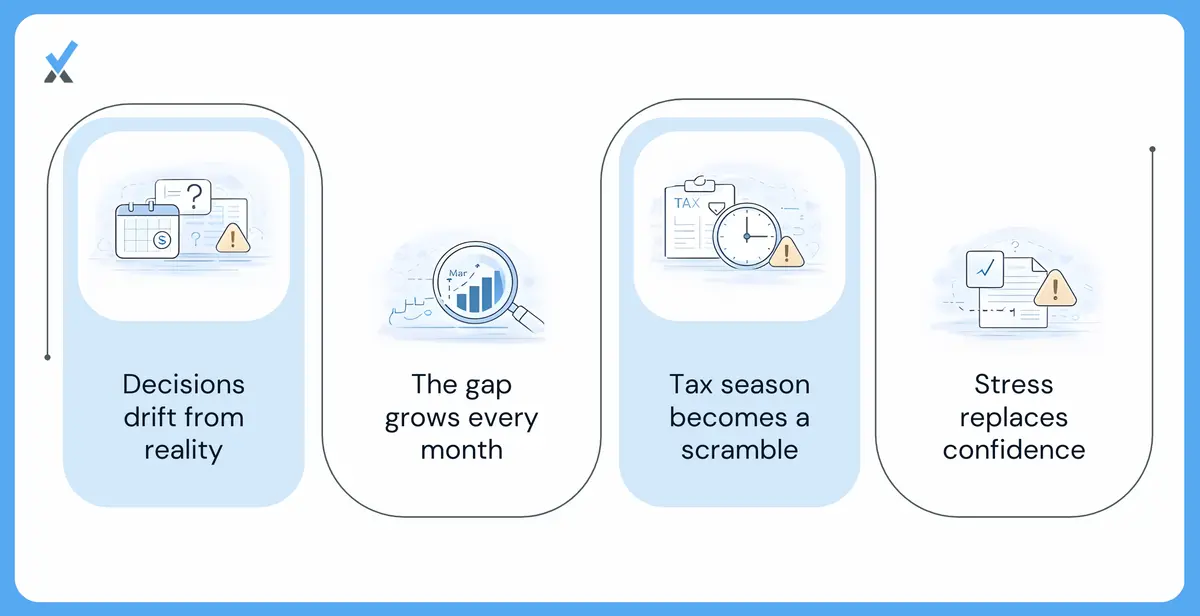
Messy books are not a cosmetic problem. They create real business consequences that grow worse the longer they sit, in two ways in particular.
-
Financial decisions suffer without accurate data. When books are months behind, decisions get made based on memory and bank balance glances rather than actual numbers.
A hiring decision under consideration becomes a guess about affordability. A big project being priced comes without a clear read on margins from similar past work. A month that felt profitable might turn out otherwise once expenses are correctly recorded.
The gap between what an owner thinks is happening and what is actually happening in the finances widens every week the books stay behind.
-
Tax season transforms from routine to crisis. This is where delayed bookkeeping extracts its highest toll.
Instead of handing a CPA clean records in February, the scramble happens in April. Rush fees get paid. Deductions get guessed at because the documentation cannot be found. Extensions get filed because there is no way to get accurate numbers in time.
Owners who have lived through this often describe losing entire weekends right before the deadline just trying to reconstruct what the business actually spent the year before. The anxiety compounds because the IRS expects accuracy, and confidence in what is being submitted is low.
What does the catch-up bookkeeping cleanup process actually involve?
The path from chaos to clarity is more systematic than it might seem. Whether the books are three months behind or three years behind, the process follows similar steps.
-
Reconciliation rebuilds the foundation. The first task is connecting the records to reality. This means going through every bank account and credit card statement for the backlog period and matching transactions to what is recorded in the accounting system.
For catch-up bookkeeping work, this typically involves:
-
Downloading statements for all accounts across the backlog period
-
Identifying unrecorded transactions and duplicate entries
-
Matching cleared transactions to bank records month by month
-
Flagging discrepancies that need investigation
This step often reveals surprises: subscriptions that were forgotten, deposits that never got recorded, expenses categorized in the wrong accounts. Reconciliation surfaces all of it.
-
-
Categorization brings meaning to raw transactions. Once transactions are reconciled, they need to be correctly categorized. "Miscellaneous" and "Ask Accountant" are not categories that help anyone understand the business.
Effective bookkeeping cleanup assigns every transaction to the correct account in the chart of accounts. For professional service firms, this includes proper allocation of:
-
Client project expenses versus general overhead
-
Contractor payments versus employee costs
-
Software subscriptions by function
-
Travel and entertainment with appropriate documentation
The goal is books that reveal something useful about where the money goes.
-
-
Documentation recovery fills the gaps. Catch-up bookkeeping also addresses the receipt problem. Many transactions will be missing supporting documentation, especially older ones.
A thorough cleanup process includes tracking what can be recovered, noting what cannot be found, and documenting for future reference. Some transactions may require reasonable estimates based on available information.
What changes once the books are caught up?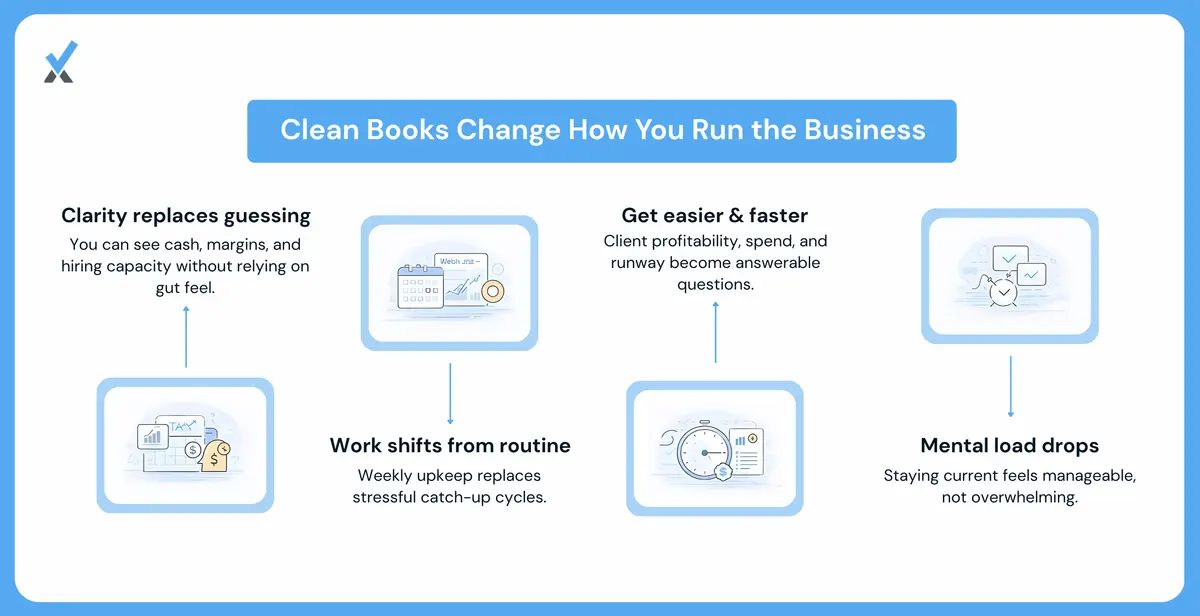
Getting caught up is not about satisfying some abstract accounting requirement. It changes the daily experience of running the business.
Real visibility replaces educated guessing. Once the books are current, questions that were previously unknowable get answered:
-
What is the actual cash position right now?
-
Which clients are profitable and which ones are not?
-
What did the firm really spend on contractors last quarter?
-
Can the firm afford to hire in Q3?
These answers exist in the data. Clean books make them accessible.
Future bookkeeping becomes maintenance, not catch-up. Perhaps the most significant shift is psychological. Once caught up, staying current becomes a weekly task rather than an annual ordeal.
The difference between maintaining clean books and catching up on messy ones is the difference between washing dishes after dinner and cleaning a kitchen that has not been touched in six months. Same dishes. Completely different experience.
How should a firm start moving forward?
A firm months behind on its books effectively has two choices: keep pushing the problem forward and deal with a bigger mess later, or address it now and operate with clean financial data going forward.
Catch-up bookkeeping services exist because firm owners fall behind on their bookkeeping. It is common. It is fixable, delivered with an expert-led, AI-powered, human-in-the-loop process, and the peace of mind that comes from accurate, current books is worth far more than the discomfort of admitting help is needed to get there.
| Dimension | Behind on books | Caught up |
|---|---|---|
| Tax season | Rush fees, guessed deductions, extensions | Clean records handed to a CPA on schedule |
| Decision making | Based on memory and bank balance glances | Based on actual, current numbers |
| Owner stress | Ongoing anxiety about hidden problems | Confidence in what the numbers show |
| Weekly time cost | Grows as the backlog grows | Small, routine maintenance |
How far behind can books be before catch-up bookkeeping is no longer practical?
There is rarely a true cutoff. Firms have caught up books that were a year or more behind, though the effort and documentation-recovery work grow with the size of the backlog. The main constraint is usually how much supporting documentation can still be located, not the calendar itself.
Will a CPA question numbers that were reconstructed rather than recorded in real time?
A good catch-up process documents its reasoning, including any reasonable estimates made where documentation could not be recovered, so a CPA can see exactly how a number was derived. That documentation trail matters more to a CPA than whether every entry was made same-day.
What should someone do first if they do not know where to even start?
Start by gathering account access rather than sorting paper: bank logins, credit card statements, and payroll records for the backlog period. A catch-up provider can build the reconciliation from there without the receipts folder being organized first, and can flag what documentation is genuinely missing along the way.
The books are behind. That is where things stand today. Where things stand next month is entirely a matter of choice.
See how Numetix accounting services handle catch-up projects, built for professional services firms specifically.
Numetix is an AI-first accounting firm. AI runs the bookkeeping, tax, payroll, and reporting workflow. Industry experts handle the judgment, month-end close, review, and advisory. We serve founder-led service firms across law, consulting, IT, healthcare, creative, and nonprofit. Headquartered in California, serving clients nationwide.
Suggested Readings
What CO-197 denial code means (authorization absent)
What CO-50 denial code means (medical necessity)
Cause marketing and commercial co-ventures explained
See what Numetix can do for you
Learn how the Numetix Portal streamlines communication, offers valuable insights, and saves you time so you can focus on growing your business.