Property management accounting: The complete guide for PM owners
Key Takeaways
State law typically requires tenant deposits to sit in a legally separate account from operating funds, with mixing the two risking fines or license suspension.
Every property needs its own revenue, expense, and owner tracking; a maintenance cost from one property should never land on another property's financial statement.
Distributions calculated from a bank balance instead of the property-level P&L almost always risk an overdraft, since deposits and pending items are not distributable.
A well-set-up chart of accounts covers five categories: operating accounts, trust or escrow accounts, property operating accounts, tenant AR, and vendor and owner AP.
Per-door profitability reveals which properties are actually profitable after allocated management costs, something top-line rent collected and fees earned cannot show on their own.
Reconciling weekly rather than monthly catches small coding errors before they compound into a much larger cleanup project.
Property management accounting: The complete guide for PM owners
Quick Answer
Property management accounting differs from standard accounting because the money mostly belongs to someone else: trust funds must stay legally separate from operating funds, every transaction tags to a specific property, and owner distributions come from a property-level P&L, not a bank balance. Five account categories, operating, trust, property operating, tenant AR, and vendor AP, plus weekly reconciliation and per-door profitability tracking, keep a growing PM portfolio from becoming a bottleneck.
A firm manages 85 doors across three properties. Rent comes in from tenants. Maintenance invoices go out to vendors. Owner distributions get wired monthly. HOA fees, insurance premiums, property taxes, and management fees all move through the accounts on different schedules.
At the end of the month, QuickBooks opens and the numbers blur together while trying to figure out whether each property is actually making money. Tenant deposits sit in the same account as operating funds. A roof repair from Building A got coded to Building B. Last month's owner distribution was calculated from a bank balance instead of a P&L, and now the owner is asking why their statement does not match.
This is the daily reality for property management companies that have outgrown basic bookkeeping but have not built accounting systems designed for this industry. Property management accounting is fundamentally different from standard business accounting because every dollar touched belongs to someone else, flows through property-specific channels, and requires tracking at a level of detail most small-business setups were never built to handle.
What makes property management accounting different from standard business accounting?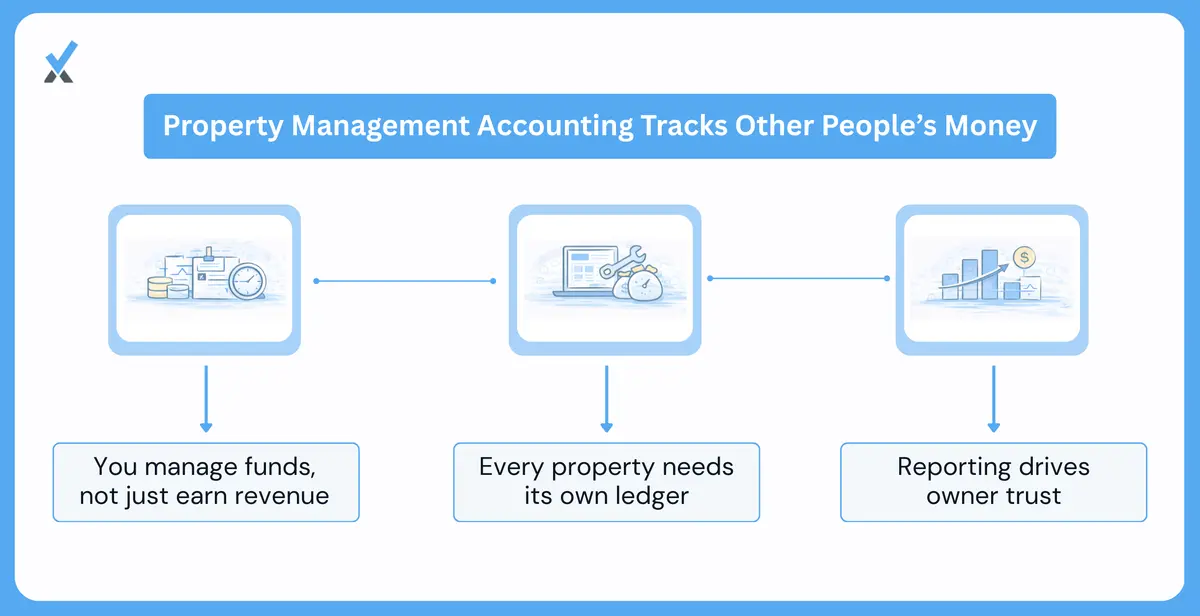
Most businesses use a single set of books. Revenue comes in, expenses go out, and the profit belongs to the owner. Property management companies operate more like financial intermediaries, collecting money on behalf of property owners, paying their expenses, and earning a management fee for coordinating it all.
This creates three accounting challenges that do not exist in typical service businesses.
Trust accounting obligations. In most states, tenant security deposits and prepaid rent must be held in separate trust accounts, not commingled with operating funds. Mixing trust funds with operating cash is not just poor practice; it is illegal and can lead to fines, license suspension, or lawsuits. The accounting system needs a clear separation between the money being managed and the money being earned to prevent legal issues.
Property-level tracking. Every property in a portfolio has its own revenue streams, expense categories, and owner. A maintenance expense for one property cannot show up on another property's financial statement. The chart of accounts needs to support property-level, and often unit-level, tracking so that every transaction is tagged to the correct asset from the moment it is recorded.
Owner reporting and distributions. Property owners expect monthly or quarterly financial statements showing income, expenses, and net operating income for their specific property. They also expect accurate distributions based on actual cash performance, not estimates. If the accounting cannot produce a clean, on-demand property-level P&L, owner relationships erode quickly, affecting trust and future business.
What core accounts does every property management company need?
Setting up the chart of accounts correctly from the start prevents most of the reconciliation headaches that plague PM companies as they scale. While every firm's chart of accounts will vary based on portfolio size and state requirements, the foundational structure includes five account categories.
Operating bank accounts. This is where management fees, internal revenue, and company expenses live. Operating funds should be completely separate from any property owner or tenant funds.
Trust or escrow accounts for security deposits. State regulations dictate how these accounts are structured. Some states require a separate trust account for each owner. Others allow pooled trust accounts with sub-ledger tracking. Regardless of the structure, the balances in these accounts must match deposit liability records at all times.
Property operating accounts (owner funds). These accounts hold rent collections and pay property-level expenses, such as maintenance, insurance, and property taxes. Some firms use one pooled account with sub-ledger tracking per property. Others maintain separate bank accounts per owner. The right approach depends on state regulations and the complexity of the portfolio.
Accounts receivable (tenant ledgers). Every tenant has a ledger tracking rent charges, payments, late fees, credits, and balances owed. These ledgers feed into property-level financial statements and are the source of truth for collections, legal proceedings, and owner reporting.
Accounts payable (vendor and owner payables). Maintenance vendors, utility companies, insurance providers, and property owners all have payment obligations running through the books. Tracking payables by property ensures expenses are posted to the correct owner's P&L and vendor payments are made from the correct funds.
Why is per-door profitability the metric that separates growing PM companies from struggling ones?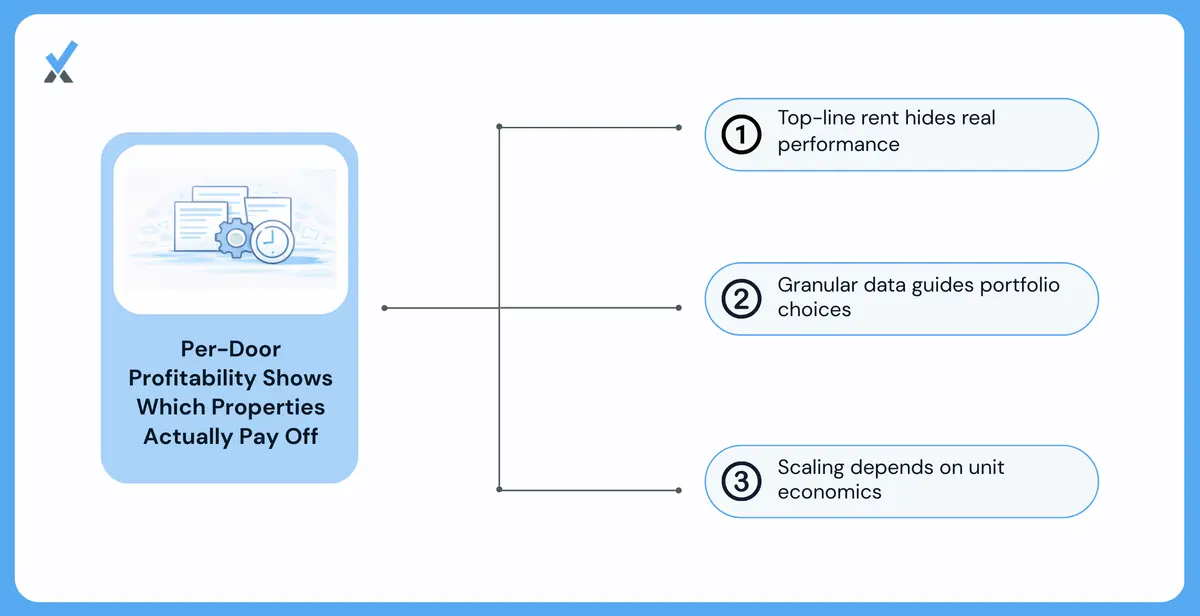
Revenue in property management is easy to measure at the top line. Rent collected and management fees earned are both straightforward numbers. But top-line numbers say nothing about which properties are profitable and which ones are consuming more resources than they generate.
Per-door profitability breaks financial performance down to the individual unit level. It answers questions like: what does it actually cost to manage each door after maintenance coordination, tenant turnover, leasing, and administrative time? Is a 40-unit apartment complex more profitable per door than 15 single-family rentals? Are certain property types or neighborhoods consistently underperforming?
Calculating per-door profitability requires property-level P&L reporting that captures direct expenses (maintenance, insurance, property taxes) and allocated management costs (staff time, software, office overhead). Without this granularity, portfolio decisions get made on gut feeling instead of data.
The PM companies that scale successfully use per-door profitability to make three critical decisions: which new management contracts to accept, which existing contracts to renegotiate, and which properties to offboard because the management fee does not cover the actual cost of service. Treated this way, per-door profitability becomes a tool for deliberate portfolio strategy rather than a lagging indicator discovered at year-end.
What accounting mistakes cost PM companies money and trust?
Commingling funds. The most dangerous mistake and the most common among smaller PM companies. Using owner funds to cover a short-term operating expense, even temporarily, creates legal liability and audit risk. Maintaining strict separation and never borrowing across accounts is non-negotiable.
Inconsistent expense coding. When a maintenance invoice gets tagged to the wrong property or coded to the wrong category, it corrupts two financial statements at once. The property that should have the expense looks artificially profitable. The one that received it looks worse than it actually is. Consistent coding rules and regular reconciliation catch these errors before they reach owner statements.
Delayed reconciliation. Bank reconciliations in property management should happen weekly, not monthly. The volume of transactions across multiple accounts makes it easy for errors to compound. A $400 coding mistake in week one can turn into a $2,000 reconciliation headache by month-end if nobody catches it early.
Calculating owner distributions from bank balances. A bank balance includes outstanding checks, pending deposits, prepaid rent, and security deposits. None of those should factor into an owner distribution. Distributions should come from the property-level P&L after all expenses, reserves, and management fees are deducted. Paying from the bank balance almost always results in an overdraft.
Why does getting the foundation right make everything else easier?
Property management accounting is not complicated because its concepts are difficult. It is complicated because the volume of transactions, the number of stakeholders, and the regulatory requirements create layers that basic bookkeeping cannot handle.
Starting with clean account separation, building a chart of accounts that tracks every dollar to a specific property, reconciling weekly, calculating per-door profitability, and producing owner statements from real P&L data instead of bank balances, backed by an expert-led, AI-powered, human-in-the-loop process, is what separates firms that scale cleanly from firms that scale into chaos.
The PM companies that get these fundamentals right spend less time fixing errors, have fewer difficult owner conversations, and can scale their portfolio without accounting becoming the bottleneck.
| Account category | What it holds | Key rule |
|---|---|---|
| Operating | Management fees, company expenses | Fully separate from owner and tenant funds |
| Trust or escrow | Security deposits | Must match deposit liability records at all times |
| Property operating | Rent collections, property-level expenses | Owner funds, tracked per property |
| Accounts receivable | Tenant ledgers | Source of truth for collections and legal action |
| Accounts payable | Vendor and owner payables | Tracked by property, paid from correct funds |
Can a PM company use one pooled trust account for all owners, or does each need a separate account?
It depends entirely on state regulation. Some states require a dedicated trust account per owner, while others permit a single pooled trust account as long as sub-ledger tracking clearly attributes each dollar to the correct owner. Checking the specific requirement in every state a firm operates in matters more than defaulting to one approach everywhere.
How is per-door profitability different from simple per-door revenue?
Per-door revenue only counts what comes in, rent and fees, while per-door profitability subtracts direct property expenses and allocated management costs like staff time and overhead. Two properties can generate identical per-door revenue and have very different per-door profitability once the actual cost of servicing each one is factored in.
What is the first accounting fix a PM company should make when scaling past 100 doors?
Property-level tracking in the chart of accounts is usually the highest-leverage fix, since without it every other report, owner statements, per-door profitability, reconciliation, has to be reconstructed manually. Getting that tagging structure right first makes every subsequent fix faster to implement.
Clean account separation, weekly reconciliation, and per-door profitability are what let a portfolio scale without accounting becoming the bottleneck.
See how Numetix accounting services handle property management accounting specifically.
For a complete overview of trust account management, three-way reconciliation, owner ledgers, and financial operations across a property management portfolio, see the complete guide to property management accounting.
Numetix is an AI-first accounting firm. AI runs the bookkeeping, tax, payroll, and reporting workflow. Industry experts handle the judgment, month-end close, review, and advisory. We serve founder-led service firms across law, consulting, IT, healthcare, creative, and nonprofit. Headquartered in California, serving clients nationwide.
Suggested Readings
Which accounting firms specialize in dental practices?
Nonprofit revenue recognition: grants vs contributions vs exchange transactions
How often do IOLTA trust accounts need to be reconciled?
See what Numetix can do for you
Learn how the Numetix Portal streamlines communication, offers valuable insights, and saves you time so you can focus on growing your business.