The 4 tax return errors quietly draining service firms before an expert steps in
Key Takeaways
A preparer checks the math against the data they were handed; a strategic reviewer checks whether that data told the whole story.
A worker misclassified as a 1099 contractor instead of a W-2 employee can expose a firm to combined back tax liability exceeding $20,000 per worker over two years.
States use different apportionment formulas for service income, and a preparer working from a standard template can apply the wrong one or miss a state entirely.
A missed Section 199A deduction on $350,000 of qualified business income can cost a firm owner $15,000 to $25,000 in unnecessary tax.
Contributing to a SEP-IRA instead of a Solo 401(k) can leave tens of thousands of dollars in retirement contributions unclaimed and taxed at the owner's marginal rate.
A quality tax return review results in a written summary of findings, corrections, and planning opportunities, not just a second pass through the same checklist.
The 4 tax return errors quietly draining service firms before an expert steps in
Quick Answer
Tax preparation checks a return against the data it was given; a professional tax return review checks whether that return was actually optimal. The four most common and expensive errors service firms miss are contractor misclassification, incorrect state income apportionment, a missed or miscalculated Section 199A deduction, and underused retirement contribution limits. Together these can cost tens of thousands of dollars a year, and they tend to repeat annually until someone with advisory expertise catches them.
A tax return gets filed on time. The accountant handled it. The numbers looked reasonable. The bill got paid, and the firm moved on.
Then eight months later, a fractional CFO pulls up the return during a quarterly review and spots something. Contractor payments were misclassified, state apportionment used the wrong formula, and a $47,000 deduction for qualified business income was never taken. The amended return saves $19,000, but only after weeks of back-and-forth with the IRS and the state revenue department.
This is not a story about bad accountants. Most tax preparers are competent at what they do. But preparing a return and reviewing a return are two fundamentally different processes. Preparation follows a checklist. A professional tax return review applies strategic judgment, industry knowledge, and a second set of eyes trained to catch what the first pass missed. For service firms with layered revenue streams, multiple states, and contractor-heavy workforces, the gap between those two processes is where expensive errors hide.
Why does preparation alone not catch strategic errors?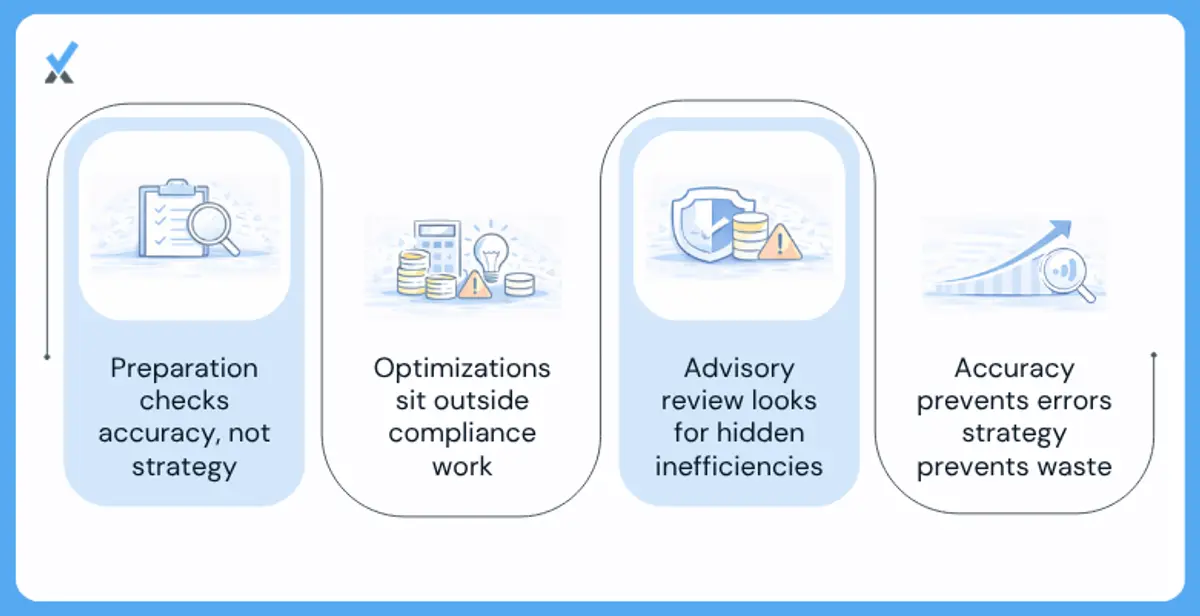
Tax preparation is a compliance function. A preparer takes the financial data provided, applies the tax code, and produces a return that accurately reflects the information given. If the data is clean and complete, the return will be technically correct.
But technically correct and financially optimal are not the same thing.
A preparer works with what is in front of them. They typically do not question whether an entity structure is costing unnecessary tax, whether a salary-to-distribution ratio is optimized, or whether client contracts have triggered unreported state filing obligations. Those are advisory functions that sit outside the scope of standard tax preparation.
A tax return review service adds that advisory layer. It examines the completed return not just for accuracy, but for missed opportunities, structural inefficiencies, and compliance gaps. Think of it as the difference between proofreading a document for spelling and editing it for clarity and persuasiveness. Both are valuable. One catches problems that the other was never designed to find.
How does contractor misclassification trigger penalties and back taxes?
This is the most common and potentially the most expensive error for professional service firms. Consulting, IT, and creative firms frequently rely on a mix of W-2 employees and 1099 contractors. The classification between the two affects payroll tax obligations, benefits requirements, unemployment insurance, and workers' compensation.
When a worker who should be classified as an employee is reported as a contractor, the IRS can assess back payroll taxes, penalties, and interest. The standard penalty is 100% of the employee's share of FICA taxes that should have been withheld, plus the employer's share. For a misclassified worker paid $120,000 over two years, the combined liability can exceed $20,000 before penalties and interest.
A tax return review catches this by examining 1099 filings against the actual working arrangements. If a contractor works exclusively for one firm, follows its processes, and uses its tools, the classification may not hold up under IRS scrutiny, regardless of what the contract says.
How does incorrect state income apportionment cost service firms money?
Service firms that work with clients in multiple states must apportion income to each state where they have nexus. The apportionment formula determines how much of total income is taxable in each state. Get the formula wrong, and a firm either overpays in high-tax states or underpays and faces penalties when the state catches up.
The complexity for service firms is that states use different apportionment methods. Some use a single sales factor based on where clients are located. Others use a three-factor formula that includes payroll and property. A few have special rules for service income that differ from the rules applied to product companies.
A preparer working from a standard template may apply the wrong formula or miss a state entirely. An expert review cross-references client revenue by state, confirms which apportionment method applies in each jurisdiction, and verifies the calculations match the rules. For firms with significant revenue from clients in California, New York, or Illinois, an apportionment error can mean thousands in overpaid or underpaid tax.
How does a missed or miscalculated QBI deduction cost money?
The Section 199A qualified business income deduction allows eligible pass-through business owners to deduct up to 20% of qualified business income. For consulting firms, this deduction is subject to income phase-outs because consulting is classified as a specified service trade or business.
The calculation is not straightforward. It involves taxable income thresholds, W-2 wage limitations, and qualified property considerations that interact differently depending on how income and deductions are timed. A preparer who misses one element can leave a significant deduction on the table entirely.
For a service firm owner with $350,000 in qualified business income who falls within the eligible range, a missed or miscalculated 199A deduction could cost $15,000 to $25,000 in unnecessary tax. An expert tax return review recalculates the deduction from scratch, confirms eligibility, and verifies that all components are applied correctly.
How do underused retirement contribution limits cost money?
Service firm owners frequently underuse retirement plan contributions, either because a preparer did not model the maximum allowable amounts or because the firm's plan structure was not optimized for the owner's compensation level.
A SEP-IRA allows contributions up to 25% of compensation, capping at $70,000 for 2025. A Solo 401(k) combines employee deferrals ($23,500 for 2025, plus a $7,500 catch-up for those over 50) with employer contributions. Defined benefit plans can allow even higher contributions for owners willing to commit to a multi-year funding schedule.
The error is usually not that contributions were made incorrectly. It is that the return reflects a contribution well below the maximum because nobody ran the numbers. For a firm owner contributing $30,000 to a SEP-IRA when a Solo 401(k) would have allowed $69,000, that missed $39,000 in contributions was taxed at the owner's marginal rate instead of being deferred.
What does a professional tax return review actually involve?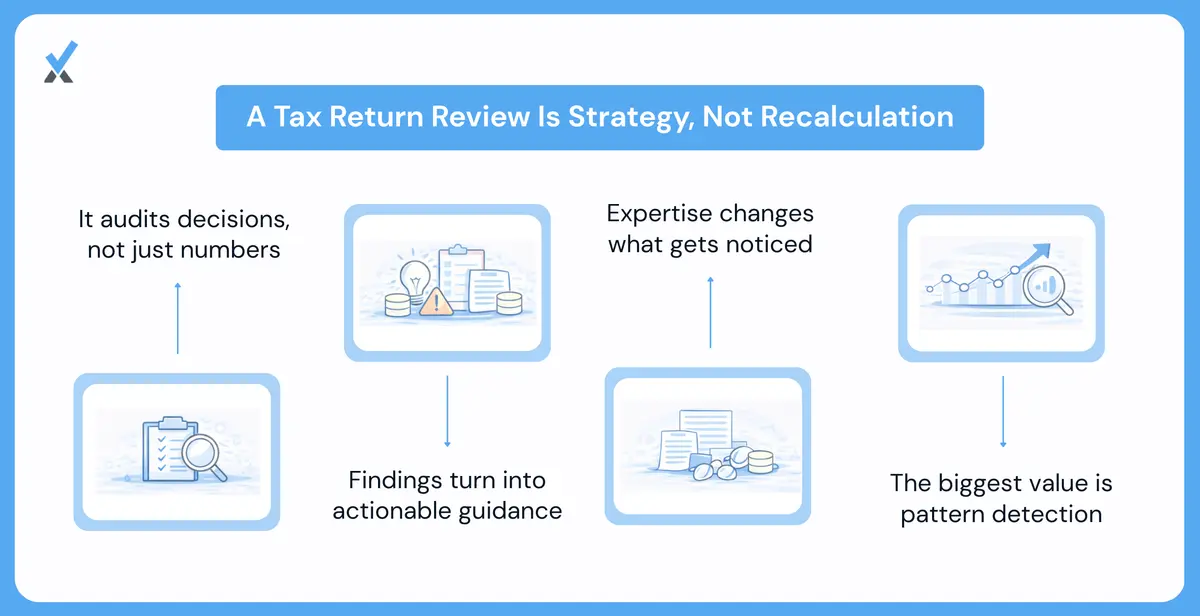
A quality tax return review service is not a second preparation. It is a strategic audit of a completed return conducted by someone with advisory expertise, typically a fractional CFO or senior tax advisor who understands the specific financial dynamics of professional service firms.
The review examines entity structure efficiency, compensation optimization, state filing completeness, deduction maximization, and compliance risk areas. It results in a written summary of findings, recommended corrections, and planning opportunities for the current tax year.
For service firms, the value is not just in catching errors on last year's return. It is in identifying patterns that repeat year after year until someone with the right expertise finally looks closely enough to find them.
Why is filing not the finish line?
A tax return represents the largest single financial transaction a firm makes each year. Treating it as a compliance checkbox rather than a strategic document means accepting whatever result the first pass produces, errors and missed opportunities included.
An expert review, run with an expert-led, AI-powered, human-in-the-loop process, turns that document into a planning tool. It shows not only what was paid, but what could have been paid, and what to change so the gap closes before the next filing deadline.
| Error | Typical cost | What catches it |
|---|---|---|
| Contractor misclassification | $20,000+ per worker over 2 years | Comparing 1099 filings to actual working arrangements |
| State apportionment error | Thousands, over- or underpaid | Cross-referencing revenue by state against each formula |
| Missed QBI deduction | $15,000 to $25,000 | Recalculating the 199A deduction from scratch |
| Underused retirement limits | Tens of thousands, deferred not saved | Modeling maximum contributions against plan type |
How often should a service firm get a tax return review, every year or periodically?
Annually is ideal, since these errors tend to repeat year after year until someone catches the pattern, and each additional year compounds the missed savings. A firm just adopting the practice can still benefit from reviewing the prior two or three years' returns to catch what has already accumulated.
Does a tax return review replace the need for a regular tax preparer?
No. Preparation and review serve different functions, and both remain necessary. The preparer still produces the return each year; the review adds a strategic layer on top, checking the completed return for optimization the preparation process was never designed to catch.
Can errors found in a review be corrected after the filing deadline has passed?
Yes, through an amended return, generally within three years of the original filing date or two years from when the tax was paid, whichever is later. Missed retirement contributions are a partial exception, since some plan types have their own separate deadlines for making prior-year contributions.
The filing is not the finish line. The review is what turns a return into a planning tool.
See how Numetix business advisory services catch these errors, for professional services firms specifically.
Numetix is an AI-first accounting firm. AI runs the bookkeeping, tax, payroll, and reporting workflow. Industry experts handle the judgment, month-end close, review, and advisory. We serve founder-led service firms across law, consulting, IT, healthcare, creative, and nonprofit. Headquartered in California, serving clients nationwide.
Suggested Readings
Missed the September 15 tax deadline: What happens next and how to reduce the penalty
September 15 tax deadline 2026: What small business owners need to file or pay today
Medical practice 1099 filing: Managing contractor clinicians without year-end chaos
See what Numetix can do for you
Learn how the Numetix Portal streamlines communication, offers valuable insights, and saves you time so you can focus on growing your business.