Bookkeeper vs CPA: Which one does your business actually need?
Key Takeaways
-
Bookkeepers record and reconcile daily transactions; CPAs interpret that data for tax strategy, entity structure, and compliance, and only CPAs can represent a business before the IRS.
-
Bookkeeping quality varies widely since bookkeepers face no licensing requirement, while CPAs must pass an exam and meet ongoing education requirements to keep their license.
-
CPAs typically charge $150 to $400 an hour or $5,000 to $20,000 a year, a premium that reflects licensure and the legal weight of their work.
-
A firm with messy books should hire a bookkeeper first, since a CPA cannot do meaningful tax planning on unreliable underlying data.
-
Firms past 10 employees or operating in multiple states typically need a bookkeeper and a CPA working in coordination, not just one or the other.
-
Skipping tax planning between bookkeeping and CPA touchpoints is how firms end up owing tens of thousands in taxes they never saw coming.
Bookkeeper vs CPA: Which one does your business actually need?
Quick Answer
A bookkeeper records and reconciles daily transactions and prepares monthly financial statements. A CPA is a licensed professional who handles tax planning, entity structure, and compliance, work only a CPA is legally authorized to do before the IRS. Most growing firms need both, in sequence: a bookkeeper first to get the data clean, then a CPA to turn that data into tax strategy, especially past 10 employees or multiple states.
You know your firm needs financial help. The receipts are piling up, payroll keeps getting more complicated, and tax season feels like a controlled emergency every single year.
So the search begins. And it immediately hits a question that seems simple but trips up most business owners: Do you need a bookkeeper or a CPA?
The two titles get used interchangeably in casual conversation. A friend says, "My accountant does my books." A colleague says, "My bookkeeper handles my taxes." Both statements are inaccurate, and that confusion costs growing firms real money.
Here is the difference, why it matters, and how to figure out what a business actually needs right now.
What does a bookkeeper actually handle day to day?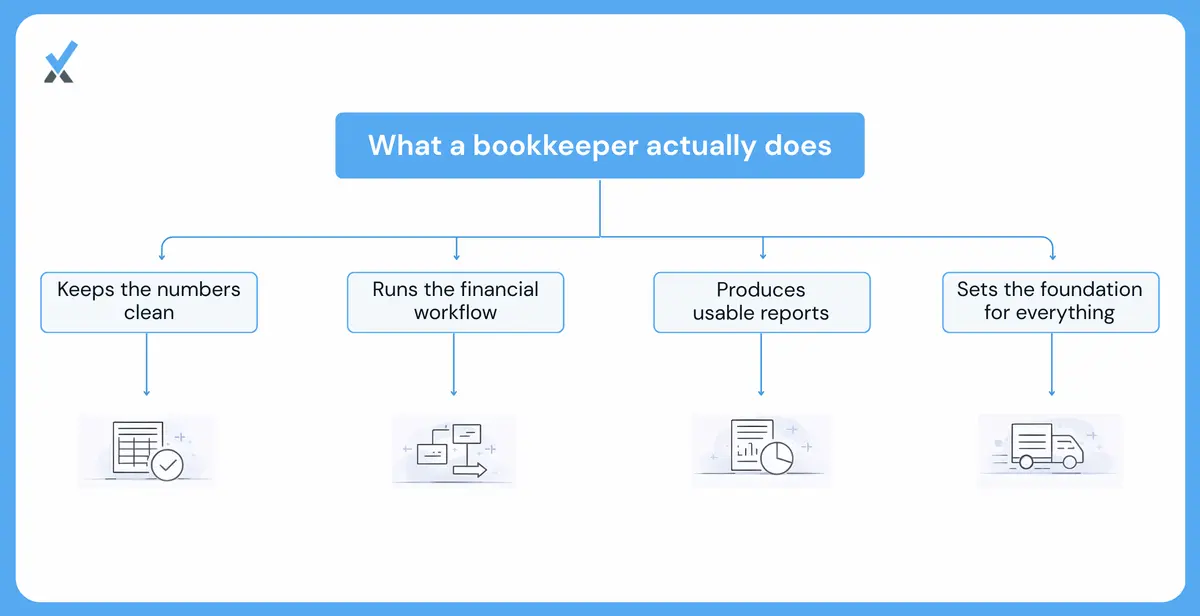
A bookkeeper is the person who keeps financial data organized, current, and accurate on a day-to-day and week-to-week basis. Think of bookkeeper responsibilities as everything that happens between transactions entering the system and financial statements coming out the other side.
What a bookkeeper typically does:
-
Categorizes income and expenses in accounting software (QuickBooks, Xero)
-
Reconciles bank and credit card statements monthly
-
Manages accounts payable (what the firm owes vendors) and accounts receivable (what clients owe the firm)
-
Processes payroll or coordinates with a payroll provider
-
Prepares monthly financial statements: profit and loss, balance sheet, cash flow
This is the operational engine of a firm's finances. Without clean bookkeeping, everything downstream breaks. Tax filings become unreliable. Financial reports become meaningless. The ability to answer the question "Are we actually profitable?" disappears.
One important distinction: bookkeepers are not required to hold a license. Some have certifications (such as QuickBooks ProAdvisor or certified bookkeeper credentials), but the barrier to entry is low. That means quality varies enormously. A great bookkeeper delivers clean, timely books every month. A mediocre one creates more problems than they solve.
What does a CPA actually handle that a bookkeeper does not?
A CPA (Certified Public Accountant) is a licensed professional who has passed a rigorous exam, met education and experience requirements, and maintains that license through ongoing continuing education. The distinction between a CPA and an accountant matters here: not all accountants are CPAs, and only CPAs carry the legal authority to represent a business before the IRS.
What a CPA typically handles:
-
Tax planning and filing (federal, state, local, quarterly estimates)
-
Entity structure advice (should the business be an S-corp, LLC, or C-corp?)
-
Compliance oversight for multi-state operations, contractor classifications, and regulatory requirements
-
Audit preparation and representation
-
Financial strategy and advisory on growth decisions
Where a bookkeeper records what happened, a CPA interprets what it means and advises on what to do next. They look at the financials and flag that the effective tax rate is too high because the entity structure is wrong. They catch that a contractor classification approach is creating audit risk. They help plan for a tax liability six months before it arrives.
CPAs charge more than bookkeepers, typically $150 to $400 per hour or $5,000 to $20,000 annually for a small firm engagement. That premium reflects their licensure, expertise, and the legal weight their work carries.
When does a firm need a bookkeeper versus a CPA?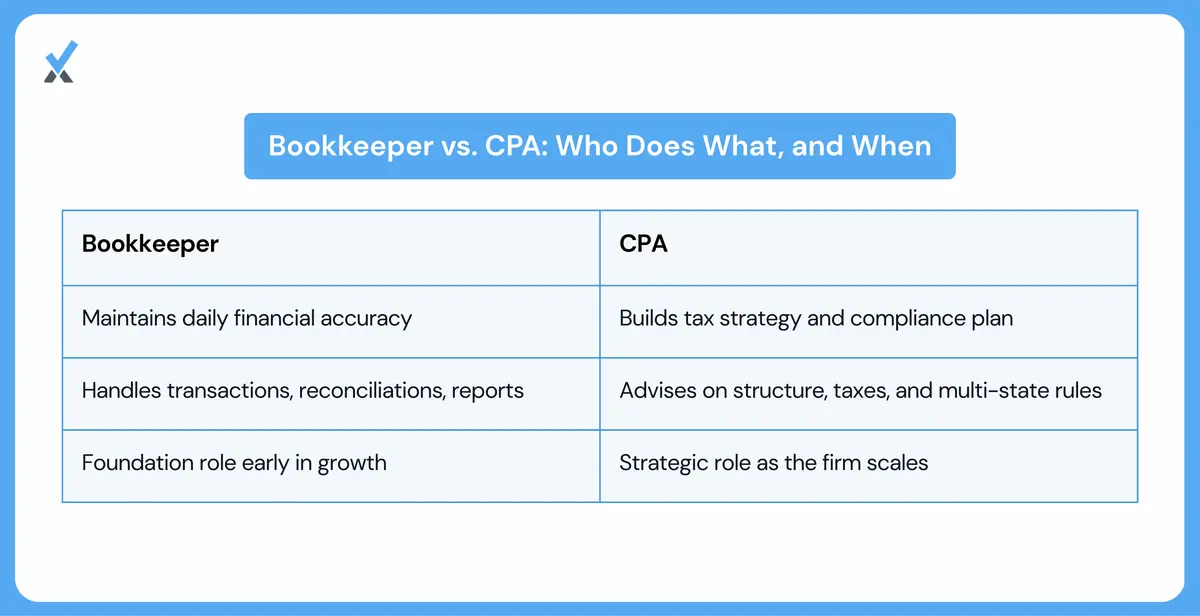
Most growing professional service firms do not need to choose between a bookkeeper and a CPA. They need both. The mistake is in the sequencing and the expectations.
-
If the books are a mess, start with a bookkeeper. A CPA cannot do meaningful tax planning or advisory work if the underlying data is unreliable. Hiring a CPA to do the bookkeeping is like hiring a surgeon to take a blood pressure reading. They can do it, but it is an expensive misuse of their expertise, and most CPAs will say the same thing.
-
If the books are clean but there is no tax strategy, add a CPA. Once monthly financials are accurate and timely, a CPA can actually work with that data: identifying tax savings, optimizing entity structure, and ensuring compliance across every jurisdiction the firm operates in.
-
If the firm has grown past 10 employees or operates in multiple states, it likely needs both working in coordination. This is where the distinction between accountant and bookkeeper becomes critical. The bookkeeper maintains daily accuracy. The CPA ensures that accuracy translates into compliant filings, optimized tax positions, and sound financial strategy.
The firms that run into the most trouble are the ones that expect a single person to do everything. They hire a bookkeeper and assume taxes are covered. Or they hire a CPA and wonder why the monthly books are still three months behind.
What happens when a firm gets this sequencing wrong?
A consulting firm owner hires a bookkeeper at $1,500 a month. The books stay relatively current. But nobody is doing tax planning, and the owner discovers in April that they owe $47,000 in taxes they did not anticipate. The bookkeeper recorded everything correctly. But recording transactions and planning for tax liability are two completely different functions.
Another firm hires a CPA firm for $12,000 a year. The CPA prepares tax returns and provides annual advisory services. But between those touchpoints, daily bookkeeping falls to the owner. Receipts pile up. Reconciliations fall behind. By the time the CPA gets the books for tax prep, they spend the first 20 hours cleaning up data, and the firm pays for that cleanup at CPA rates.
Both scenarios cost more than doing it right from the start.
What do firms that get this right have in common?
They stop treating finance as a collection of disconnected tasks assigned to disconnected people. Instead, they find a model in which bookkeeping, accounting, tax, and advisory work together as a coordinated function, delivered with an expert-led, AI-powered, human-in-the-loop process rather than siloed handoffs.
Whether that means hiring internally and building a team, or engaging a full-service provider that covers the entire spectrum, the principle is the same. The bookkeeper and the CPA should not operate in silos. When they do, gaps form, and those gaps show up as tax surprises, compliance penalties, and financial reports that cannot be trusted.
The first step is simple: know what each role actually does. The second step is making sure both functions are covered. Everything else builds from there.
| Dimension | Bookkeeper | CPA |
|---|---|---|
| License required | No, certifications optional | Yes, exam plus ongoing education |
| Typical cost | Roughly $500 to $2,500 a month | $150 to $400 an hour, or $5,000 to $20,000 a year |
| Core work | Recording, reconciling, monthly statements | Tax planning, entity structure, compliance, strategy |
| Legal authority | None before the IRS | Can represent a business before the IRS |
Can one person be both a bookkeeper and a CPA for a small firm?
Yes, some CPAs offer bookkeeping as part of a bundled service, and this can work well for very small firms with simple books. The risk is cost: paying CPA hourly rates for routine data entry is expensive, so it is worth confirming the bookkeeping portion is priced at a bookkeeping rate, not a CPA rate.
Is an Enrolled Agent the same as a CPA for tax purposes?
Not exactly. An Enrolled Agent is federally licensed specifically for tax matters and can also represent a business before the IRS, but CPAs typically offer a broader scope that includes audited financials, entity structuring, and general financial advisory beyond tax.
How can a firm tell if its current bookkeeper is actually doing a good job?
Books that close within one to two weeks of month-end, statements that match the actual bank balance, and clear answers to profitability questions without a multi-day scramble are the main signals. If the books are consistently weeks or months behind, that is the clearest warning sign.
The question is not bookkeeper or CPA. It is knowing what each role actually does, then making sure both functions are covered and coordinated instead of siloed.
See how Numetix accounting services coordinate bookkeeping and tax in one system, built for professional services firms specifically.
Numetix is an AI-first accounting firm. AI runs the bookkeeping, tax, payroll, and reporting workflow. Industry experts handle the judgment, month-end close, review, and advisory. We serve founder-led service firms across law, consulting, IT, healthcare, creative, and nonprofit. Headquartered in California, serving clients nationwide.
Suggested Readings
What CO-197 denial code means (authorization absent)
What CO-50 denial code means (medical necessity)
Cause marketing and commercial co-ventures explained
See what Numetix can do for you
Learn how the Numetix Portal streamlines communication, offers valuable insights, and saves you time so you can focus on growing your business.