Property management automation: Scaling from 100 to 500 doors
Key Takeaways
-
Transaction categorization typically breaks at 150 to 200 doors, where manual error rates of 2 to 4 percent create 12 to 40 miscategorized entries monthly.
-
Reconciling bank and trust accounts becomes unmanageable once a portfolio passes roughly 200 to 300 doors, delaying owner statements industry-wide.
-
Preparing owner statements manually starts consuming 15 to 25 hours of bookkeeper time a month once a portfolio reaches roughly 250 to 350 doors.
-
Staging automation across transaction categorization, AP processing, and reporting roughly doubles how many doors a single bookkeeper can manage.
-
A 300-door firm without automation typically spends $100,000 to $195,000 a year on bookkeeping staff alone, a cost automation directly reduces.
-
Automation should never replace human oversight of trust reconciliation, owner communication, or financial strategy, since judgment calls still require a person.
Property management automation: Scaling from 100 to 500 doors
Quick Answer
Property management automation works best staged to door count, not as a single overhaul: transaction categorization and bank feeds around 100 to 200 doors, accounts payable workflows around 200 to 300, then reporting and forecasting from 300 to 500. Done in sequence, one experienced bookkeeper can typically manage 250 to 350 doors instead of the usual 100 to 150, without replacing human judgment on trust accounts, owner relationships, or strategy.
At 100 doors, a bookkeeper reconciles bank accounts in the morning. The property manager knows every tenant by name. Owner statements go out on time because there are only 12 of them. The processes are manual, but they work because the volume is manageable and one person can hold the entire operation in their head.
At 250 doors, those same processes consume three times the hours but produce worse results. Reconciliation takes two days instead of a morning. The property manager confuses tenant details across properties. Owner statements go out late because the bookkeeper is still categorizing last week's transactions. At 400 doors, the manual processes that built the business are actively preventing it from growing further.
Property management automation is not about replacing people with software. It is about removing repetitive, high-volume tasks that consume a team's time, so they can focus on judgment-based work that actually requires human expertise. The property management company that scales from 100 to 500 doors without proportionally scaling headcount is the one that automates its accounting infrastructure at each growth stage.
Which three accounting processes break first as a portfolio grows?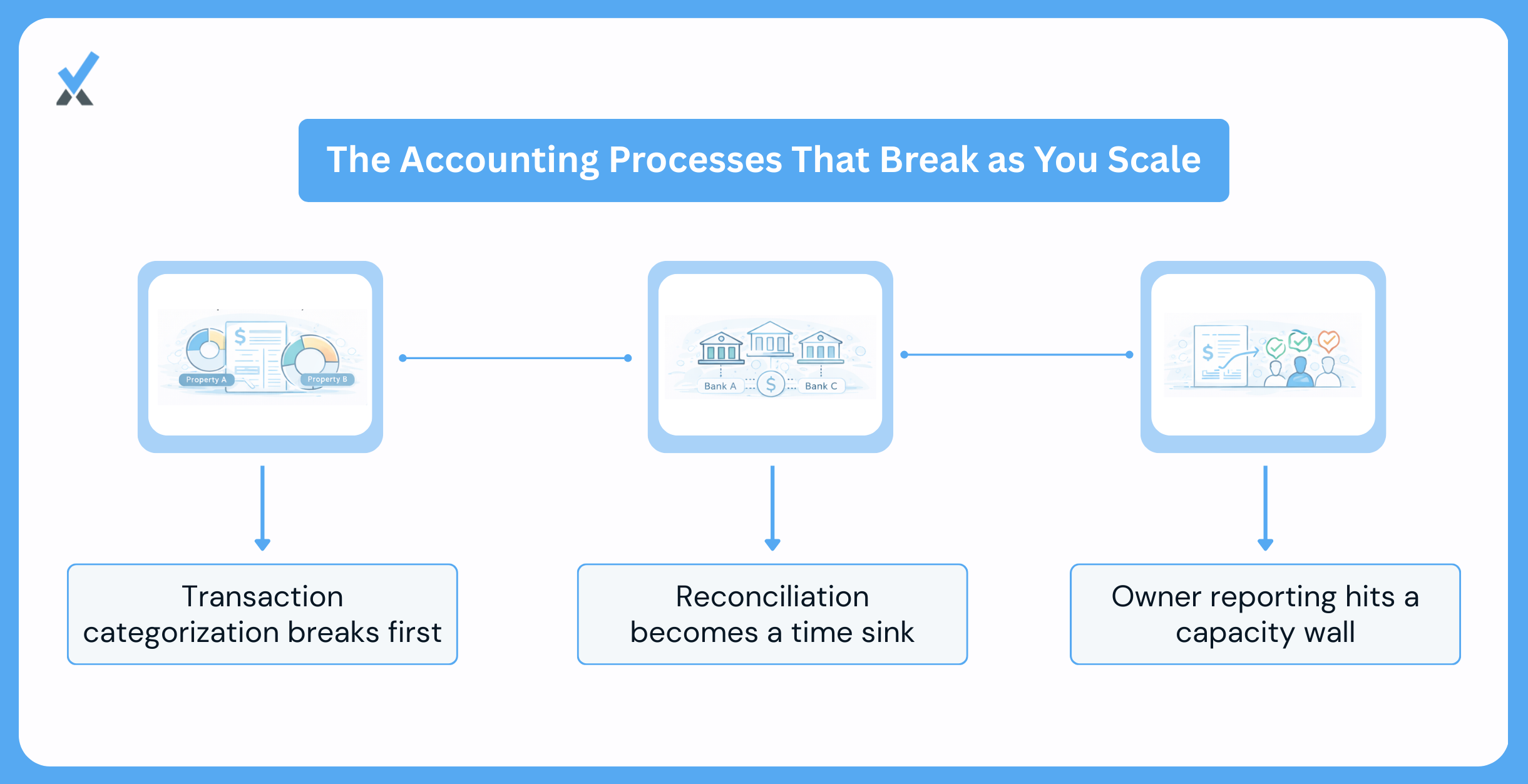
Not every manual process fails at the same door count. Understanding which ones break first helps a firm order automation investments correctly rather than automating whatever feels most urgent that week.
-
Transaction categorization breaks at 150 to 200 doors. At this volume, a firm processes 600 to 1,000 transactions per month across 10 to 20 bank accounts. Every transaction needs a property tag, an expense category, and a fund designation. A single bookkeeper manually categorizing transactions at this volume will average an error rate of 2 to 4 percent, resulting in 12 to 40 miscategorized entries each month. Each error cascades into property-level P&Ls, owner statements, and trust reconciliations.
Automated transaction categorization uses rule-based engines and pattern recognition to assign property tags and expense categories based on vendor history and transaction descriptions. At a well-configured firm, 85 to 90 percent of transactions are automatically categorized, reducing manual review to the 10 to 15 percent that genuinely require human judgment.
-
Bank and trust reconciliation breaks at 200 to 300 doors. Manual bank reconciliation across 15 to 25 accounts is a multi-day process that stretches the month-end close past the point where owner statements can go out on time. The bookkeeper downloads statements, matches transactions against the ledger, investigates discrepancies, and documents the reconciliation. When this process takes four to five days, the month-end close stretches past the 15th and owner statements arrive late.
Automated bank feeds pull transactions daily and match them against recorded entries in real time. By month-end, reconciliation becomes a verification exercise rather than a construction project. Firms using automated bank feeds typically complete reconciliation in 2 to 4 hours rather than 2 to 4 days.
-
Owner statement preparation breaks at 250 to 350 doors. Owner statement preparation at this volume involves pulling property-level data, formatting each statement, reviewing it, and distributing it. At roughly 30 minutes per statement, that is 15 to 25 hours of bookkeeper time every month dedicated to a single deliverable.
Automated statement generation pulls property-level data directly from the accounting system, applies a standardized template, and produces statements ready for review and distribution. The bookkeeper's role shifts from building statements to reviewing them, reducing the time from 25 hours to three or four.
How should a firm build its automation stack at each growth stage?
Automation investments should match the current bottleneck, not an aspirational door count. Implementing everything at once creates its own complexity. A staged approach works better.
- 100 to 200 doors: automate transaction categorization and bank feeds. This is the foundation. Connect all bank accounts to the accounting platform for daily transaction imports. Configure categorization rules for the top 30 to 50 recurring vendors and transaction types. Establish the matching rules that will scale with the portfolio. The investment is primarily setup time, not software cost, since most PM platforms and accounting tools already include these features. Digital self-service has become a baseline owner expectation industry-wide, which makes automation at this stage as much a service standard as an internal efficiency play.
- 200 to 300 doors: automate AP processing and approval workflows. At this stage, the volume of vendor invoices justifies automating the accounts payable cycle. Implement OCR-based invoice capture to automatically extract vendor name, amount, and line items. Configure approval routing so invoices flow to the right approver based on property, amount, and expense type. Automate payment scheduling based on vendor terms. This eliminates the manual data entry that consumes 15 to 20 hours per month at this portfolio size.
- 300 to 500 doors: automate reporting, compliance monitoring, and forecasting. With clean, automated data flowing through the accounting system, a firm can now automate the outputs. Generate owner statements automatically from property-level data. Set up compliance alerts for trust account thresholds, filing deadlines, and reconciliation schedules. Build dashboards that update in real time with portfolio-wide KPIs, surfacing per-door margins, collection rates, and AR aging across every property without manual report pulls. At this stage, automation is not just saving time. It is producing financial intelligence that manual processes could never deliver at scale.
How does the staffing math change at each automation level?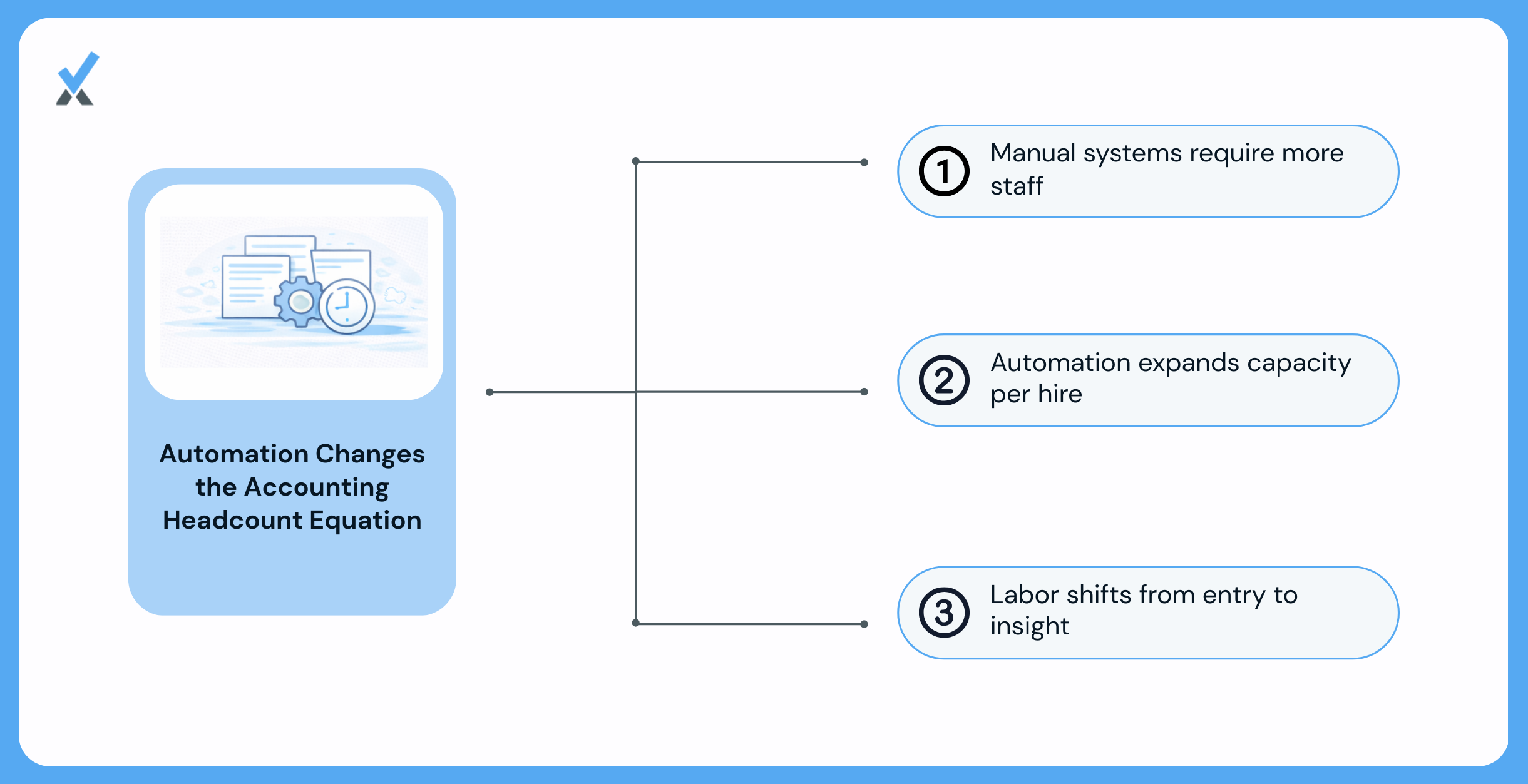
The most tangible benefit of automation is the reduction in the ratio of doors to accounting staff, which shows up directly in payroll cost long before it shows up anywhere else.
Without automation, many PM firms need roughly one full-time bookkeeper per 100 to 150 doors, a ratio consistent with staffing norms published in NARPM's Financial Benchmarks Guide for residential property management firms. A 300-door firm typically employs two to three bookkeeping staff at $50,000 to $65,000 each, totaling $100,000 to $195,000 annually in accounting labor alone.
With automation at the transaction, AP, and reporting levels, one experienced bookkeeper supported by automated systems can manage 250 to 350 doors. The second position either becomes unnecessary or shifts to a higher-value role, such as financial analysis, owner relationship management, or controller-level oversight, which a specialist accounting partner can also provide if in-house capacity does not yet justify a full-time hire.
The savings are not just in salary. They include the management time spent supervising, training, and replacing bookkeeping staff. They include the error-correction hours that disappear when 90 percent of transactions are correctly categorized the first time. And they include the opportunity cost of an owner's own time once weekends stop going to reviewing reconciliations.
What should automation never replace in a property management firm?
Automation handles volume. Humans handle judgment. The line between the two matters, and it is worth drawing correctly at every growth stage.
- Automation should not replace oversight of trust accounts. Automated feeds keep trust transactions up to date, but a qualified human must review the three-way reconciliation monthly. The stakes of trust compliance are too high for any automated sign-off.
- Automation should not replace owner communication. Automated statements are efficient, but owners with questions need a knowledgeable person who can explain the numbers in context. Time saved on preparation should be reinvested in relationship management.
- Automation should not replace financial strategy. Dashboards surface data, but interpreting it requires human judgment. Declining margins, tightening cash flow, and underperforming properties all require experienced analysis.
Why should automation start with the current bottleneck, not the technology?
The PM firms that automate successfully start by identifying which manual process consumes the most time or produces the most errors at their current door count. They automate that process, stabilize it, and then move to the next bottleneck.
The firms that struggle with automation try to implement everything simultaneously, creating a six-month implementation project that disrupts operations and delivers benefits too slowly to justify the effort.
A firm's property management accounting infrastructure at 500 doors should look nothing like it did at 100. But the path between them is a series of targeted investments, each one removing a specific bottleneck so the team can handle more volume with fewer errors and less time. That, built on an expert-led, AI-powered, human-in-the-loop foundation, is how automation scales a property management company without scaling headcount at the same rate.
| Metric | Manual process | Automated process |
|---|---|---|
| Categorization error rate | 2 to 4 percent | 10 to 15 percent needs review, rest auto-tagged |
| Reconciliation time | 2 to 4 days | 2 to 4 hours |
| Owner statement prep | 15 to 25 hours a month | 3 to 4 hours a month |
| Bookkeeper-to-door ratio | 1 per 100 to 150 doors | 1 per 250 to 350 doors |
| Annual labor cost, 300-door firm | $100,000 to $195,000 | One role, plus optional controller partner |
At what door count should a PM company start automating accounting?
Start around 100 to 150 doors, before transaction categorization becomes unmanageable. Waiting until reconciliation or owner statements are already breaking means implementing under pressure, which is harder than building the foundation while volume is still manageable. Transaction categorization and bank feeds are the right first target.
Does automation eliminate the need for a bookkeeper entirely?
No. Automation removes repetitive, high-volume work, not judgment. A firm still needs a qualified person reviewing trust reconciliations, answering owner questions, and interpreting financial trends. What changes is headcount: one skilled bookkeeper supported by automation typically replaces two or three people doing manual data entry across the same portfolio.
How long does implementing a full automation stack typically take?
A staged rollout across all three levels, transaction categorization, AP automation, and reporting, typically spans 3 to 6 months when tackled one bottleneck at a time. Firms that try to implement everything simultaneously often take longer and see more operational disruption along the way.
Automation scales a portfolio without scaling headcount at the same rate, but only when it is staged to the current bottleneck and paired with human oversight where judgment still matters.
For a complete overview of trust account management, three-way reconciliation, owner ledgers, and financial operations across a property management portfolio, see the complete guide to property management accounting.
Related reading
This article is part of our coverage of Bookkeeping for property management: complete guide, the hub for bookkeeping and accounting setup.
For the full framework, see the complete guide to property management accounting.
Numetix is an AI-first accounting firm. AI runs the bookkeeping, tax, payroll, and reporting workflow. Industry experts handle the judgment, month-end close, review, and advisory. We serve founder-led service firms across law, consulting, IT, healthcare, creative, and nonprofit. Headquartered in California, serving clients nationwide.
Suggested Readings
AppFolio accounting: Best practices for 200+ door PM companies
AppFolio and QuickBooks don’t sync: Here’s how PM firms fix it
Best property management accounting software for growing PM firms
See what Numetix can do for you
Learn how the Numetix Portal streamlines communication, offers valuable insights, and saves you time so you can focus on growing your business.