10 accounting tips every startup founder needs to know
Key Takeaways
Entity structure decisions made at formation are expensive to undo later; a Delaware C-corp usually fits venture-backed startups, while an S-corp-taxed LLC often fits bootstrapped ones.
Mixing personal and business finances in one bank account weakens liability protection and roughly doubles the time tax preparation takes each year.
A $500 miscategorized expense caught in February takes minutes to fix; the same error found during October tax prep can take hours to trace.
Startups that run out of cash often had plenty of revenue on paper; they simply never enforced their own net-30 collection terms.
Cash-basis accounting is simpler early on, but investors expect accrual-basis financials, and switching is easier if planned for from the start.
A first employee hire, an active funding round, or multi-state operations are common triggers for bringing in professional bookkeeping help.
10 accounting tips every startup founder needs to know
Quick Answer
Founder accounting basics come down to getting the foundation right early, entity choice, a dedicated bank account, a customized chart of accounts, then building habits that hold up under scrutiny: monthly reconciliation, AR follow-up, correct categorization, and documented receipts. Understanding cash versus accrual accounting and reviewing financials monthly rounds it out. None of these ten habits is hard alone, but skipping them compounds into entity mistakes, failed due diligence, and tax penalties.
Most founders started a company to build something, not to learn accounting. But sooner or later there is a moment staring at QuickBooks, wondering whether an expense should be categorized as "professional services" or "contract labor," and whether the distinction even matters.
It does. The accounting decisions made in year one follow a company for years. The wrong entity structure costs thousands in unnecessary taxes. Sloppy bookkeeping kills fundraising deals during due diligence. Mixing personal and business expenses creates liability exposure nobody wants to discover in a lawsuit.
The good news: founder accounting basics are not complicated. They are just easy to skip when the focus is on product, customers, and staying alive. These ten accounting tips for startups are the ones that matter most, organized by when they need to get right.
What should a startup get right from day one?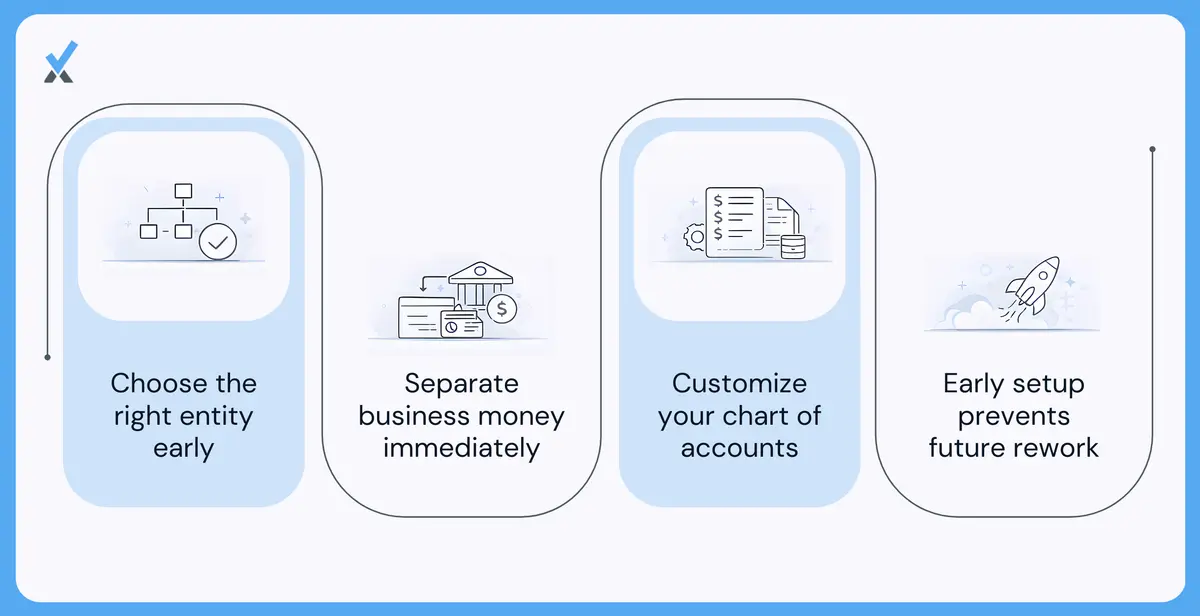
1. Choose the entity structure deliberately
Entity type determines how taxes get paid, how funding can be raised, and how protected the founder is from personal liability. Most startups choose between an LLC and a C-corp. A company planning to raise venture capital almost certainly needs a Delaware C-corp. A bootstrapped service business often does better with an LLC taxed as an S-Corp.
This decision is hard to undo later. Changing entity structure mid-growth triggers tax consequences and legal costs. Getting startup accounting advice from a CPA before filing formation documents, not after, avoids most of that pain.
2. Open a dedicated business bank account immediately
This is the simplest new business bookkeeping tip and the one most often ignored. As soon as a company is legally established, a separate bank account in the company's name should be opened, with every business transaction running through it. No exceptions.
Mixing personal and business finances creates three problems. It makes bookkeeping a nightmare. It weakens liability protection, since courts can "pierce the corporate veil" when company money is treated as personal money. And it makes tax preparation take twice as long because someone has to untangle which expenses were business and which were personal.
3. Set up the chart of accounts for how the business actually operates
A chart of accounts is the list of categories where revenue and expenses get recorded. The default template in QuickBooks was designed for generic small businesses, not startups. It is worth customizing.
For early-stage financial management, the categories that matter are the ones that answer real questions: how much is being spent on contractors versus employees, what customer acquisition actually costs, how much runway remains by expense type. A chart of accounts tailored to the business model saves hours of recategorization later.
Which operational habits actually scale as a startup grows?
4. Reconcile accounts monthly, not quarterly
Reconciliation means matching every transaction in bank and credit card statements against accounting records. This should happen monthly, ideally within the first week of the month.
Waiting longer lets errors accumulate. A miscategorized $500 expense in January is easy to fix in February. That same error discovered in October during tax prep requires digging through nine months of records. Monthly reconciliation is the single habit that keeps books clean.
5. Track accounts receivable and follow up consistently
Revenue only counts once it is collected. Firms that invoice clients need to track outstanding amounts and systematically follow up on overdue payments. Net-30 terms mean nothing if they are never enforced.
Setting a weekly reminder to review accounts receivable, sending a polite follow-up at day 31, and escalating at day 45 catches most collection problems early. The startups that run out of cash often have plenty of revenue on paper. They just never collected it.
6. Categorize expenses correctly from the start
Every expense should be assigned to a category that reflects what it actually is. Software subscriptions are not office supplies. Contractor payments are not professional services, unless they come from lawyers or accountants. Travel for a client project is a direct cost, not overhead.
Getting this right matters because financial statements should show how money actually flows. If half of expenses sit in a generic "miscellaneous" category, the P&L cannot answer basic questions about where the money goes.
7. Keep receipts and documentation for everything
The IRS requires documentation for business expenses. So do investors during due diligence. So does anyone trying to remember what a $3,400 charge was for eighteen months later.
Using a receipt capture tool, such as Expensify, Dext, or QuickBooks' built-in feature, to photograph receipts and attach them to transactions turns thirty seconds per expense now into hours saved on reconstruction later.
How should a startup prepare for growth and external scrutiny?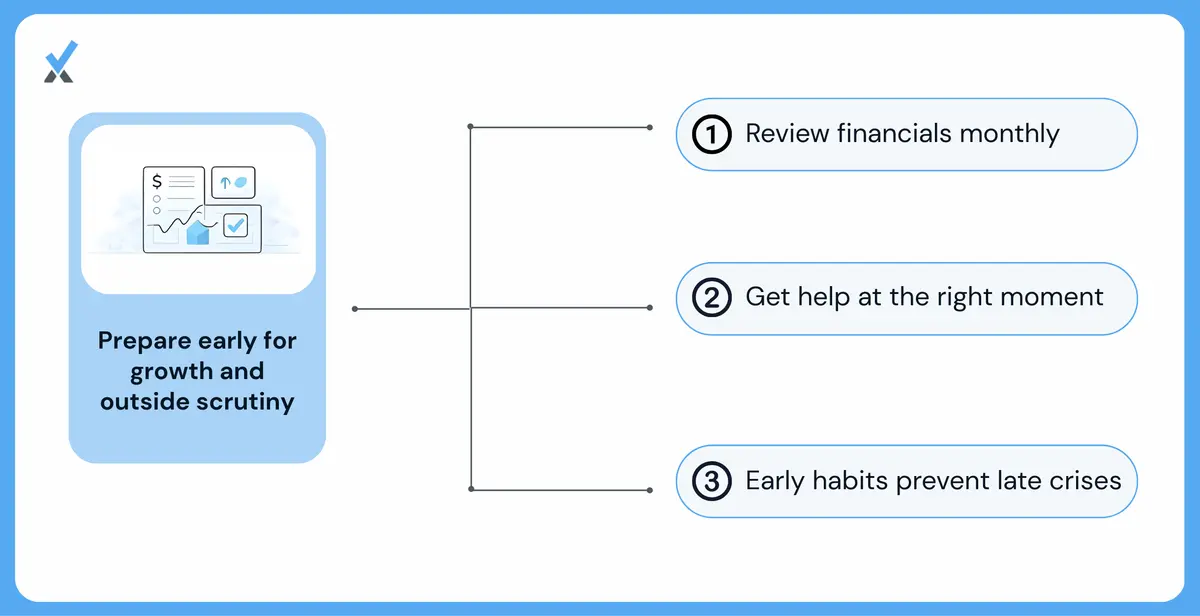
8. Understand the difference between cash and accrual accounting
Cash accounting records revenue when payment is received and expenses when they are paid. Accrual accounting records revenue when it is earned and expenses when they are incurred, regardless of when cash actually moves.
Early-stage startups often start on a cash basis because it is simpler. But companies planning to raise funding should expect investors to want accrual-basis financials. The transition is easier when planned for from the beginning, so it is worth asking an accountant which method fits the company's trajectory.
9. Build the habit of monthly financial reviews
Once a month, three things deserve a look: the profit and loss statement (making or losing money?), the balance sheet (what is owned and owed?), and cash flow (how long until the money runs out?).
No finance background is required to read these reports. What matters is the habit of looking at them regularly, so changes get noticed. A founder who reviews financials monthly catches problems in weeks, not months. A founder who waits for tax time ends up seeing them only months or years later.
10. Know when to get professional help
Founder accounting basics carry a company through the earliest stage. But there is a point where DIY bookkeeping costs more in errors and founder time than professional help would cost in fees.
Common triggers: hiring a first employee (payroll compliance gets complicated), raising a funding round (investors want clean books and professional financials), operating in multiple states (tax obligations multiply), or spending more than five hours a month on bookkeeping personally. When any of these happen, the advice is simple: get help before the problems compound.
What does getting this wrong actually cost?
None of these tips is difficult on its own. The challenge is that they compete for attention with product development, sales, and a hundred other priorities that feel more urgent.
But accounting mistakes compound. A missed quarterly tax payment results in penalties and interest. A sloppy cap table becomes a legal mess during a Series A. An entity structure mistake can result in a five-figure tax bill that could have been avoided.
Building these habits early, with an expert-led, AI-powered, human-in-the-loop process backing them up when they outgrow DIY, is what separates founders who treat early-stage financial management as a foundation rather than an afterthought, the ones who scale without their finances becoming a crisis.
| # | Tip | Why it matters |
|---|---|---|
| 1 | Choose entity structure deliberately | Hard and costly to undo later |
| 2 | Open a dedicated business bank account | Protects liability shield, simplifies books |
| 3 | Customize the chart of accounts | Answers real operating questions |
| 4 | Reconcile monthly | Stops small errors from compounding |
| 5 | Track and follow up on AR | Revenue on paper is not cash in the bank |
| 6 | Categorize expenses correctly | Keeps the P&L actually useful |
| 7 | Keep receipts and documentation | Required by the IRS and investors alike |
| 8 | Understand cash vs. accrual accounting | Investors expect accrual-basis financials |
| 9 | Review financials monthly | Catches problems in weeks, not months |
| 10 | Know when to get professional help | Prevents DIY costs from exceeding fees |
Should a very early-stage startup with no revenue yet bother with all ten of these habits?
The entity structure and dedicated bank account tips matter from day one regardless of revenue, since both get harder to fix the longer they wait. Habits like monthly financial reviews and AR follow-up become urgent once there is actual revenue and cash flow to manage, but building them early costs little and avoids a harder retrofit later.
How much does professional bookkeeping typically cost compared to doing it yourself?
Outsourced bookkeeping for an early-stage startup commonly runs a few hundred to a couple thousand dollars a month depending on transaction volume. The real comparison is not the fee against zero, it is the fee against founder time diverted from product and sales, which is often worth far more per hour.
What is the single most common accounting mistake new founders make?
Mixing personal and business finances is the most common and most damaging, since it simultaneously creates a liability risk, a bookkeeping mess, and a slower tax season, all from one avoidable decision that usually gets made in the very first week of operating.
Ten habits, built early, are what let a founder scale without their finances turning into a crisis.
See how Numetix accounting services handle the foundation for growing startups, built for professional services firms specifically.
Numetix is an AI-first accounting firm. AI runs the bookkeeping, tax, payroll, and reporting workflow. Industry experts handle the judgment, month-end close, review, and advisory. We serve founder-led service firms across law, consulting, IT, healthcare, creative, and nonprofit. Headquartered in California, serving clients nationwide.
Suggested Readings
Which accounting firms specialize in dental practices?
Nonprofit revenue recognition: grants vs contributions vs exchange transactions
How often do IOLTA trust accounts need to be reconciled?
See what Numetix can do for you
Learn how the Numetix Portal streamlines communication, offers valuable insights, and saves you time so you can focus on growing your business.