Finance & accounting outsourcing services that give founders their time back
Key Takeaways
-
Manual bookkeeping typically costs founders 10 to 15 hours weekly in categorization and reconciliation, work that produces no billable revenue.
-
Manual error rates run 15 to 20 percent, and a single misclassified $50,000 payment can trigger $2,000 to $5,000 in tax penalties.
-
AI powered outsourcing platforms learn a firm's transaction patterns within 30 days, auto classifying more than 90 percent of entries correctly.
-
Continuous reconciliation keeps books current within 48 hours instead of the 30 to 45 day lag common with manual bookkeeping.
-
Firms typically reclaim 10 to 12 hours weekly within the first month, worth an estimated $120,000 to $132,000 in net annual value.
-
Outsourcing lets consulting firms grow headcount from roughly 10 to 50 people without hiring dedicated in-house finance staff.
Finance and accounting outsourcing services: How founders reclaim 10+ hours a week
Quick Answer
Finance and accounting outsourcing services combine AI powered transaction categorization with human controller oversight to keep a firm's books accurate within 48 hours, rather than the 30 to 45 day lag typical of manual bookkeeping. Consulting firms that outsource typically reclaim 10 to 12 hours per week, cut error rates from roughly 15 percent to under 2 percent, and gain the capacity to scale headcount without hiring an in-house controller.
Why does manual bookkeeping cost founders more than they realize?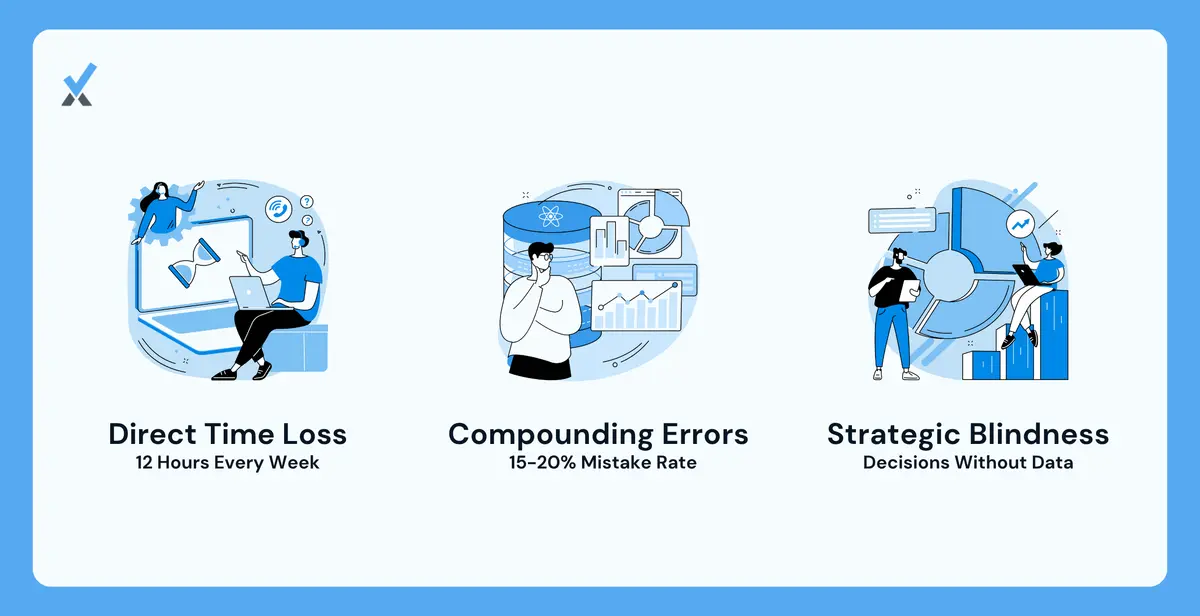
Manual bookkeeping drains three separate cost buckets for a growing consulting firm: direct time loss, compounding errors, and decisions made on stale numbers. Together these routinely exceed $150,000 a year for a mid-size firm. Numetix built its model around expert-led, AI-powered, human-in-the-loop delivery specifically to give that time back. The damage rarely shows up as one clean number; it shows up as missed billable hours, IRS penalties, and hiring calls made on 30-day-old cash balances.
Direct time loss: 12 hours every week
You lose 10 to 15 hours weekly to transaction categorization, bank reconciliation, and statement review.
This is not an administrative inconvenience. It is a strategic disaster.
If you bill $300 per hour, those 12 weekly hours represent $187,200 in lost annual revenue. You are trading high-value consulting for low-value data entry.
The fragmentation hurts worse than the raw hours. You do not lose one clean afternoon; you lose 30 minutes here, an hour there, spread across evenings and weekends.
Picture your Tuesday: client strategy meeting at 9 AM, QuickBooks at 10:30 AM to categorize Monday's transactions, proposal work at 11 AM. Lunch, then bank reconciliation at 1 PM because the credit card statement arrived. Back to the proposal at 2:30 PM, except now you have lost the thread.
This context-switching destroys deep work. Research shows it takes 23 minutes to regain focus after an interruption. Three bookkeeping interruptions daily cost another 5 or more hours weekly, just switching mental gears.
Compounding errors: 15 to 20 percent mistake rate
Manual bookkeeping introduces errors in 15 to 20 percent of transactions.
These are not typos you catch next month. They cascade into tax problems, inaccurate cash flow projections, and bad decisions based on wrong data.
One misclassified $50,000 payment triggers $2,000 to $5,000 in estimated tax penalties. A missed 1099 contractor classification costs $50 to $280 in IRS fines per form. Miss five contractors and you are down $1,000 or more before you realize the mistake.
Worse, when your reconciliation runs 30 to 45 days behind, you make hiring and investment decisions based on outdated snapshots, not current reality.
Strategic blindness: decisions without data
Month-end close creates a third cost: decision-making on stale information.
When your books are perpetually behind, you hire too late, invoice too slowly, and miss cash flow problems until they are critical. This strategic blindness costs more than the bookkeeping hours themselves.
The month-end close also disrupts your entire operation. You cannot fully commit to client work because you are chasing receipts, following up with a part-time bookkeeper, and reviewing spreadsheets. Questions go unanswered. Proposals get delayed. Strategic planning gets pushed to next month, repeatedly.
This does not scale as you grow from 10 to 30 employees, and it scales even worse across the broader base of professional services firms juggling multiple client engagements at once.
How does modern finance outsourcing actually work?
Today's outsourcing is not hiring a remote bookkeeper. It is deploying AI-powered automation with expert human validation, which changes the equation for speed and accuracy completely. (If you are weighing overseas options, here is a quick look at whether consulting firms should take the leap into offshore bookkeeping services.)
AI learns your business in 30 days
Modern services deploy AI categorization engines that learn your specific transaction patterns. Week one requires manual review. By day 30, the system auto-classifies more than 90 percent of transactions correctly.
It understands that "WeWork" means office rent, "Gusto" means payroll, and "John Smith Consulting" means contractor payments.
This is not generic software you configure yourself. The AI adapts to your firm's unique vendor mix, revenue streams, and expense categories. A human controller reviews every AI decision for the first 60 days, training the system on your business logic.
Continuous reconciliation replaces month-end chaos
A month-end close that used to take five days is gone.
Modern outsourcing keeps your books current within 48 hours, every day. Bank feeds sync automatically. The system categorizes transactions overnight. Reconciliation happens in real time rather than in panicked weekend sprints.
When you open your dashboard on Tuesday morning, you see accurate cash balances, an up-to-date P&L, and real-time budget variance, not 30-day-old guesses. You make decisions with current data.
Dedicated teams respond in hours, not days
Traditional bookkeepers take 3 to 5 business days to answer questions.
Modern outsourcing assigns you a dedicated finance pod: a team of bookkeepers, controller services, and fractional CFOs with guaranteed response times. Urgent questions get answered in under 2 hours. Complex analysis gets delivered the same day.
This is not generic offshore support. It is specialized expertise in consulting firm economics. Your team understands project-level profitability, utilization tracking, and client billing cycles because they work exclusively with professional services firms.
Everything integrates into one system
Manual bookkeeping means juggling separate vendors for bookkeeping, payroll, AP/AR, and tax prep.
This is also why many firms turn to accounts payable outsourcing companies to eliminate manual AP workflows, removing yet another source of complexity from operations.
Modern outsourcing integrates everything into one connected system. QuickBooks syncs with Gusto payroll. Bill.com handles vendor payments. Everything flows into real-time dashboards.
One source of truth. One point of contact. One monthly fee.
What ROI can founders actually expect from outsourcing?
Three buckets drive the return: reclaimed time, improved accuracy, and scalability without new hires. Each one typically shows up within 60 days.
Time savings: 10 to 12 hours weekly
Clients reclaim 10 to 12 hours per week within the first month.
That is 520 hours annually: not abstract hours, but actual Friday afternoons, actual Sunday mornings, actual focused weekday blocks you can now spend on client work worth $200 to $500 per hour instead of data entry worth $30.
Do the math at $300 an hour billing rates: $156,000 in newly available capacity. Subtract a $2,000 to $3,000 monthly outsourcing cost ($24,000 to $36,000 annually) and you net $120,000 to $132,000 in value.
That is a 4 to 5x return on cash alone, before counting reduced stress, better sleep, and actual weekends off.
Accuracy gains: error rates drop 85 percent
Errors drop from 15 percent to under 2 percent through dual human-AI review, which prevents tax penalties, improves cash flow forecasting, and enables confident decisions.
Picture the difference: last quarter under manual bookkeeping, you thought you had $80,000 in the bank. You actually had $62,000, because three client payments were not properly recorded and $15,000 in vendor bills had not been entered yet. You almost hired two people you could not afford.
Now your dashboard shows accurate cash within 48 hours. You trust the numbers, and you hire with confidence.
The compound value is invisible but enormous: better decisions made a dozen times a year compound into significantly better outcomes over 3 to 5 years.
Scalability: grow without adding finance headcount
Firms scale from 10 to 50 employees without adding finance staff or losing financial visibility.
(If you are aiming to scale without adding headcount, this breakdown of payroll and bookkeeping services as the smartest way to grow without extra hires explains exactly how firms unlock that leverage.)
Your outsourcing partner absorbs the complexity: more vendors, more payroll, more contractor 1099s, multi-state tax filings, while you keep the same simple dashboard and responsive support team.
Compare this to hiring in-house: a controller costs $85,000 to $120,000 plus benefits, requires management overhead, and leaves you exposed when they quit. Outsourcing provides controller-plus-CFO expertise at $24,000 to $42,000 annually with no turnover risk.
| Manual bookkeeping | Outsourced finance and accounting | |
|---|---|---|
| Weekly time cost | 10 to 15 hours | Under 1 hour of owner review |
| Error rate | 15 to 20 percent | Under 2 percent |
| Books current within | 30 to 45 days | 48 hours |
| Annual cost | $85,000 to $120,000+ for an in-house controller | $24,000 to $42,000 for a dedicated finance pod |
| Scalability | Requires new hires as the firm grows | Absorbs growth from 10 to 50 employees, no added headcount |
The gap widens every year a firm stays on manual bookkeeping: the time cost compounds through lost billable hours, and the error cost compounds through penalties and bad decisions made on late data.
How much does finance and accounting outsourcing cost for a consulting firm?
Pricing typically runs $2,000 to $3,500 a month for firms under 20 employees, scaling toward $3,500 to $5,000 as headcount, entity count, and transaction volume grow. Most providers price by transaction volume and service scope rather than a flat industry rate, so request a quote based on your current books.
How long does it take an outsourced provider to fully learn my books?
Most providers reach full accuracy within 30 to 60 days. The first two weeks involve mapping your chart of accounts and vendor list, followed by 30 to 45 days where a human controller reviews every AI-categorized transaction before it posts, training the system on your specific business logic.
Will outsourcing replace my in-house bookkeeper or controller?
Not necessarily. Many firms keep a part-time internal bookkeeper for local vendor relationships while outsourcing reconciliation, payroll processing, and controller-level reporting. Firms with an existing full-time controller typically outsource the transactional work only, freeing that person to focus on forecasting and strategic finance instead of data entry.
Finance and accounting outsourcing services give consulting firm founders back their most precious resource: time to focus on clients, strategy, and growth. The ROI is measurable: 10 or more hours weekly, 85 percent fewer errors, and scaling capacity without new hires.
If you are spending more than 5 hours a week on bookkeeping, or if month-end close keeps disrupting your operations, it is worth exploring our accounting services to see what outsourcing could hand back to your week, built on the same expert-led, AI-powered, human-in-the-loop model behind every Numetix engagement.
Numetix is an AI-first accounting firm. AI runs the bookkeeping, tax, payroll, and reporting workflow. Industry experts handle the judgment, month-end close, review, and advisory. We serve founder-led service firms across law, consulting, IT, healthcare, creative, and nonprofit. Headquartered in California, serving clients nationwide.
Suggested Readings
When does a medical or dental practice need a fractional or outsourced CFO?
Should a nonprofit hire an in-house bookkeeper or outsource its accounting?
Outsourced trust accounting for property management companies
See what Numetix can do for you
Learn how the Numetix Portal streamlines communication, offers valuable insights, and saves you time so you can focus on growing your business.