Why waiting until month-end to update your books is costing you money
Key Takeaways
Checking a bank balance without current books means guessing at real cash position, since committed expenses and outstanding invoices are not reflected yet.
A firm discovered it had underpriced its core service by 15 percent for four months because month-end books always arrived too late to catch rising costs.
Stale books can make a stated six-month cash runway actually closer to four months, since the starting cash position used to project it was already wrong.
An unpaid invoice caught on day 3 is a friendly reminder; caught on day 35 after payroll is due, it becomes an emergency collection call.
A firm's largest client can be its least profitable, consuming 40 percent of team capacity while generating half the average margin, and stay hidden until year-end.
Bank feeds already flow transactions daily into modern accounting systems; the gap between real-time data and month-end reporting is a choice, not a technical limit.
Why waiting until month-end to update the books costs money
Quick Answer
Waiting until month-end to update books means pricing, hiring, and cash decisions get made on data already weeks stale, turning informed choices into guesses. Problems that would be a quick email at 7 days become an emergency call at 45 or a write-off at 90, since the signal stays hidden until the books catch up. Modern accounting systems already pull bank feeds daily; the real question is whether that data gets used.
It is the 15th of the month. A potential client wants to know if the firm can take on a major project starting next week. A contractor would need to be hired to deliver it. Can the firm afford to say yes?
The bank balance looks okay. But the books have not been updated since last month. There is no clear picture of what is actually committed, what invoices are still outstanding, or what the real cash position will be in three weeks.
So the guess gets made. The answer is yes, and the hope is that the math works out.
This is what running a business on month-old financial data looks like. And it costs more than most firms realize.
How does stale financial data lead to expensive guesswork?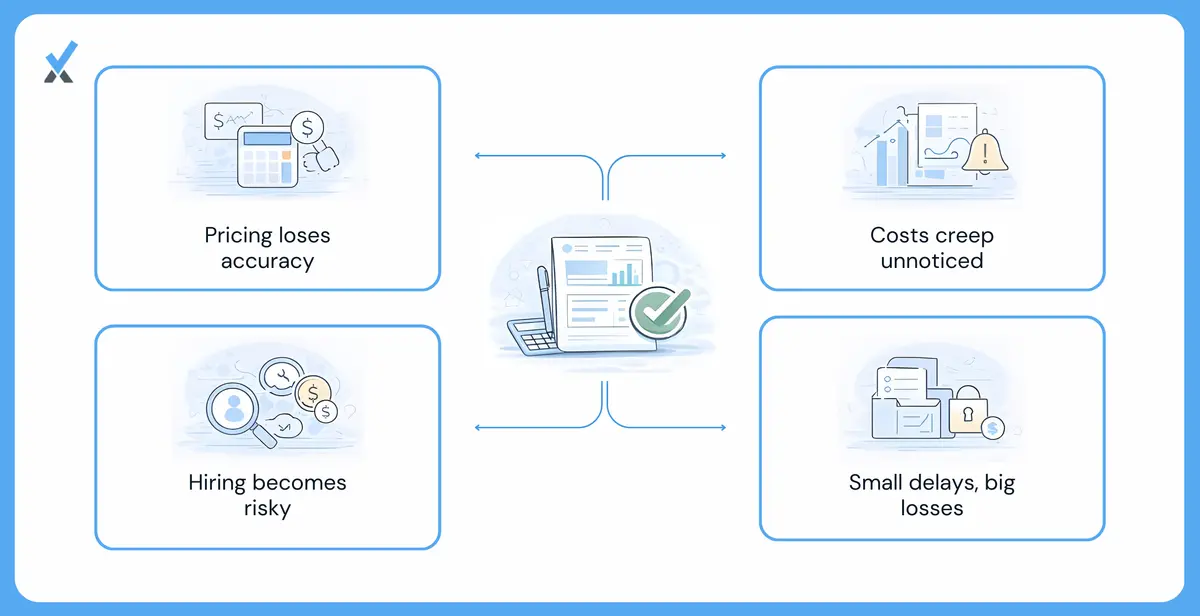
Every significant business decision has financial implications. When books are weeks behind reality, decisions stop being informed and start being educated guesses hoping to turn out right.
Pricing becomes a gamble without current margins
Quoting a new project raises an immediate question: what should it cost? The answer depends on current costs, overhead, and actual margins on similar recent work.
But if the books are three weeks old, that information is not there. Pricing gets based on what costs are remembered to be, not what they actually are. Maybe software subscriptions increased. Maybe contractor rates went up. Perhaps that "profitable" project type is actually breaking even once all the expenses are recorded.
Consider a firm that discovered it had been underpricing its core service by 15% for four months. Costs had crept up, but the month-end books always arrived too late to inform active proposals. By the time the margin erosion showed up, three more contracts had already been signed at the old rates.
Hiring decisions rest on outdated cash projections
Adding a team member is one of the most significant financial commitments a professional service firm makes: salary, benefits, equipment, and training. Sustaining that cost for at least 12 months needs to be a known fact, not a hope.
With month-old books, cash flow gets projected from a starting point that is already wrong. A "six months of runway" figure might actually be four. A "comfortable buffer" might be tighter than it looks.
The decision to hire or not hire shapes a firm's capacity and growth trajectory. Using stale data is like navigating with a map from last season. The roads may have changed.
How does delayed visibility let minor problems become big ones?
Financial problems rarely announce themselves with sirens. They build gradually. A payment comes in late. An expense runs over budget. A client takes longer to pay than expected.
When books lag weeks behind reality, these signals stay hidden until they have compounded into something serious.
Cash crunches appear sudden when they were not sudden at all
Here is a pattern that plays out constantly: a firm owner gets month-end financials on the 10th and discovers that a major client payment expected on the 5th never arrived. That payment was supposed to cover payroll on the 15th. Now there are five days to solve a problem that actually started three weeks ago.
With up-to-date bookkeeping, the invoice aging would have been visible in real time. Follow-up could have happened on day 3, not day 35. The conversation would have been a friendly reminder rather than an emergency collection call.
Unprofitable work continues unchecked
Not every client is worth keeping. Not every project makes money. But there is no way to know which ones are dragging down margins while looking at last month's data.
Consider the consulting firm that discovered its largest client was actually its least profitable. The account consumed 40% of team capacity but generated margins half the firm's average. The revenue got celebrated while the profitability data sat unprocessed in the accounting system.
Three months of up-to-date bookkeeping would have surfaced this pattern. Instead, it took a year-end analysis to reveal the firm had essentially subsidized this client for 18 months.
How do current books put a firm in control of outcomes?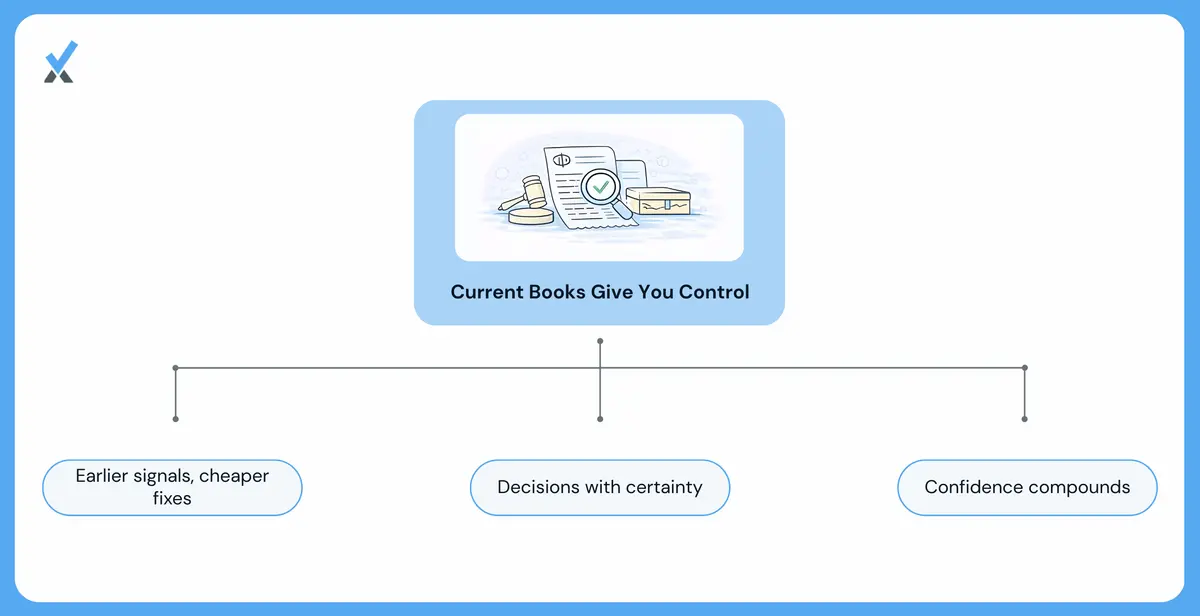
The alternative to month-end batch bookkeeping is not working harder. It is working with better information, sooner.
Problems caught early cost less to fix
A late invoice at 7 days is a quick email. At 45 days, it is an awkward phone call. At 90 days, it might be a write-off.
A budget variance spotted in week two can be corrected. Spotted at month-end, it is already history.
A cash gap identified three weeks out allows for options. Identified three days out creates panic.
The math is simple: earlier visibility means more time to respond, more options, and better outcomes. Up-to-date bookkeeping buys that time.
Confidence replaces uncertainty in financial decisions
There is a different feeling to current financial data. When a client asks whether the firm can take on new work, the answer is already known. When an opportunity requires investment, it can be evaluated against real numbers. When someone asks whether the firm can afford something, guessing is not required.
This confidence compounds. Negotiation improves with a known position. Pricing improves with a clear understanding of costs. Sleep improves without wondering what surprises next month's books will reveal.
What does the shift from batch to current bookkeeping actually look like?
Month-end bookkeeping made sense when transactions were kept in paper files and reconciliation required physical bank statements. That world is gone.
Modern accounting systems connect directly to bank feeds. Transactions flow daily. The infrastructure for up-to-date bookkeeping is already in place. The question is whether it is being used.
Some firms handle this with internal discipline and weekly bookkeeping blocks. Others outsource to services that continuously process transactions. The approach matters less than the outcome: books that reflect reality when decisions need to be made, not four weeks later.
For a firm currently running on month-old financial data, the lag is worth pricing out honestly. The cost is not just the problems already discovered. It is the problems still hiding in unprocessed transactions, waiting for month-end to surface.
By then, they will be expensive to fix. Today, they are just information not yet available, delivered with the same expert-led, AI-powered, human-in-the-loop process that keeps that gap from opening in the first place.
| Problem | Caught early | Caught late |
|---|---|---|
| Unpaid invoice | Quick email, day 7 | Emergency call or write-off, day 90 |
| Budget variance | Corrected in week two | Already history at month-end |
| Cash gap | Options, identified 3 weeks out | Panic, identified 3 days out |
| Unprofitable client | Repriced or renegotiated within months | Discovered at year-end, after months of subsidy |
How current do books actually need to be to make a real difference?
Weekly is a meaningful improvement over monthly, and daily or near-daily, which is what automated bank feeds enable, is where the real payoff shows up for decisions like pricing and hiring. The goal is not perfection down to the hour; it is closing the gap enough that decisions get made on this month's reality, not last month's.
Does real-time bookkeeping cost significantly more than month-end batch processing?
Not necessarily. Much of the cost difference comes from process, not price, since modern accounting platforms already pull bank feeds daily at no extra charge. The real cost driver is whether someone, internal or outsourced, is actually reviewing and categorizing that data continuously rather than batching it once a month.
What is the fastest way to move from month-end to current books?
Connecting bank feeds for daily transaction imports is the fastest first step, followed by setting a weekly, not monthly, review cadence. Firms that are significantly behind usually need a one-time catch-up project first to establish a clean starting point before the weekly rhythm can hold.
Today, the gap between what the books show and what is actually happening is just information not yet available. Left until month-end, it becomes an expensive surprise.
See how Numetix bookkeeping services keep data current, built for professional services firms specifically.
Numetix is an AI-first accounting firm. AI runs the bookkeeping, tax, payroll, and reporting workflow. Industry experts handle the judgment, month-end close, review, and advisory. We serve founder-led service firms across law, consulting, IT, healthcare, creative, and nonprofit. Headquartered in California, serving clients nationwide.
Suggested Readings
What CO-197 denial code means (authorization absent)
What CO-50 denial code means (medical necessity)
Cause marketing and commercial co-ventures explained
See what Numetix can do for you
Learn how the Numetix Portal streamlines communication, offers valuable insights, and saves you time so you can focus on growing your business.