Owner’s equity examples: How to track ownership value in your firm
Key Takeaways
An owner's stake in a business reflects capital put in, profit the company kept, and cash later withdrawn, not some abstract line item on a spreadsheet.
Every dollar contributed, whether cash or equipment, increases equity dollar for dollar; the type of asset contributed does not change the accounting.
Net income increases equity even with zero new capital contributed, since profit that stays in the business belongs to the owner as retained value.
A firm can be profitable and still see equity fall if owner draws exceed net income for the year, the opposite of what the P&L alone suggests.
Equity trending steadily upward across multiple years signals a business creating value faster than owners withdraw it; flat or declining equity signals the opposite.
Partner capital accounts track each partner's equity separately, increasing by their allocated share of profit regardless of whether they actually withdraw any cash.
Owner's equity examples: How to track ownership value in a firm
Quick Answer
Owner's equity tracks money an owner puts into a business, profit the business keeps, and cash later withdrawn, calculated as beginning capital plus contributions plus net income minus draws. Contributions and profitable operations increase it; losses and draws exceeding income decrease it, sometimes even in a profitable year. Watching the trend across multiple years, growing, flat, or declining, reveals whether a business builds long-term wealth or just generates current income.
A balance sheet shows owner's equity of $127,000. Last year it was $98,000. Is that growth good? What caused the increase? And what would make it go down?
These questions matter because owner's equity represents the actual ownership stake in a business. It is not an abstract accounting concept. It is the accumulated result of everything invested, everything the company has earned, and everything owners have taken out.
Understanding owner's equity through concrete examples transforms confusing balance sheet figures into meaningful insights about a firm's financial trajectory.
How does owner's equity appear on the balance sheet?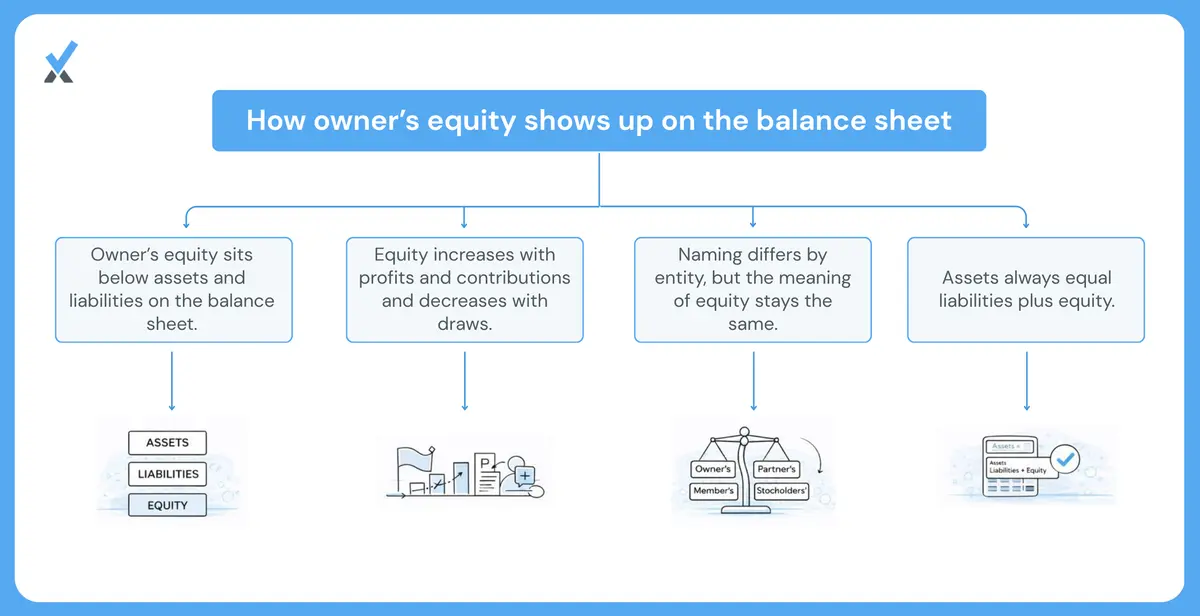
Understanding the statement structure helps in finding and interpreting the numbers that matter. The equity section appears at the bottom of the balance sheet, after assets and liabilities. For a consulting firm structured as a sole proprietorship, the statement might look like this:
| Line item | Amount |
|---|---|
| Owner's capital, beginning of year | $85,000 |
| Add: Net income | $62,000 |
| Add: Additional contributions | $5,000 |
| Less: Owner's draws | ($25,000) |
| Owner's capital, end of year | $127,000 |
This format shows the complete story: where the firm started, what changed, and where it ended.
Terminology varies by entity type:
Sole proprietorships use "Owner's Capital" or "Owner's Equity."
Partnerships use "Partners' Capital" with separate accounts for each partner.
LLCs use "Members' Capital" or "Members' Equity."
Corporations use "Stockholders' Equity" with common stock and retained earnings.
The underlying concept remains the same regardless of the terminology. Equity represents the owners' residual claim on the business's assets after all liabilities are satisfied.
A simplified balance sheet view makes the relationship concrete:
| Category | Line item | Amount |
|---|---|---|
| Assets | Cash | $45,000 |
| Accounts Receivable | $68,000 | |
| Equipment | $22,000 | |
| Total Assets | $135,000 | |
| Liabilities | Accounts Payable | $8,000 |
| Total Liabilities | $8,000 | |
| Equity | Owner's Capital | $127,000 |
| Total Liabilities and Equity | $135,000 | |
Notice that assets ($135,000) equal liabilities plus equity ($8,000 + $127,000). The balance sheet always balances.
How do contributions build equity?
Every dollar invested increases ownership stake. Three examples show the mechanics.
Example 1: Initial business investment
A firm starts with a $30,000 deposit from personal savings into a new business bank account. Before the contribution, assets, liabilities, and equity are all zero. After the contribution, assets rise to $30,000 in cash, liabilities remain zero, and owner's equity rises to $30,000.
The journal entry debits cash $30,000 and credits owner's capital $30,000. The investment created both an asset, the cash the business now owns, and equity, the ownership claim on that cash.
Example 2: Additional capital contribution
Two years later, the owner injects another $15,000 to fund a marketing initiative. Equity moves from $72,000 to $87,000, a direct dollar-for-dollar increase from the additional investment, a larger ownership stake in the business.
Example 3: Contributing equipment instead of cash
A $5,000 computer setup gets transferred from personal ownership into the business. The entry debits equipment $5,000 and credits owner's capital $5,000. Non-cash contributions increase equity exactly like cash ones: value contributed, ownership stake grown accordingly.
How do profits and losses change equity over time?
Profits and losses flow through to the ownership position. This is how most equity growth occurs in established firms.
Example 4: A profitable year
A consulting firm generates $400,000 in revenue and incurs $320,000 in expenses, producing $80,000 in net income. Equity moves from $87,000 at the start of the year to $167,000 by year-end, before any draws. No additional capital was contributed. The business itself generated the value.
Example 5: A lost year
Economic conditions shift. Revenue drops to $280,000 while expenses remain at $310,000, producing a $30,000 net loss. Equity falls from $167,000 to $137,000. The ownership stake shrank because the business consumed more resources than it generated.
Example 6: Partner capital accounts in a partnership
Partnerships track equity separately for each partner. Consider a two-partner consulting firm where profits are split 60/40, earning $50,000 in net income for the year.
| Partner | Beginning capital | Profit share | Ending capital |
|---|---|---|---|
| Partner A (60%) | $60,000 | $30,000 | $90,000 |
| Partner B (40%) | $40,000 | $20,000 | $60,000 |
| Total | $100,000 | $50,000 | $150,000 |
Each partner's capital account increased by their share of profits, regardless of whether they withdrew any cash, before draws.
How do distributions and draws reduce ownership value?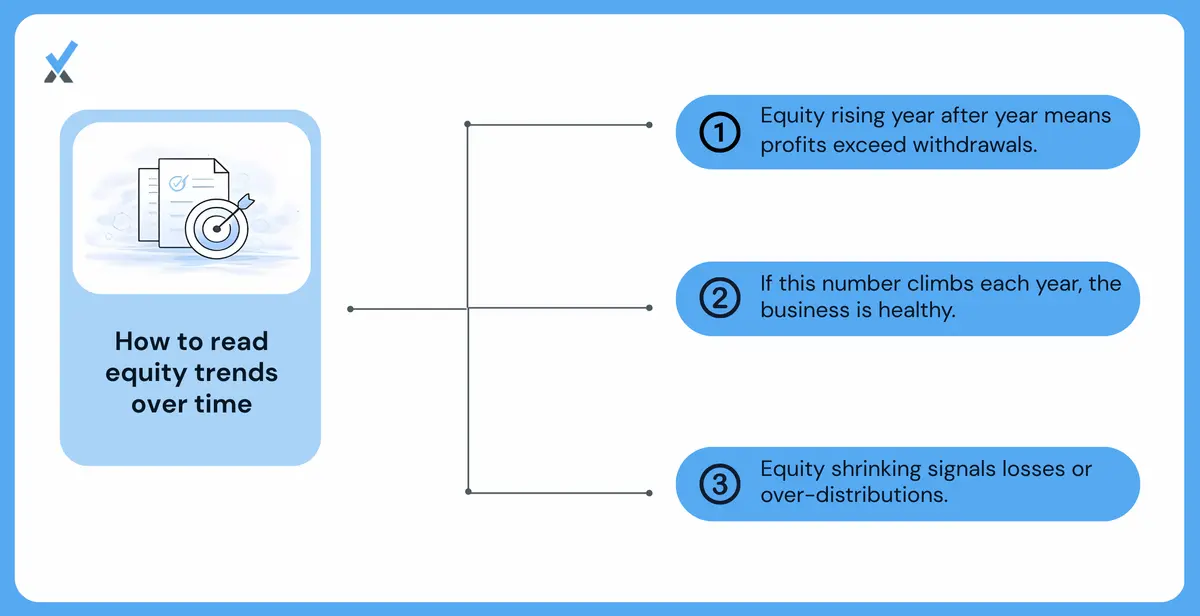
Taking money out decreases equity stake. Understanding this relationship helps balance current income needs against long-term wealth building.
Example 7: Regular owner draws
An owner pays themselves $8,000 monthly as an owner draw throughout the year, totaling $96,000. Starting equity of $167,000, plus $80,000 in net income for the year, minus $96,000 in draws, ends the year at $151,000.
Even with $80,000 in profits, equity decreased by $16,000 because draws exceeded income. More was consumed than the business generated.
What patterns should get tracked in equity over time?
The fundamental insight comes from watching how owner's equity changes across multiple periods.
Healthy pattern: Equity steadily increasing over the years indicates the business creates value faster than owners withdraw it. This is long-term wealth building.
Maintenance pattern: Equity roughly flat over time suggests distributions approximately equal profits. Current income is being taken but not additional ownership value.
Concerning pattern: Equity declining over the years indicates distributions exceed profits or the business is operating at a loss. Ownership value is eroding.
A simple tracking schedule makes the pattern visible at a glance:
| Year | Beginning equity | Net income | Contributions | Distributions | Ending equity |
|---|---|---|---|---|---|
| 2022 | $30,000 | $45,000 | $0 | ($35,000) | $40,000 |
| 2023 | $40,000 | $62,000 | $5,000 | ($42,000) | $65,000 |
| 2024 | $65,000 | $80,000 | $0 | ($48,000) | $97,000 |
This schedule shows a healthy firm: equity growing each year despite significant owner distributions. Profits consistently exceed draws.
How can equity insights inform better decisions?
Understanding examples of owner's equity helps inform decisions about a consulting firm.
Before taking large distributions, checking whether the draw will reduce equity to comfortable levels matters. A one-time $50,000 distribution might be fine if equity is $200,000, but concerning if equity is $70,000.
When planning growth investments, additional capital contributions increase equity but represent real money out of pocket, while retained earnings from profitable operations build equity without additional investment.
During partner negotiations, partners' capital account balances matter for buyouts, admitting new partners, or restructuring ownership percentages. Precise equity tracking prevents disputes.
Owner's equity is not just an accounting line item. It is the scorecard showing whether a firm is creating wealth or consuming it, tracked with the same expert-led, AI-powered, human-in-the-loop clarity behind every close. Tracking it consistently, understanding what changes it, and using that financial clarity to guide decisions is what separates firms that build ownership value from firms that quietly erode it.
Does owner's equity include the value of unbilled work in progress?
Only once that work gets recognized as revenue under the firm's accounting method. Under cash basis, unbilled work has no impact on equity until collected; under accrual basis, earned but unbilled revenue can increase equity through net income even before an invoice goes out, depending on how work in progress is recognized.
How is owner's equity different from the cash sitting in the business bank account?
Cash is just one asset on the balance sheet; equity is assets minus liabilities across everything the business owns, including receivables and equipment. A firm can have very little cash on hand and still show strong equity if it holds substantial receivables or paid-off equipment.
What is a reasonable equity cushion to maintain before taking a large distribution?
There is no universal number, but many firms aim to keep enough equity to cover several months of operating expenses plus a buffer for slow-paying clients, before pulling out a large one-time distribution. The right cushion depends heavily on how predictable the firm's cash flow actually is.
Owner's equity is the scorecard for whether a firm is building wealth or quietly spending it down.
See how Numetix accounting services keep that scorecard current, for professional services firms specifically.
Numetix is an AI-first accounting firm. AI runs the bookkeeping, tax, payroll, and reporting workflow. Industry experts handle the judgment, month-end close, review, and advisory. We serve founder-led service firms across law, consulting, IT, healthcare, creative, and nonprofit. Headquartered in California, serving clients nationwide.
Suggested Readings
Which accounting firms specialize in dental practices?
Nonprofit revenue recognition: grants vs contributions vs exchange transactions
How often do IOLTA trust accounts need to be reconciled?
See what Numetix can do for you
Learn how the Numetix Portal streamlines communication, offers valuable insights, and saves you time so you can focus on growing your business.