Outsourced property management accounting: In-house vs partner comparison
Key Takeaways
-
A 220-door firm's in-house bookkeeper typically costs $72,000 to $95,000 fully loaded per year, well above the $49,210 median base salary alone.
-
Outsourced PM accounting for the same 220-door portfolio typically runs $30,000 to $54,000 annually, with no added benefits or recruiting costs.
-
A single in-house bookkeeper is a point of failure; outsourced teams cover vacations and turnover without pausing trust reconciliations.
-
Growing beyond one bookkeeper's capacity means a $50,000 to $65,000 annual step-up, while outsourced fees typically rise just $500 to $1,000 per 50 doors added.
-
Firms managing 150 to 250 doors with one bookkeeper at capacity generally see the most value from switching to an outsourced partner.
-
Firms above 400 doors with an existing controller or finance manager often keep accounting in-house, since the infrastructure already justifies the volume.
Outsourced property management accounting: In-house vs. partner comparison
Quick Answer
Outsourced property management accounting typically costs $30,000 to $54,000 a year for a 220-door portfolio, versus $72,000 to $95,000 fully loaded for one in-house bookkeeper. The decision spans five dimensions: cost, expertise, scalability, control, and risk. In-house wins on immediate access; outsourcing wins on cost, coverage, and continuity. Firms with 150 to 250 doors at capacity typically benefit most from switching, while firms above 400 doors with an existing controller often do better staying in-house.
You are staring at two numbers. Your in-house bookkeeper costs $68,000 per year in salary and benefits. She manages 220 doors, works overtime during month-end close, and has not taken a full vacation in 2 years because no one else can run your trust reconciliations. An outsourced PM accounting firm quoted you $3,200 per month for full-service accounting, which is $38,400 annually.
The outsourced option is $29,600 cheaper on paper. But you are not sure what you would lose in control, response time, or quality. You may not know if the quoted scope actually covers everything your bookkeeper does today.
This is the decision most PM owners face when they have 150 to 400 doors. The in-house model that worked when you were smaller is showing strain, but switching to outsourced accounting feels like a leap. Our guide to in-house vs outsourced bookkeeping covers the trade-offs at a broader level. This article focuses on the five-dimensional comparison that moves the decision from gut feel to a clear analysis. The right decision depends on a clear comparison across five dimensions that go beyond sticker price.
Dimension 1: How does total cost of ownership compare?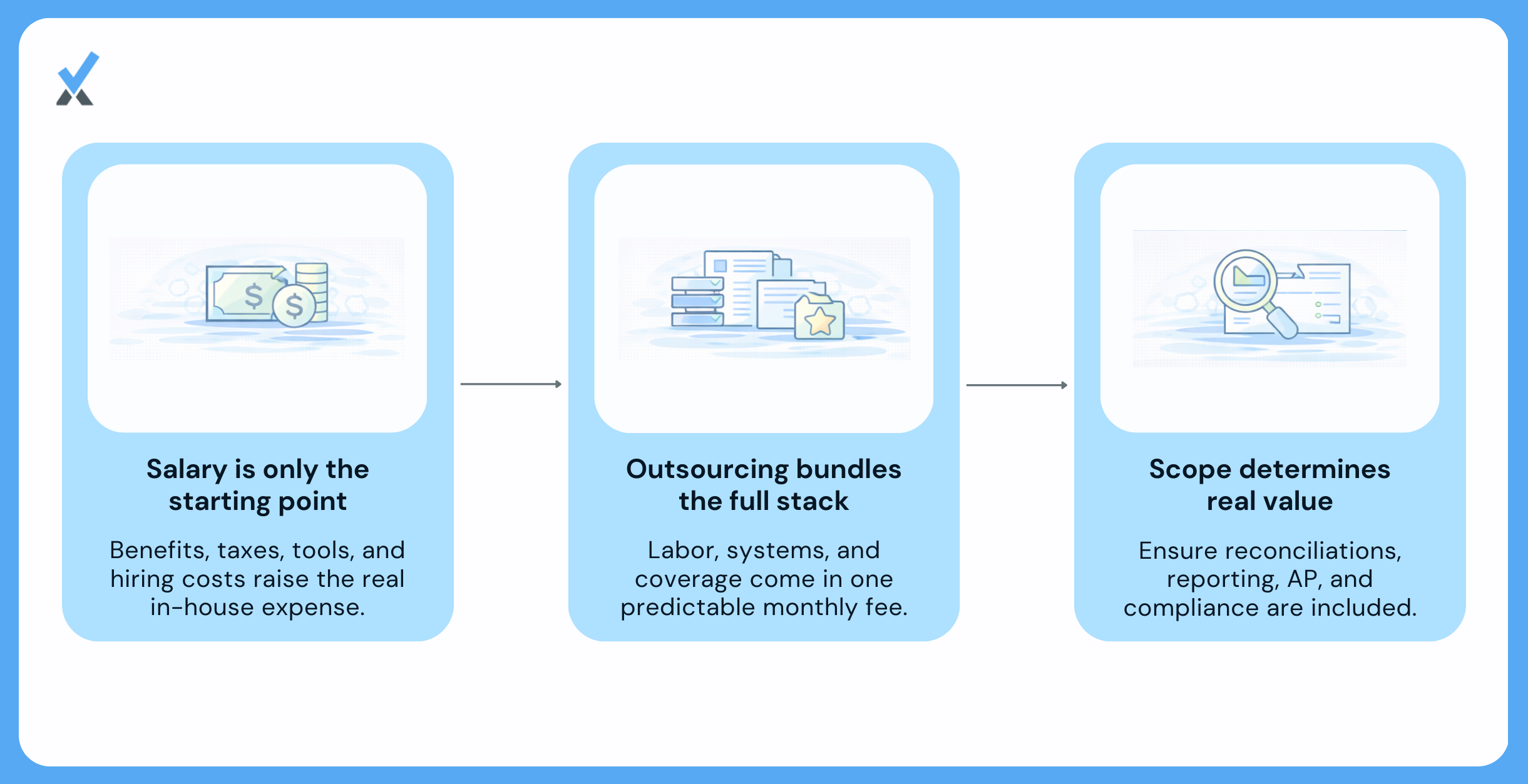
The salary comparison is where most PM owners start and stop. It is also where the analysis is most misleading.
- In-house true cost. Your bookkeeper's salary is the base. According to the Bureau of Labor Statistics, the median bookkeeping salary runs $49,210 annually, but fully loaded employment costs, including employer payroll taxes, benefits, and technology, consistently run 50% to 100% above base salary for professional service roles. Add employer payroll taxes (7.65%, comprising the employer share of Social Security and Medicare), workers' compensation, health insurance or benefits stipend, and any retirement contributions. Then add the technology costs the bookkeeper requires: accounting software licenses, bank feed subscriptions, document storage, and hardware. Add recruiting and training costs, amortized over average tenure (typically 2 to 4 years for bookkeeping staff). For a 220-door PM firm, the fully loaded annual cost of an in-house bookkeeper, covering salary, taxes, benefits, technology, and recruiting amortization, typically runs $72,000 to $95,000, according to market observations.
- Outsourced true cost. The monthly fee covers labor, technology, training, and management overhead. There are no additional costs for benefits, recruiting, or coverage during absences. What you see is what you pay. For a 220-door firm, outsourced PM accounting typically costs $2,500 to $4,500 per month, or $30,000 to $54,000 annually. Confirm that the quoted scope includes all components: transaction categorization, bank and trust reconciliations, AP processing, owner statement preparation, and compliance monitoring. If key functions are excluded, the effective cost increases. Our guide on what to look for in a PM accounting partner covers exactly what to verify before signing, including questions that reveal whether a firm's scope aligns with your operational needs.
- The hidden cost you cannot put in a spreadsheet. Your time supervising the bookkeeper, answering their questions, reviewing their work, and covering during their absences is a cost that never appears on a P&L. Most PM owners spend five to ten hours per week on financial oversight when managing an in-house bookkeeper. That time has value, whether you measure it in dollars or in the growth activities it displaces.
Dimension 2: How do expertise and specialization compare?
In-house bookkeepers bring general skills. Even a bookkeeper with PM experience has one perspective: your firm's processes. They learn your systems, your chart of accounts, and your workflows. But they rarely bring exposure to industry best practices, new technology implementations, or compliance approaches used by other PM firms. Their knowledge grows linearly with your firm's experience.
Outsourced PM accounting firms bring concentrated expertise. A firm specializing in PM accounting manages books for dozens of PM companies. They see patterns across portfolios. They know which accounting configurations work at 200 doors and which break at 350. They stay current on trust accounting regulations, tax law changes, and software updates because their entire business depends on it. The expertise advantage is not theoretical. It shows up in fewer errors, faster month-end close, and proactive compliance monitoring.
Dimension 3: How do scalability and coverage compare?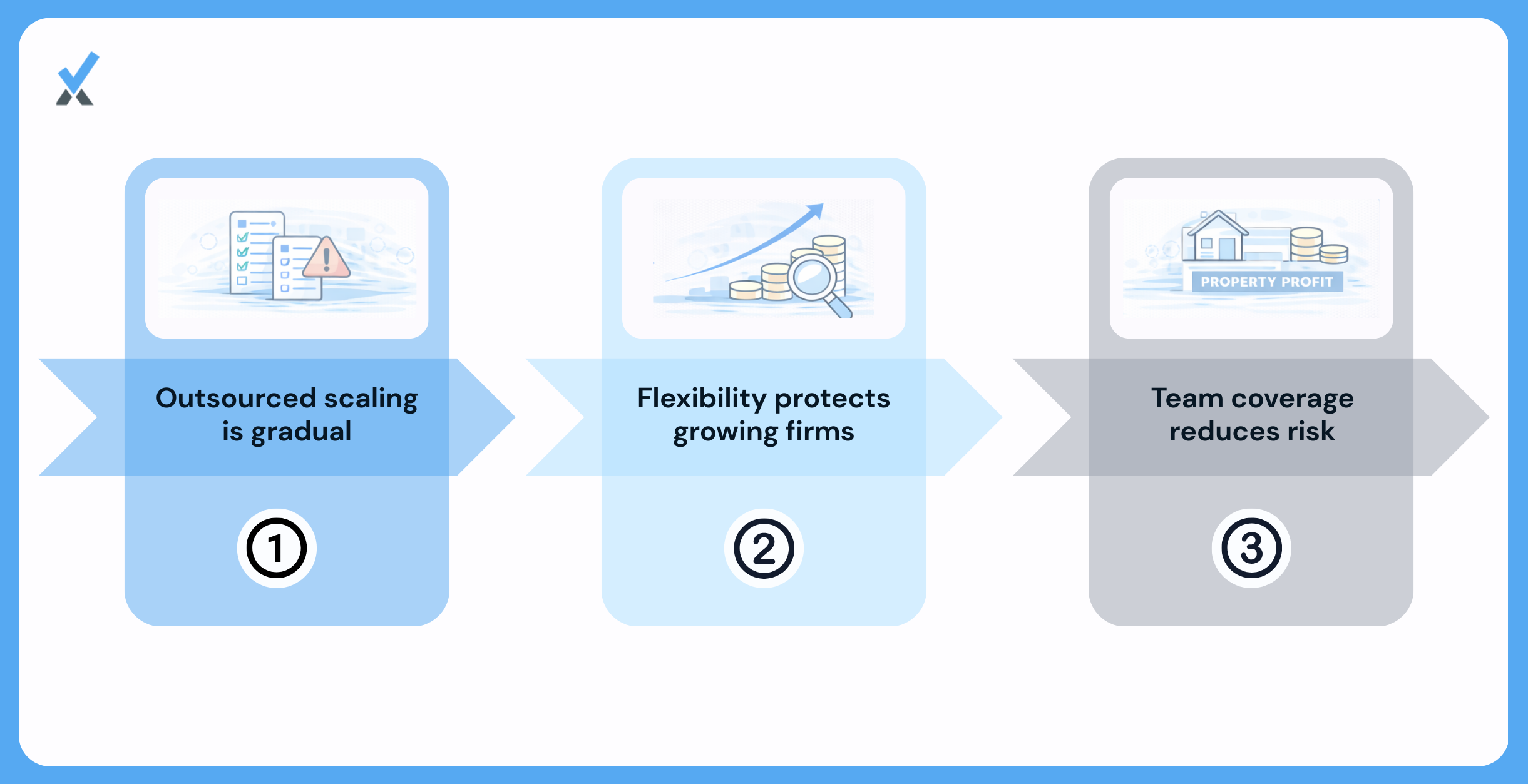
- In-house scaling is a step function. When your portfolio grows beyond what one bookkeeper can handle, you hire another one. That is a $50,000 to $65,000 step-up in annual cost, plus three to six months of training before the new hire is fully productive. If growth slows or a major client leaves, you are carrying the full cost of a position you may not need.
- Outsourced scaling is gradual. Most PM accounting firms adjust their service scope and pricing as your portfolio grows. Adding 50 doors might increase your monthly fee by $500 to $1,000, not by $50,000. This scalability is also why outsourced firms typically pair well with accounting automation at each growth stage, since both approaches reduce the door-to-headcount ratio without adding fixed labor costs. If your portfolio contracts, the fee adjusts downward. This flexibility matters for firms in growth phases where door count fluctuates quarter to quarter.
- Coverage is the silent advantage. A single in-house bookkeeper is a single point of failure. Vacations, sick days, and turnover create periods when no one is processing transactions or preparing reconciliations. Outsourced firms operate with teams. When your primary contact is out, another team member covers your account. Trust reconciliations do not pause for vacation, and neither should the five-day close process that makes them reliable.
Dimension 4: How do control and responsiveness compare?
This is the dimension where in-house accounting has a genuine advantage, and where PM owners feel the most anxiety about outsourcing.
- In-house gives you direct, immediate access. Your bookkeeper sits in your office or works on your schedule. When you need an answer about a property's financial status, you walk to their desk or send a Slack message and get an answer within minutes. You can observe their work habits, real-time redirect priorities, and maintain direct oversight of every financial process.
- Outsourced responsiveness depends on the provider's SLA. A good PM accounting firm offers response times measured in hours, not days. The best ones provide a dedicated communication channel (Slack, Teams, or a client portal) with a defined SLA: a 4-hour response time for standard questions and a same-day response time for urgent issues. But this is still slower than walking to someone's desk. If real-time, in-the-moment financial access is critical to how you operate, outsourcing requires you to adjust your workflow expectations.
- Control can be maintained through structured reporting. The feeling of control requires visibility, not proximity. Outsourced firms providing real-time dashboard access, weekly transaction summaries, and monthly financial packages deliver as much visibility as an in-house bookkeeper who maintains books in a system only they understand. Properly structured financial controls, delivered through an outsourced provider, can deliver more reliable oversight than a single in-house bookkeeper, precisely because they are documented and process-driven rather than person-dependent.
Dimension 5: How do risk and business continuity compare?
- In-house risk is concentrated in one person. If your bookkeeper leaves, every process stops until you hire and train a replacement. Undiscovered errors may surface months later. If they are the only person who understands your chart of accounts and trust structure, their departure creates an institutional knowledge crisis.
- Outsourced risk is distributed across a team. Your account is documented in the firm's systems, managed by a team, and backed by processes that survive individual turnover. If your primary accountant leaves the outsourced firm, another team member who already has context on your account takes over. The transition happens internally without disrupting your books.
Which model fits your firm at your current door count?
For property management firms managing 150 to 250 doors with a single bookkeeper who is at or near capacity, outsourcing typically delivers better value: lower total cost, specialized expertise, scalable capacity, and business continuity protection. The control trade-off is real but manageable with the right provider.
For firms managing 400+ doors with an established accounting team and a controller or finance manager providing oversight, keeping accounting in-house may make sense because the volume justifies the infrastructure, and the management layer is already in place.
Firms in the middle, 250 to 400 doors, often benefit from a hybrid approach: outsourcing core accounting functions while maintaining one internal person focused on financial oversight, owner communication, and strategic reporting.
Wherever you land, make the decision based on all five dimensions, evaluated with the same expert-led, AI-powered, human-in-the-loop rigor a good partner should bring to your books. The cheapest option is rarely the best option, and the most comfortable option is not always the right one for where your business is heading.
| Dimension | In-house (220 doors) | Outsourced (220 doors) |
|---|---|---|
| Annual cost | $72,000 to $95,000 fully loaded | $30,000 to $54,000 |
| Scaling cost per 50 doors | $50,000 to $65,000 step-up | $500 to $1,000 monthly increase |
| Coverage during absence | Single point of failure | Team-covered, no pause |
| Typical response time | Minutes, in person | Hours, per SLA |
| Risk concentration | One person, high risk | Distributed across a team |
Can a firm switch back to in-house accounting after outsourcing?
Yes, though it means rebuilding the hiring, training, and coverage infrastructure that outsourcing removed. Most firms that switch back do so because they crossed into a door count where an in-house controller became cost-justified, not because outsourcing itself failed.
Does outsourced PM accounting work for a single-owner boutique firm well under 150 doors?
Often yes, and sometimes it makes even more sense there, since a small firm rarely justifies a full-time in-house bookkeeper's fully loaded cost. The main thing to verify is that the provider's minimum engagement scope matches a smaller portfolio's actual transaction volume.
What SLA response time should a firm expect from an outsourced PM accounting partner?
A 4-hour response for standard questions and same-day response for urgent issues is a reasonable baseline. Anything slower than 24 hours on urgent items, such as a trust discrepancy or an owner dispute, signals the provider is understaffed for the account.
If you are in the 150 to 400 door range and want to understand exactly what a Numetix PM accounting services engagement covers before comparing it against your current in-house cost, that is the right starting point.
For a complete overview of trust account management, three-way reconciliation, owner ledgers, and financial operations across a property management portfolio, see our complete guide to property management accounting.
Related reading
This article is part of our coverage of Bookkeeping for property management: complete guide, the hub for bookkeeping and accounting setup.
For the full framework, see the complete guide to property management accounting.
Numetix is an AI-first accounting firm. AI runs the bookkeeping, tax, payroll, and reporting workflow. Industry experts handle the judgment, month-end close, review, and advisory. We serve founder-led service firms across law, consulting, IT, healthcare, creative, and nonprofit. Headquartered in California, serving clients nationwide.
Suggested Readings
Should a nonprofit hire an in-house bookkeeper or outsource its accounting?
Outsourced trust accounting for property management companies
Outsourced IOLTA trust accounting for law firms
See what Numetix can do for you
Learn how the Numetix Portal streamlines communication, offers valuable insights, and saves you time so you can focus on growing your business.