Offshore bookkeeping services: Should consulting firms take the leap?
Key Takeaways
-
Offshore bookkeeping services typically cost 40 to 60 percent less than domestic providers, often cutting a $3,000 monthly bill to about $1,200.
-
Most offshore providers lack SOC 2 certification, the baseline security standard that reputable domestic bookkeeping firms treat as non negotiable.
-
Time zone gaps turn quick five minute clarifications into 12 hour email cycles, and communication friction compounds as account complexity grows.
-
Firms that skip quality review spend 10 or more hours a month catching errors, erasing much of the original cost advantage.
-
A single data breach traced to an offshore provider damages the consulting firm's reputation directly, not the provider's.
-
Providers focused specifically on professional services firms typically scale support smoothly as a consulting firm's headcount grows from 15 to 50.
Offshore bookkeeping services: Should consulting firms take the leap?
Quick Answer
Offshore bookkeeping services can cut costs 40 to 60 percent compared with domestic providers, but most offshore firms lack SOC 2 certification and operate across time zones that slow communication to 12 hour cycles. For consulting firms where client trust and confidential data matter most, domestic providers who specialize in professional services typically deliver better security, faster response, and support that scales as the firm grows from 15 to 50 employees.
You have been staring at the proposal for 20 minutes.
The numbers look incredible. Full-service bookkeeping for half what you are paying now. Your current bookkeeper raised rates again, and you are wondering if it is time to explore offshore bookkeeping services. The provider promises certified accountants, secure systems, and 24-hour turnaround. What is not to love?
But here is the thing. That nagging feeling in your gut? It is there for a reason.
As a consulting firm owner, you have built your reputation on trust, expertise, and knowing your clients inside out. The question is not whether offshore bookkeeping services can save you money. They absolutely can. The real question is whether offshore outsourcing bookkeeping can scale with you without putting everything you have built at risk.
What exactly are offshore bookkeeping services?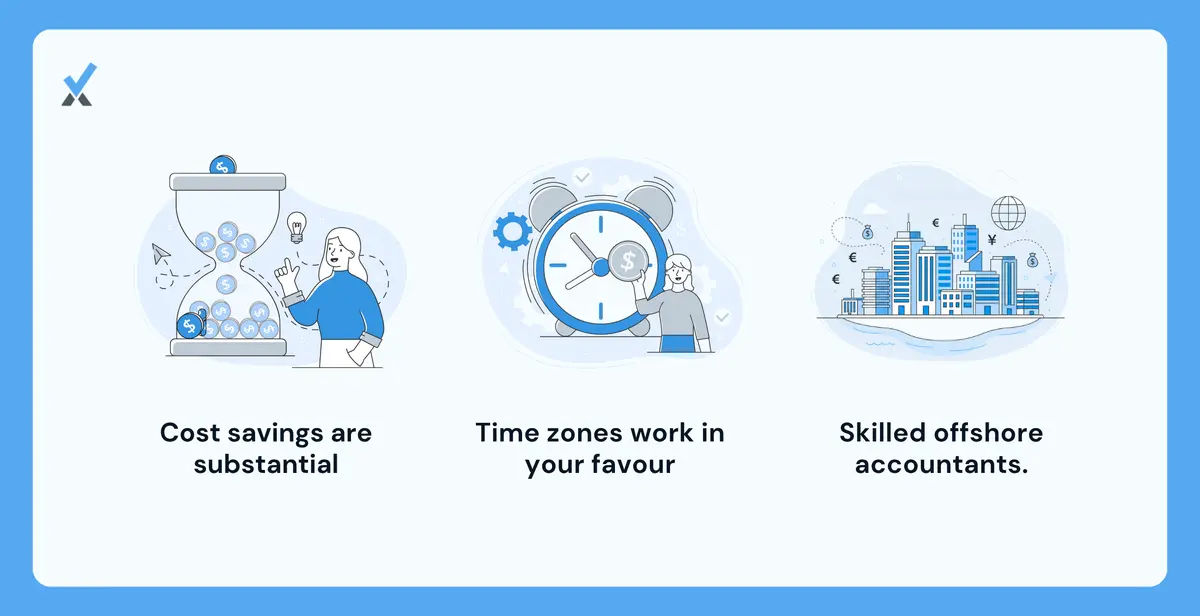
Offshore bookkeeping services are typically companies based in India, the Philippines, or Eastern Europe that handle a firm's financial records remotely. These firms employ accountants who manage everything from transaction categorization to financial statement preparation from outside the client's home country.
The appeal is obvious. Labor costs in these regions are significantly lower than domestic rates. Consulting firms are typically looking at potential savings of 40 to 60 percent compared with the best outsourced bookkeeping services based in the U.S. For a firm running on tight margins, that is real money back in the budget.
But before signing a contract with any offshore bookkeeping services provider, a firm needs to understand what it is really getting into.
What are the real advantages of offshore bookkeeping services?
Offshore outsourcing bookkeeping is not something to dismiss outright. For some businesses, these services work perfectly fine. The benefits are real.
Cost savings are substantial. A firm spending $3,000 monthly on bookkeeping could cut that to $1,200 with offshore bookkeeping services. That is $21,600 annually that could go toward marketing, hiring a project manager, or finally upgrading a CRM system.
Time zones work in a firm's favor. When a founder closes the laptop at 6 PM, the offshore team is just starting its day. Send a file before bed, wake up to completed work. Many consulting firms using offshore bookkeeping services appreciate this around-the-clock workflow.
For firms chasing time back rather than just a lower invoice, it is worth comparing offshore teams against finance and accounting outsourcing services that give founders their time back.
Many offshore firms have talented, educated accountants. Impeccable work comes out of overseas bookkeeping teams routinely. They are often working with the same software U.S. firms use, following the same accounting standards, and bringing genuine expertise to the table. The best outsourced bookkeeping services, regardless of location, share one thing in common: skilled professionals who understand the numbers.
So why does not everyone switch to offshore outsourcing bookkeeping?
What are the hidden costs of offshore bookkeeping services?
Here is where things get complicated, and expensive. Communication becomes an Olympic event: not just time zones, but language nuances, cultural differences in business communication, and the fact that a quick five-minute clarification now requires scheduling across three time zones and waiting 12 hours for a response.
One consulting firm owner spent more time explaining the business model to an offshore bookkeeping services provider than it would have taken to do the books directly. Six months in, basic errors were still happening because the context never quite clicked. This is where offshore outsourcing bookkeeping shows its limitations.
The same dynamic shows up in AP processes too, which is why so many firms turn to accounts payable outsourcing companies to eliminate manual AP workflows instead of adding yet another communication bottleneck.
Client data is crossing borders. This is the big one. Consulting clients trust their firm with sensitive information: project details, financials, strategic plans. That data now sits on servers in another country, possibly subject to different privacy laws and regulations.
Consider explaining to the firm's biggest client that confidential information is stored securely, while working with an offshore bookkeeping services provider whose exact server location and access controls are unclear.
Quality control becomes a second job. The hourly rate is lower with offshore outsourcing bookkeeping, but spending 10 hours monthly reviewing work, catching errors, and re-explaining business processes effectively creates an unpaid bookkeeping supervisor role. That is not scalability. That is a headache with a discount.
How does security compare between offshore and domestic bookkeeping services?
SOC 2 compliance is the standard worth understanding first. In simple terms, it is a certification that proves a company has rigorous controls around data security, availability, processing integrity, confidentiality, and privacy.
Most reputable domestic providers ranked among the best outsourced bookkeeping services carry SOC 2 certification. It is not optional. It is the baseline for handling client financial data today.
Many offshore bookkeeping services do not carry it, or claim they do, but their version of secure does not match U.S. standards once the details get examined. This creates a significant gap when comparing offshore outsourcing bookkeeping to domestic alternatives.
Here is what should raise concern: one data breach, one leaked client file, one security incident traced back to an offshore bookkeeping services provider, and the firm's own reputation takes the hit, not the provider's.
Clients hire a firm because they trust it. That trust evaporates fast when their financial information ends up compromised.
Why are the best outsourced bookkeeping services often domestic?
Firms trying to scale often look at the expense sheet and assume costs need to be cut somewhere. But talking to dozens of consulting firm owners reveals a pattern: the best outsourced bookkeeping services are not the cheapest. They become true partners in growth.
A few factors matter most when comparing offshore bookkeeping services to domestic providers.
Domestic providers understand the business environment. They know U.S. tax law inside out, understand the compliance landscape for consulting firms, and have seen the exact business model before, along with the financial pitfalls firms are trying to avoid. This expertise is what separates the best outsourced bookkeeping services from budget alternatives.
Communication happens in real time. A phone call at 2 PM on a Wednesday about cash flow projections gets answered by a domestic bookkeeper directly. No email chains, no overnight waiting, just immediate support from someone who understands the account. This responsiveness is rarely found with offshore outsourcing bookkeeping.
Security is not negotiable. The best outsourced bookkeeping services build their entire business around SOC 2 compliance, bank-level encryption, and data protection that meets or exceeds industry standards. Client data stays protected and the firm's reputation remains intact. This level of security often is not guaranteed with offshore bookkeeping services.
They scale with the firm. As a consulting firm grows from 15 to 30 to 50 employees, bookkeeping needs evolve. Domestic providers who specialize in professional services firms know exactly what that growth path looks like and are ready to expand services and integrate new systems before the need becomes urgent.
For firms evaluating options, this breakdown of the best accounting outsourcing companies for service firms, and what best actually means helps clarify the difference between a vendor and a true scaling partner.
How should a firm choose between offshore and domestic bookkeeping services?
Should a consulting firm leap into offshore bookkeeping services? Maybe. If needs are simple, the data is not sensitive, and there is time to manage communication challenges, the cost savings from offshore outsourcing bookkeeping might be worth it.
But for a firm where client trust is everything, where reputation depends on confidentiality, and where the need is for a finance partner that can scale without constant hand-holding, the best outsourced bookkeeping services are often worth the premium price.
The real purchase when evaluating offshore bookkeeping services versus domestic alternatives is not just bookkeeping hours. It is a partner who protects the firm's stability while it scales, one that understands the difference between cutting costs and cutting corners.
The cheapest offshore bookkeeping services are not always the smartest choice, not when a firm's future is on the line.
| Offshore bookkeeping services | Domestic bookkeeping services | |
|---|---|---|
| Typical monthly cost | 40 to 60 percent lower | Higher, but often bundled with advisory support |
| SOC 2 certification | Uncommon | Standard among reputable providers |
| Response time | Often 12+ hours across time zones | Same business day, often same hour |
| Data location and privacy law | Varies, subject to foreign regulation | U.S. based, U.S. regulation |
| Quality review time needed | 10+ hours monthly, common | Minimal, built into the service |
| Scalability with firm growth | Depends heavily on the individual provider | Built for growth from 15 to 50+ employees |
Before committing to offshore outsourcing bookkeeping, the real question is whether a firm can afford the cost of getting it wrong. In consulting, trust is everything, and once it is gone, no amount of cost savings brings it back.
Do offshore bookkeeping services ever make sense for a consulting firm?
They can work well for firms with simple, low-sensitivity data and the internal bandwidth to manage time zone gaps and quality review. Straightforward transactional bookkeeping with minimal client-confidential detail is the best fit. Complex engagements involving proprietary client strategy or regulated data are a poorer match for offshore delivery.
What questions should a firm ask an offshore bookkeeping provider before signing?
Ask for proof of SOC 2 or equivalent certification, where data is physically stored, average response time to urgent requests, and references from firms of similar size. A provider that cannot answer these clearly in writing is not ready to handle sensitive financial data.
How much does switching from offshore back to domestic bookkeeping typically cost?
Transition costs mostly show up as time, not fees: rebuilding chart of accounts context, reconciling any backlog, and onboarding a new team typically takes 2 to 4 weeks. Most domestic providers absorb setup at no extra charge as part of onboarding.
The right partner does not just manage the books. It protects everything a firm has built, which is the standard Numetix holds itself to under an expert-led, AI-powered, human-in-the-loop model.
See how domestic bookkeeping services compare, or explore the full bookkeeping glossary entry to understand exactly what should be included in a scalable finance partnership.
Numetix is an AI-first accounting firm. AI runs the bookkeeping, tax, payroll, and reporting workflow. Industry experts handle the judgment, month-end close, review, and advisory. We serve founder-led service firms across law, consulting, IT, healthcare, creative, and nonprofit. Headquartered in California, serving clients nationwide.
Suggested Readings
What CO-197 denial code means (authorization absent)
What CO-50 denial code means (medical necessity)
Cause marketing and commercial co-ventures explained
See what Numetix can do for you
Learn how the Numetix Portal streamlines communication, offers valuable insights, and saves you time so you can focus on growing your business.