Multi-location accounting: How to keep one clean set of books when your service firm spans 2 or more offices
Key Takeaways
Each office naturally becomes its own accounting silo, separate bank accounts, different expense coding, unless a firm deliberately builds one unified structure across locations.
Tagging every office to one shared chart of accounts, rather than giving each location separate accounts, is what allows both consolidated and location-level reporting from the same data.
Transaction entry can stay local, but processing, review, and reconciliation should be centralized to keep coding standards consistent across every office.
Undocumented intercompany transactions, cash moving between offices or one office covering another's expense, are where multi-location books most commonly break down.
Not every local difference needs standardizing; expense submission timing can vary by office as long as it does not affect month-end consolidation.
Firms with the cleanest multi-location books built the structure before opening a second office, not after fragmentation had already set in.
Multi-location accounting: How to keep one clean set of books when a service firm spans 2 or more offices
Quick Answer
Multi-location accounting stays clean when every office is tagged by location within one shared chart of accounts instead of running separate books per site, entry stays local but processing and reconciliation get centralized, and intercompany transactions follow documented protocols instead of ad hoc handling. Consolidated and location-level reports then draw from the same data set automatically. Retrofitting this after offices have already fragmented takes effort, but it is achievable.
A consulting firm started in one city. Then a second office opened to serve a regional client base. Then a third to expand into a new market. The growth is exactly what was wanted. The accounting chaos is not.
Each office has its own bank account. Expenses hit different credit cards. Some team members are on one payroll run, others on another. When month-end arrives, consolidating the books requires a week of reconciliation. The numbers from each location do not match, and nobody can explain why.
One business should mean one clean set of books. Multi-location accounting makes that possible, but only if the structure is designed intentionally rather than assembled accidentally.
Why does geographic expansion naturally fragment accounting?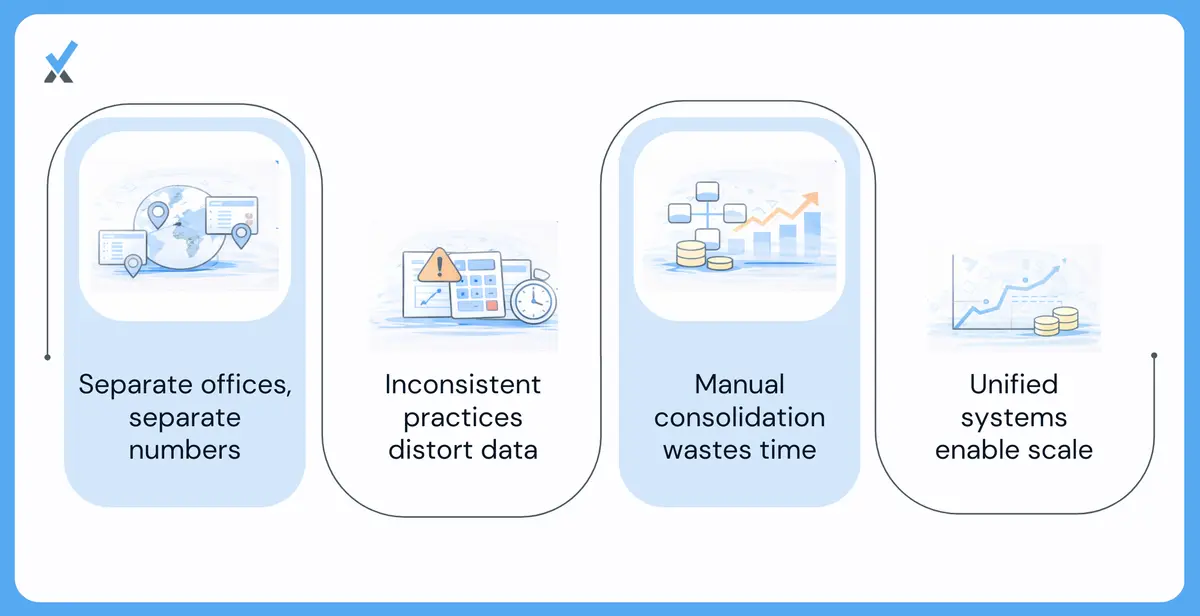
The fragmentation is not a failure of the team. It is the natural result of growth without infrastructure built to account for it. Multi-location business finances drift apart unless something holds them together.
-
Each location generates separate financial streams. Office A has a bank account with deposits from regional clients and expenses for local operations. Office B has a different bank account with different clients and different expenses. Each location is a separate business from an accounting perspective, even though they share a single legal entity, P&L, and tax return.
Without intentional structure, these streams stay separate. They are reconciled, reviewed, and reported separately. Combining them into a single view requires manual consolidation, which is time-consuming and error-prone.
-
Local autonomy creates inconsistent practices. The office manager at one location codes travel expenses one way. The office manager at another location codes them differently. One office submits expense reports weekly. Another submits monthly. One location uses the corporate credit card for everything. Another uses personal cards and reimbursements.
These variations seem minor individually. Collectively, they make consolidated reporting unreliable. The same type of expense appears in different accounts depending on which office incurred it. Comparisons between locations become meaningless because the data is not consistent.
-
Consolidation becomes a manual reconciliation project. Without a unified structure, the month-end close for a multi-location firm means pulling data from multiple sources, reformatting it to match, reconciling intercompany transactions, and manually building consolidated statements. This process can take days and introduces errors at every step.
The firms that struggle most with geographic expansion accounting are those that treat each new office as a separate accounting problem rather than an extension of one unified system.
What structural elements does unified multi-location accounting actually require?
Multi-office bookkeeping that produces one clean set of books requires intentional design. Four structural elements make multi-location accounting work.
-
A single chart of accounts with a location dimension. All locations should use the same chart of accounts. Revenue is recorded in the same revenue accounts. Expenses use the same expense categories. The structure is identical regardless of which office generated the transaction.
Location tracking happens through a dimension, class, or department code rather than through separate accounts. Office A's office supplies and Office B's office supplies both go to the same Office Supplies account, tagged with a location identifier. This structure allows consolidated reporting (total office supplies across all locations) and location reporting (office supplies for each location) from the same data.
-
Centralized processing with distributed input. Transaction entry can happen locally. The office manager who approves an expense can code it and enter it in the system. But the processing, review, and reconciliation should be centralized.
Centralized processing ensures consistency. One team applies the same coding standards across all locations. One review process catches errors regardless of where they originated. One reconciliation confirms that all locations balance to their bank accounts and to each other.
Distributed team accounting works when local staff handles input and central staff handles control. The reverse, where each location processes its own accounting independently, creates the fragmentation firms are trying to avoid.
-
Clear intercompany transaction protocols. When one office incurs an expense that benefits another, or when cash moves between location bank accounts, intercompany transactions occur. Without clear protocols, these transactions create reconciliation nightmares.
Defining how intercompany transactions get recorded matters: does the paying office book an expense, and the receiving office book a reduction? Does a cash transfer require matching entries on both sides? Who initiates the entry, and who confirms it? The specific answers matter less than having documented answers that everyone follows.
Intercompany transactions are where multi-location accounting most commonly breaks. Clear protocols prevent the "I thought you recorded it" errors that make consolidation impossible.
-
Consolidated and location-level reporting. The reporting structure should serve both corporate and location needs. Corporate management needs consolidated financial statements covering the entire firm. Location managers need location-level reports showing their office performance.
Both views should be based on the same data: consolidated reports sum across the location dimension, location reports filter to a single location. The numbers reconcile automatically because they draw from a single unified data set rather than separate books that are manually combined.
How should implementation balance central control with local flexibility?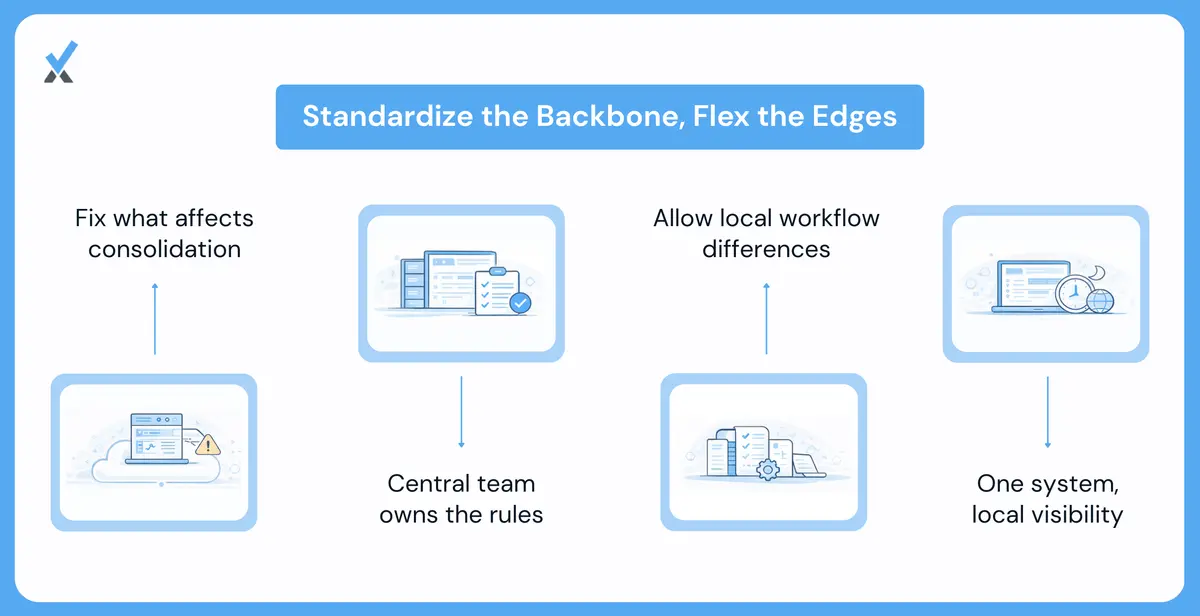
Building unified multi-location accounting requires balancing standardization with practical flexibility.
-
Standardize what must be consistent. The chart of accounts structure must be identical. Coding conventions must be uniform. Intercompany protocols must be documented and followed. These elements are non-negotiable because inconsistency here breaks consolidation.
The centralized team owns these standards. When a new expense category is needed, the central team adds it to the chart of accounts for all locations. When a coding question arises, the central team provides the answer that all locations follow.
-
Allow local variation where it does not affect consolidation. Some local variation is harmless. If one office submits expenses daily and another submits weekly, the consolidated books are unaffected as long as both submit before month-end. If one office uses a corporate card and another uses reimbursements, the accounting treatment can accommodate both as long as both follow the same coding standards.
Forcing unnecessary uniformity creates friction without benefit. Standardization should focus on what affects financial accuracy and reporting consistency, with flexibility allowed elsewhere.
-
Build visibility that serves both corporate and location needs. Location managers need to see their numbers to manage their operations, with visibility into their revenue, expenses, and profitability without waiting for corporate to produce reports.
Self-service reporting by location gives local managers the information they need while keeping data in a single, unified system. They see their slice of the books without a separate set being created.
Why does one business deserve one set of books?
A firm is one legal entity, one tax return, one business. The accounting should reflect that unity even as operations span multiple locations.
Multi-location accounting is no more difficult than accounting generally. It is accounting with an additional dimension. Every transaction has a location tag. Reports can show the whole or the parts. Consolidation happens automatically because there is only one data set to begin with.
The firms that maintain clean books across multiple offices built the structure before expansion outpaced it, not after fragmentation had already set in. They use a single chart of accounts, centralized processing, documented intercompany protocols, and reporting from a unified data source, delivered with the same expert-led, AI-powered, human-in-the-loop discipline behind every close.
If the books are already fragmented, unification is possible but requires intentional effort: consolidate to one chart of accounts, centralize processing responsibility, clean up intercompany transactions, and build the structure that should have been there from the start.
Geographic expansion should add revenue and capability. It should not add accounting chaos. The structure that keeps one clean set of books exists. The only question is whether it gets built proactively or retrofitted after fragmentation has already created confusion.
| Element | Standardize centrally | Can vary locally |
|---|---|---|
| Chart of accounts | Yes, identical across all offices | No |
| Coding conventions | Yes, uniform rules | No |
| Expense submission timing | No | Yes, as long as it clears before month-end |
| Payment method (card vs. reimbursement) | No | Yes, as long as coding stays consistent |
| Intercompany transaction protocol | Yes, documented and followed by all | No |
How long does it typically take to unify a fragmented multi-location set of books?
For two or three offices, consolidating to a single chart of accounts and centralizing processing typically takes 4 to 8 weeks, most of it spent mapping each office's existing coding to the unified structure. Cleaning up historical intercompany discrepancies can extend that timeline depending on how far back the fragmentation goes.
Does each office need its own separate bank account?
Not necessarily, and fewer accounts generally simplify reconciliation. Some firms keep local accounts for practical reasons like local vendor relationships or regional banking requirements, which is fine as long as every account rolls up into the same chart of accounts and location-tagging structure.
What is the biggest mistake firms make when opening a second location's books?
Letting the new office set up its own accounting independently, often with a different chart of accounts or coding approach, because it feels faster in the moment. That shortcut is exactly what creates the manual consolidation project the structure was supposed to prevent.
One business, one clean set of books, even across multiple offices. The structure exists. The only question is whether it gets built before expansion, or retrofitted after.
See how Numetix accounting services handle multi-location consolidation, built for professional services firms specifically.
Numetix is an AI-first accounting firm. AI runs the bookkeeping, tax, payroll, and reporting workflow. Industry experts handle the judgment, month-end close, review, and advisory. We serve founder-led service firms across law, consulting, IT, healthcare, creative, and nonprofit. Headquartered in California, serving clients nationwide.
Suggested Readings
Which accounting firms specialize in dental practices?
Nonprofit revenue recognition: grants vs contributions vs exchange transactions
How often do IOLTA trust accounts need to be reconciled?
See what Numetix can do for you
Learn how the Numetix Portal streamlines communication, offers valuable insights, and saves you time so you can focus on growing your business.