Form 1041: A guide to trust and estate income tax returns
Key Takeaways
A trust or estate must file Form 1041 once gross income reaches $600, a threshold low enough that most income-producing entities need to file.
The gap between trust and individual tax brackets is stark: a trust hits the 37 percent top rate at a tiny fraction of what an individual filer would need to earn.
A trust that distributes income up to its Distributable Net Income shifts the tax liability to beneficiaries, who then report it on their own returns.
Income passed through on a Schedule K-1 keeps its original character, so qualified dividends stay qualified dividends on the beneficiary's personal return.
Simple trusts get a $300 exemption for distributing all income currently; complex trusts, which can accumulate income, get only $100.
Capital gains default to being taxed at the trust level rather than passed through to beneficiaries, unless the governing document or state law says otherwise.
Form 1041: A guide to trust and estate income tax returns
Quick Answer
Form 1041 is the fiduciary return trusts and estates file once gross income reaches $600, and it hinges on Distributable Net Income: distributions up to DNI shift the tax liability to beneficiaries via Schedule K-1, while retained income gets taxed at the trust's own rate. That matters because the trust tax brackets are dramatically more compressed than individual brackets, making distribution decisions the central tax planning question for most trustees rather than an afterthought.
Being named trustee of a family trust, or executor of a deceased relative's estate, often comes with an entity that owns investments, rental property, or business interests generating income. Taxes are clearly owed, but exactly how trust and estate taxation works is less clear.
The answer is Form 1041, the fiduciary return that trusts and estates file to report income. Unlike individual returns, fiduciary returns involve decisions about whether income is taxed at the entity level or passed through to beneficiaries. Those decisions affect both how much tax is owed and who pays it.
Understanding the 1041 instructions helps trustees and executors fulfill their tax obligations correctly and avoid the costly compressed tax rates that apply to trusts retaining income.
When is a trust or estate actually required to file Form 1041?
Not every trust or estate needs to file Form 1041. The filing threshold depends on income levels and entity type.
The basic threshold is $600 in gross income. If a trust or estate has gross income of $600 or more during the tax year, a fiduciary return is required. Gross income includes interest, dividends, rents, capital gains, and any other income the entity received. This threshold is low enough that most income-producing trusts and estates will need to file.
Any taxable income also triggers filing. Even if gross income is below $600, having any taxable income requires a return. This catches situations where deductions are minimal and net income exists despite low gross amounts.
Different trust types have specific rules. Revocable trusts typically do not file Form 1041 during the grantor's lifetime because all income is reported on the grantor's personal return. After the grantor's death, the trust becomes irrevocable and begins filing its own returns. Irrevocable trusts file Form 1041 from inception if they meet income thresholds.
Estates file during administration. An estate exists as a separate tax entity from the date of death until assets are fully distributed to beneficiaries. During this administration period, the estate files Form 1041 for any year it has sufficient income. Estate income tax obligations can span multiple tax years for complex estates.
Filing deadlines depend on the tax year. Trusts generally must use a calendar year and file by April 15. Estates can elect a fiscal year ending in any month, which can provide tax planning flexibility. The return is due on the 15th day of the fourth month after the tax year ends.
How do distributions determine who actually pays the tax?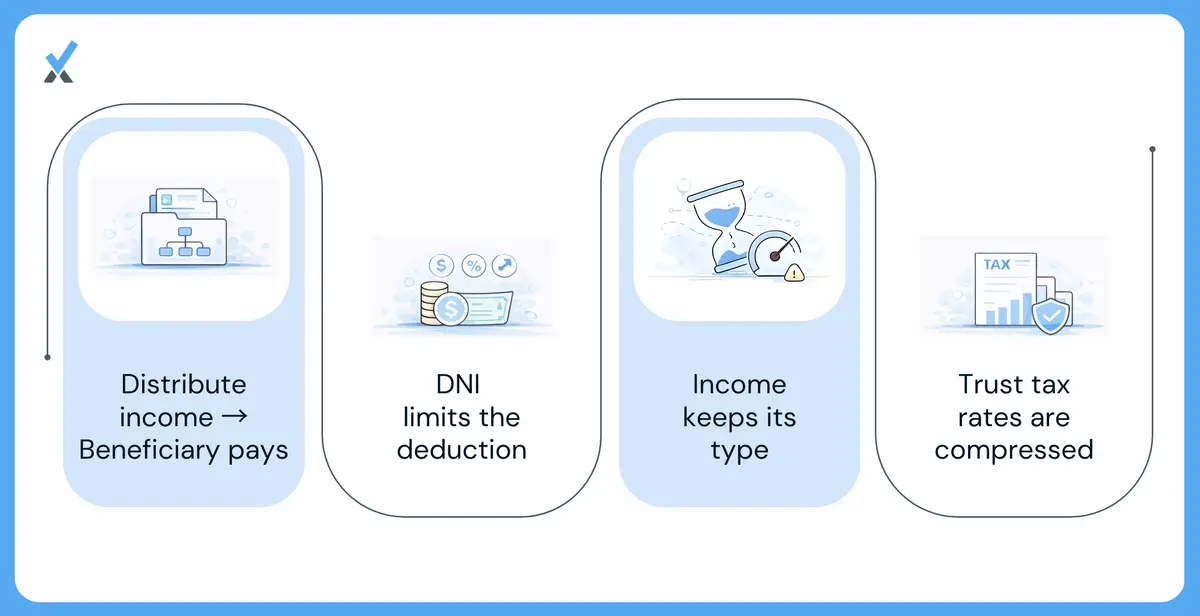
Here is the critical concept for trust tax return preparation: trusts and estates can deduct distributions made to beneficiaries, shifting the tax liability from the entity to the recipients.
-
Distributable Net Income (DNI) governs this calculation. DNI is a tax concept that limits the amount of income a trust can shift to beneficiaries through the distribution deduction. It roughly equals the trust's taxable income, with certain adjustments, including adding back the personal exemption and excluding capital gains allocated to the corpus.
When a trust distributes cash or property to beneficiaries, it deducts those distributions up to the amount of DNI. The beneficiaries then report that income on their personal returns. If the trust retains income rather than distributing it, it pays tax on the retained income.
-
Trust beneficiary taxation follows the K-1. Beneficiaries receive Schedule K-1 from the trust showing their share of distributed income. This income retains its character when it flows through. Qualified dividends distributed to a beneficiary remain qualified dividends on their personal return. Capital gains retain their character as capital gains. This preservation of character can benefit beneficiaries who have preferential rates for certain income types.
-
Trust rates create strong incentives to distribute. Trusts and estates reach the highest marginal tax rate (37%) at just $15,200 of taxable income for 2024. By comparison, individuals do not hit the top bracket until income exceeds $609,350. This compressed rate structure means income retained in a trust is often taxed more heavily than the same income distributed to beneficiaries in lower brackets.
A trust with $50,000 of taxable income pays significantly more tax if it retains that income than if it distributes it to a beneficiary in the 22% or 24% bracket. This rate differential drives much of the planning around trust income distribution.
What do the key schedules on Form 1041 actually calculate?
The fiduciary return has several sections that work together to calculate tax liability and allocate income to beneficiaries.
Page 1 calculates total income and deductions. Like an individual return, Form 1041 starts with income categories: interest, dividends, capital gains, rents, and business income. Deductions for expenses, including trustee fees, tax preparation costs, and charitable contributions, reduce gross income.
-
Schedule B calculates DNI and the distribution deduction. This is where the mechanics of trust income distribution happen. Schedule B computes distributable net income, determines how much was actually distributed, and calculates the deduction the trust claims for those distributions. The deduction cannot exceed DNI or actual distributions.
If a trust has $100,000 in DNI and distributes $80,000, the distribution deduction is $80,000. The remaining $20,000 stays in the trust and is taxed at trust rates.
Schedule K-1 reports beneficiary allocations. Each beneficiary who receives a distribution receives a Schedule K-1 showing their share of trust income. The K-1 breaks down income by type so beneficiaries can report it correctly on their personal returns. Beneficiaries need this form to file their own taxes.
Simple trusts versus complex trusts matter. Simple trusts must distribute all income currently, have no charitable beneficiaries, and make no principal distributions. They get a $300 exemption. Complex trusts can accumulate income, make charitable distributions, or distribute principal. They get only a $100 exemption. The trust type affects both the exemption amount and required distribution behavior.
What common issues come up in trust tax return preparation?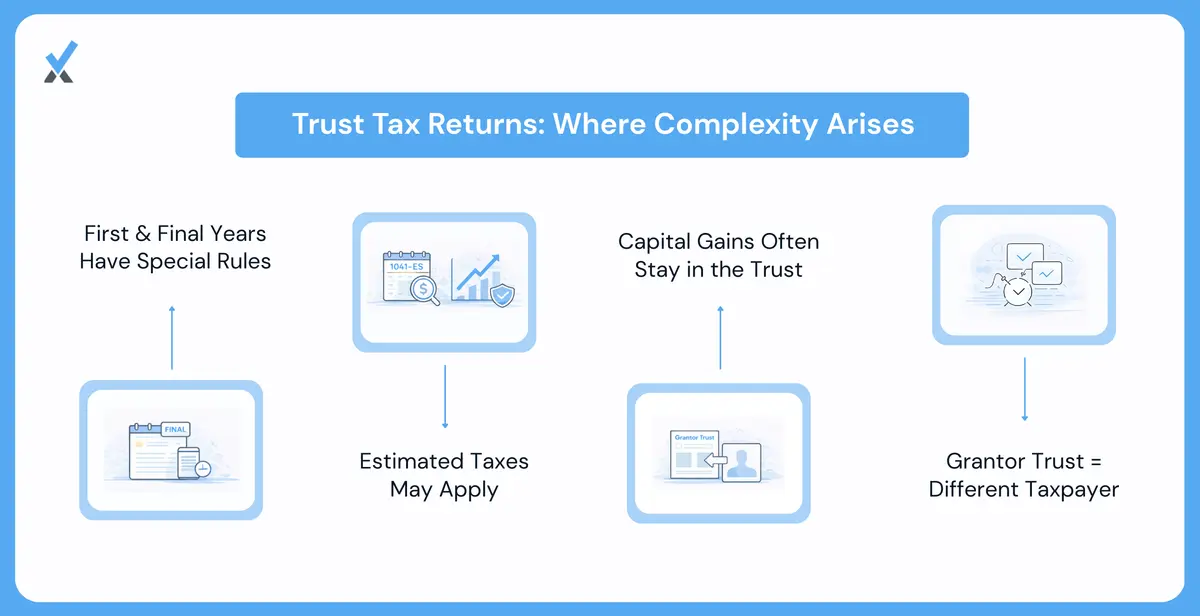
Certain situations create complexity in fiduciary returns that trustees should watch for.
First-year and final-year returns have special rules. An estate's first tax year begins on the date of death. A trust's final year requires careful handling of unused deductions and losses, which may pass through to beneficiaries. Timing distributions around year-end affects which year the income is taxed.
Estimated tax payments may be required. Trusts and estates must make quarterly estimated tax payments if they expect to owe $1,000 or more. Alternatively, trusts can elect to treat distributions to beneficiaries as made on the last day of the tax year, allowing beneficiaries to include the income on their returns and pay the tax.
Capital gains treatment requires attention. By default, capital gains are allocated to the corpus (principal) and taxed at the trust level rather than being passed through to beneficiaries. The governing document or state law may allow different treatment. Understanding how a specific trust handles capital gains affects both the trust and the beneficiary's taxes.
Grantor trust rules override normal taxation. If a trust is a grantor trust for tax purposes, all income is reported on the grantor's personal return, and Form 1041 may be filed only for informational purposes. Identifying grantor trust status is an essential first step before preparing a fiduciary return.
How far does fiduciary duty extend into tax compliance?
Trustees and executors have a fiduciary responsibility to manage trust and estate assets prudently, including tax compliance. Filing Form 1041 correctly, making appropriate distribution decisions, and providing accurate K-1s to beneficiaries are all part of that duty.
The compressed tax rates on trusts mean that tax planning around distributions is mandatory. Retaining income in a trust when it could be distributed to lower-bracket beneficiaries wastes money that belongs to those beneficiaries.
Understanding the 1041 instructions is the foundation. For complex trusts, estates with significant assets, or situations involving multiple beneficiaries with different circumstances, professional trust tax return preparation, backed by an expert-led, AI-powered, human-in-the-loop process, ensures compliance while optimizing the tax outcome for everyone involved.
| Requirement | Simple trust | Complex trust |
|---|---|---|
| Income distribution | Must distribute all income currently | Can accumulate income |
| Charitable beneficiaries | Not allowed | Allowed |
| Principal distributions | Not allowed | Allowed |
| Exemption amount | $300 | $100 |
Does a small family trust with modest investment income really need a separate tax preparer?
Often yes, since Form 1041 involves DNI calculations, K-1 preparation, and distribution deduction rules that differ meaningfully from an individual return, even for a trust with straightforward holdings. The compressed trust brackets also mean small preparation mistakes on distribution timing can carry a real tax cost.
What happens if a trustee misses the Form 1041 filing deadline?
Late filing typically triggers a penalty based on unpaid tax and how late the return is, similar to individual return penalties, plus interest on any tax due. An extension can be filed before the deadline to avoid the late-filing penalty, though any tax owed is still due by the original date to avoid late-payment penalties and interest.
Can a trustee change how capital gains are allocated after the trust is already established?
Sometimes, depending on the governing document and state law. Some states allow a trustee discretion to allocate capital gains to income rather than corpus under certain circumstances, but this typically requires specific authority in the trust document or a formal state-law provision, not just a preference at tax time.
Compressed trust tax rates make distribution decisions the central question of fiduciary tax compliance, not an afterthought.
See how Numetix tax services handle fiduciary returns, built for professional services firms specifically.
Numetix is an AI-first accounting firm. AI runs the bookkeeping, tax, payroll, and reporting workflow. Industry experts handle the judgment, month-end close, review, and advisory. We serve founder-led service firms across law, consulting, IT, healthcare, creative, and nonprofit. Headquartered in California, serving clients nationwide.
Suggested Readings
Missed the September 15 tax deadline: What happens next and how to reduce the penalty
September 15 tax deadline 2026: What small business owners need to file or pay today
Medical practice 1099 filing: Managing contractor clinicians without year-end chaos
See what Numetix can do for you
Learn how the Numetix Portal streamlines communication, offers valuable insights, and saves you time so you can focus on growing your business.