Why tax preparation is a bill but tax planning is a payday
Key Takeaways
Tax preparation reports what already happened; tax planning shapes what happens before the numbers get locked in for the return.
By February or March, the books are closed and the transactions are recorded, so a preparer can find missed deductions but cannot restructure decisions already made.
An S-corp election, when appropriate, can reduce self-employment tax by $15,000 to $25,000 a year, but only if made before the deadline, not retroactively.
Hiring decisions, equipment purchases, and how compensation gets structured all carry tax consequences that go unmanaged without a forward-looking process.
Retirement contributions and the timing of major purchases can move deductions into years where a firm's tax bracket makes them worth more.
Many CPAs and fractional CFOs already offer planning alongside preparation; the real question is whether they get used for it year-round.
Why tax preparation is a bill but tax planning is a payday
Quick Answer
Tax preparation is backward-looking: it reports what already happened, but by the time a preparer sees the numbers in February or March, every decision is already locked in. Tax planning is forward-looking, addressing entity structure, expense timing, and retirement contributions while choices still exist, often saving thousands of dollars a year through strategies like an S-corp election. Preparation prevents bad outcomes; planning creates good ones, and only works before the year closes.
Every April, receipts get gathered, bank statements downloaded, and everything sent to a CPA. A few weeks later, the tax return comes back. It gets signed, the bill gets paid, and the year moves on.
Sound familiar?
If this describes a firm's approach to taxes, that firm is doing tax preparation. And tax preparation is necessary. But it is only half the picture.
The other half is tax planning. And that is where professional service firm owners leave real money on the table.
What is the actual difference between tax preparation and tax planning?
These two terms get used interchangeably, but they describe entirely different activities with different goals. Understanding what each one actually does is the first step to getting more from a tax strategy.
Tax preparation is backward-looking compliance
Tax preparation starts after the fiscal year ends. A CPA or accountant collects the financial records, categorizes everything correctly, calculates what is owed, and files the required forms with the IRS and state agencies.
This work is essential. Filed incorrectly, returns trigger audits, penalties, and interest charges. A good tax preparer ensures accuracy and compliance.
But here is what tax preparation cannot do: change anything. By the time a return is being prepared, every decision has been made. Every expense has been recorded. Every dollar of revenue has been earned. The preparer's job is to report what happened, not to influence what happens.
Tax planning is a forward-looking strategy
Tax planning operates on a completely different timeline. Instead of looking backward at completed transactions, it looks forward at upcoming decisions and asks: how can this be structured to minimize tax impact?
Consider these questions:
Should an equipment purchase happen in December or January?
Would an S-corp election reduce self-employment tax burden?
Should expenses accelerate this year or should income defer to next year?
How should contractor payments be structured versus employee compensation?
Tax preparation cannot answer these questions because it arrives too late. Tax planning addresses them while choices still exist.
Why does timing determine what is actually possible?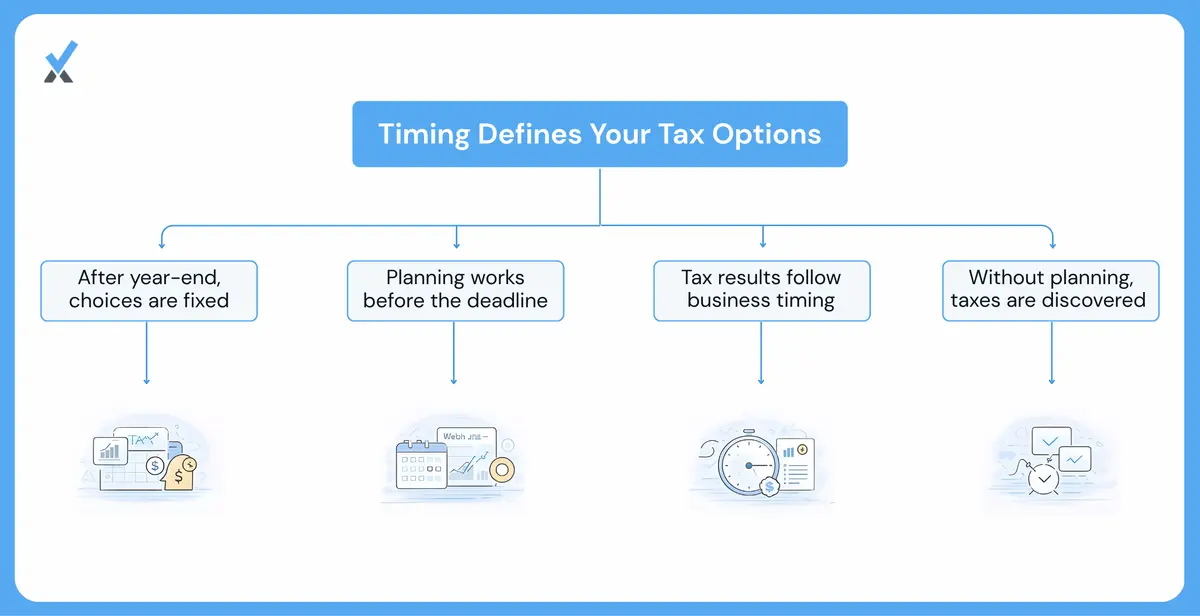
The difference between these two approaches is not just philosophical. It is practical. And timing explains why.
Year-end leaves few options on the table
By the time a firm sits down with its tax preparer in February or March, the year is already closed. The books are finalized. The transactions are recorded. A preparer might find a few deductions that were missed, but cannot restructure decisions already made.
This is like showing up at the airport and asking for a cheaper flight after boarding. The time for price comparison was before the ticket was bought.
Most tax preparers do excellent work within these constraints. But the constraints are real. They are working with fixed inputs to produce an accurate output.
Year-round planning creates opportunities
Tax planning happens in real time, throughout the year. It is a June conversation about whether to take a bonus now or wait until next quarter. It is a September analysis of whether accelerating a significant expense makes sense given projected income. It is an October decision about retirement contributions before December 31.
Each of these decisions shifts numbers on the eventual tax return. But only if they get made before the year ends.
Professional service firm owners make dozens of financially significant decisions each year: hiring, purchasing equipment, taking on new clients, investing in marketing, and setting their own compensation. Every one of these has tax implications. Without year-round planning, those implications get discovered, not managed.
How does the financial impact actually differ between the two?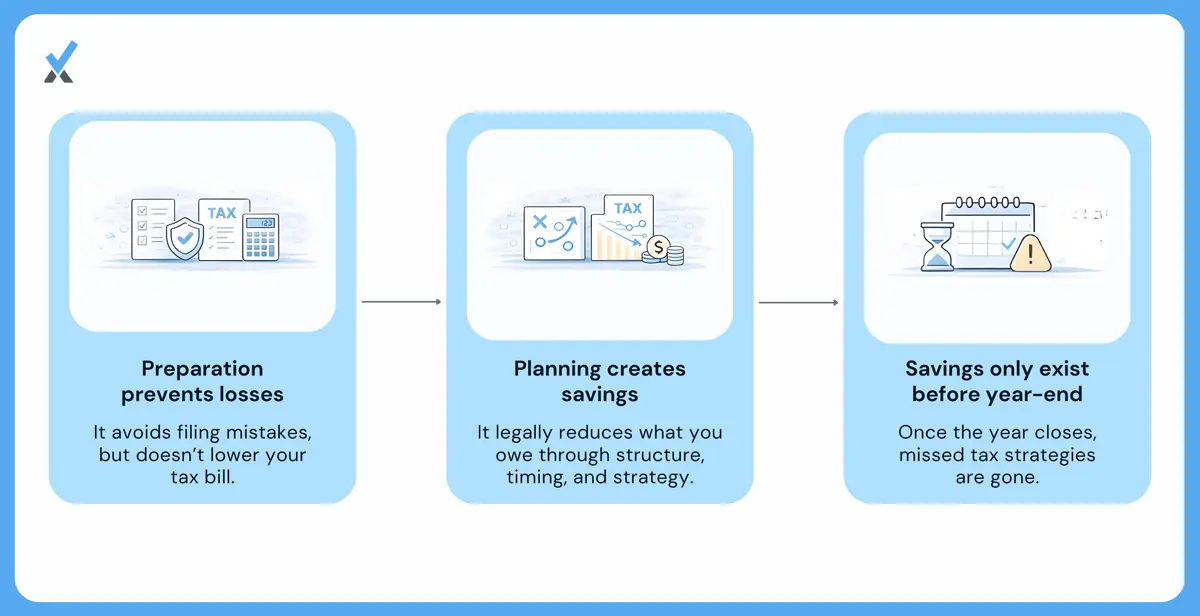
Both tax preparation and tax planning have value. But the value they deliver is fundamentally different.
Preparation ensures accurate filing
Good tax preparation prevents problems. Accurate returns mean no penalties for underpayment. Proper documentation means lower audit risk. Timely filing means no late fees or interest charges.
This is real value. The cost of mistakes can be high. But the value of preparation is defensive. It prevents bad outcomes rather than creating good ones.
Planning reduces what actually gets owed
Tax planning creates positive outcomes. It identifies legal strategies to minimize tax liability before it is locked in.
Here is what that looks like in practice:
A consulting firm owner earning $400,000 in net income might pay $60,000 or more in self-employment taxes alone under a standard sole proprietorship structure. An S-corp election, when appropriate, can reduce that burden by $15,000 to $25,000 annually. But that election cannot be made retroactively. It requires planning.
Similarly, timing major purchases or investments can shift deductions into higher-income years where they deliver more value. Contributing to retirement accounts before year-end reduces current taxable income. Choosing the right entity structure, depreciation approach, or compensation mix compounds over the years.
None of these strategies is available through tax preparation alone. They require someone looking forward, not backward.
What does this mean for a firm?
Most professional service firm owners have a tax preparer. Far fewer have a tax planning process.
The preparer gets the forms filed correctly. That matters. But without planning, a firm is accepting whatever tax bill results from decisions made without tax considerations in mind.
A simple test: when was the last conversation about taxes that did not involve completing a return? If the answer is "never" or "cannot remember," that firm is preparing without planning.
Tax planning does not require a separate provider. Many CPAs and fractional CFOs offer both services. The question is whether they get engaged throughout the year or only at tax time.
The firms that treat taxes as a year-round strategic conversation, run with an expert-led, AI-powered, human-in-the-loop process, pay less than firms that treat taxes as an annual compliance event. Same rules. Same IRS. Different outcomes.
Tax preparation files the forms. Tax planning shapes what goes on them.
| Dimension | Tax preparation | Tax planning |
|---|---|---|
| Timing | After the year closes | Throughout the year |
| Purpose | Report what already happened | Shape what happens next |
| Example actions | Categorize records, file forms | Entity election, expense timing, retirement contributions |
| Value type | Defensive, avoids penalties | Active, reduces what is owed |
How far in advance should tax planning conversations start before year-end?
Ideally planning runs year-round rather than clustering at year-end, but if starting fresh, the fall, September through November, is the latest realistic window for decisions like entity elections, retirement contributions, and equipment purchase timing to still take effect for the current year.
Does a bookkeeper's clean monthly data actually matter for tax planning?
Yes, significantly. Tax planning decisions depend on knowing current-year income and expenses with reasonable accuracy months before year-end, which is only possible when monthly books are current rather than reconstructed after the fact.
Is tax planning worth it for a smaller firm with straightforward finances?
Often yes, even for simple situations, since entity structure alone can represent thousands of dollars in annual self-employment tax savings once net income passes a certain threshold. The complexity of the finances matters less than whether income has grown enough to make structural decisions worth revisiting.
One is a requirement. The other is an opportunity.
See how Numetix tax services combine both, built for professional services firms specifically.
Numetix is an AI-first accounting firm. AI runs the bookkeeping, tax, payroll, and reporting workflow. Industry experts handle the judgment, month-end close, review, and advisory. We serve founder-led service firms across law, consulting, IT, healthcare, creative, and nonprofit. Headquartered in California, serving clients nationwide.
Suggested Readings
Missed the September 15 tax deadline: What happens next and how to reduce the penalty
September 15 tax deadline 2026: What small business owners need to file or pay today
Medical practice 1099 filing: Managing contractor clinicians without year-end chaos
See what Numetix can do for you
Learn how the Numetix Portal streamlines communication, offers valuable insights, and saves you time so you can focus on growing your business.