Stop payroll headaches: How to structure consultant pay the right way
Key Takeaways
Variable pay components, bonuses, utilization incentives, revenue sharing, each pull data from a different system that payroll cannot read on its own.
Because variable amounts shift every pay cycle, a single bad spreadsheet formula can quietly misfire for a long stretch before anyone catches it.
Missing a payroll cutoff for variable pay forces a choice between delaying payroll, estimating and truing up later, or pushing the payment to next cycle.
A real compensation formula names its inputs, data source, and payment timing; "bonus based on profitability" is a concept, not something payroll can execute.
Scheduling a bonus payment before the underlying data is finalized is one of the most common sources of payroll friction and rework.
Every variable payment needs a documented calculation trail showing inputs and formula, both for tax audits and for resolving employee pay disputes.
Stop payroll headaches: How to structure consultant pay the right way
Quick Answer
Consultant compensation gets hard to execute once bonuses, utilization incentives, and revenue sharing stack on top of base pay, since each pulls data from a different system, time tracking, project management, billing, that payroll cannot read directly. The fix is defining every component as an exact formula with a named data source and realistic timing, then integrating those systems so numbers flow into payroll automatically instead of through rebuilt spreadsheets.
A top consultant closed a $180,000 project and expects a 10% performance bonus. Another team member hit their quarterly utilization target and qualifies for a $3,500 incentive. A third consultant is on a blended rate structure where part of their pay is tied to client billing realization. All three payments need to run this pay cycle.
The bookkeeper stares at the payroll screen. None of these amounts is in the standard payroll template. The bonus calculations live in a spreadsheet the operations manager maintains separately. The utilization data sits in the time-tracking tool. And the blended rate formula exists only in an email thread from six months ago.
This is what happens when a service firm's compensation structure outgrows its payroll system. Variable pay is not the problem. Variable pay is what keeps top consultants motivated and aligned with firm performance. The problem is that most consulting firms design compensation plans on paper and then struggle to actually execute them through payroll without manual workarounds, errors, and delays.
Why is service firm compensation harder to run than standard payroll?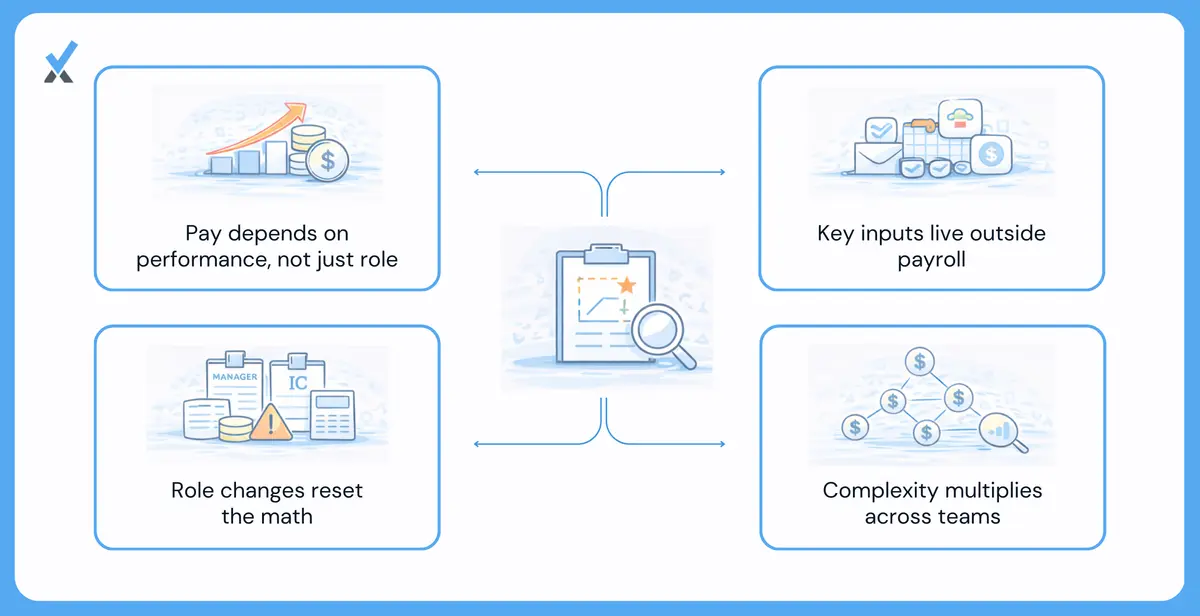
A retail business or a SaaS company pays most employees a fixed salary or hourly wage. Payroll runs the same amount every cycle. Adjustments are rare. The system handles it automatically.
Professional service firms operate differently. Consultant compensation structures typically include multiple variable components layered on top of base pay, and each one introduces complexity.
-
Performance bonuses tied to project outcomes. Many firms pay bonuses based on project profitability, client satisfaction scores, or revenue milestones. These amounts change every quarter or even every project, and the calculation often depends on data that lives outside the payroll system entirely.
-
Utilization-based incentives. Firms that track billable hours frequently tie a portion of compensation to utilization targets. A consultant who bills 85% or more of available hours might earn an additional $1,500 to $5,000 per quarter. But calculating actual utilization requires pulling data from time-tracking tools like Harvest or Toggl, comparing it against capacity, and then translating the result into a payroll-ready number.
-
Revenue sharing and commission structures. Some firms pay consultants a percentage of the revenue they generate, particularly for business development roles or partner-track positions. These calculations depend on billing data, collection timing, and sometimes client-specific rate agreements that vary across engagements.
-
Contractor-to-employee transitions. Growing firms frequently convert top-performing contractors to full-time employees, which means restructuring their compensation from a flat project rate to a base-plus-variable model while maintaining similar total earnings. Getting this transition wrong creates compliance risk and retention problems simultaneously.
Each of these components is manageable in isolation. The headaches start when three or four of them run at the same time across a team of 10 to 25 people, and someone has to reconcile all the numbers before payroll closes.
Why does the spreadsheet workaround create most of the errors?
Nearly every service firm follows some version of the same process. Compensation plans get documented in offer letters and policy memos. The actual calculations happen in spreadsheets maintained by an office manager or operations lead. Those spreadsheet outputs get manually entered into the payroll system before each pay cycle.
This workflow creates three predictable failure points.
-
Calculation errors go undetected. A formula error in a utilization spreadsheet can overpay or underpay a consultant for months before anyone catches it. Unlike fixed salary, where the same incorrect amount would be immediately obvious, variable pay changes every cycle, making discrepancies harder to spot.
-
Data lives in silos. The time-tracking tool knows hours worked. The project management system knows project profitability. The CRM knows revenue attribution. The payroll system knows none of these things unless someone manually bridges the gap. Every manual handoff is an opportunity for stale data, transposed numbers, or missed updates.
-
Payroll deadlines create pressure. Variable pay calculations take time. When the data is not ready by the payroll cutoff date, firms face an unpleasant choice: delay payroll (which damages trust with employees), estimate the variable amounts and true them up later (which creates accounting complexity), or skip the variable payment and push it to the next cycle (which frustrates the consultants who earned it).
How do you build a compensation structure payroll can actually execute?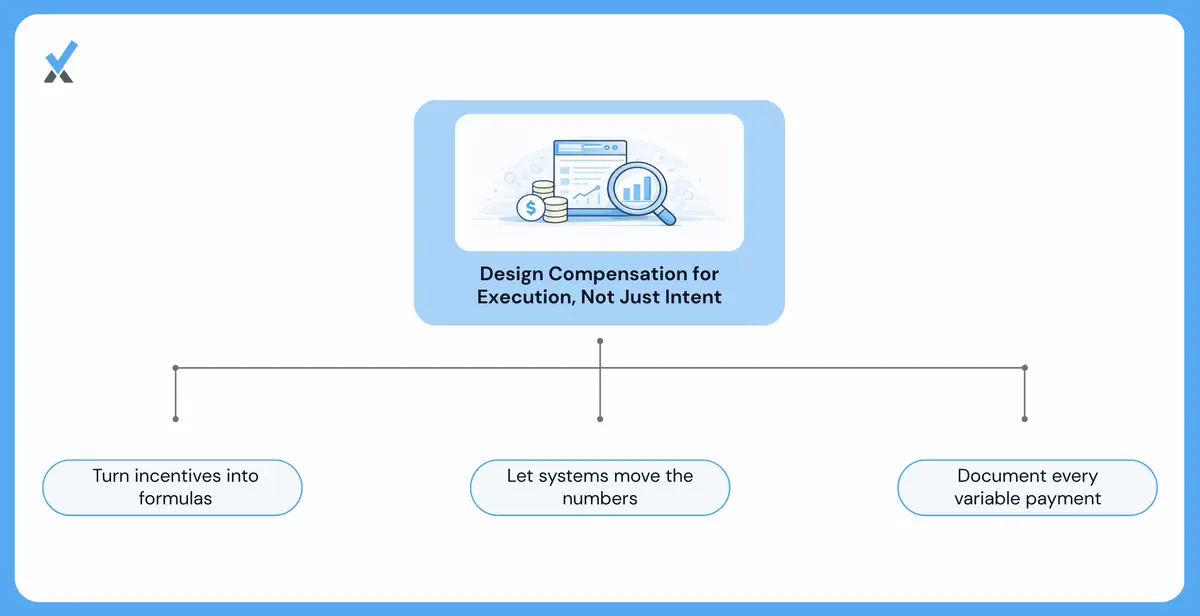
The goal is not to simplify a compensation plan to the point where it loses its strategic value. The goal is to design the structure so that execution is systematic rather than heroic. Four principles make this work.
-
Define every variable component as a formula, not a concept. "Performance bonus based on project profitability" is a concept. "10% of net project margin above 35%, calculated quarterly using finalized project P&L data, paid in the first payroll cycle following quarter close" is a formula. If a compensation plan cannot be expressed as a calculation with defined inputs, data sources, and payment timing, it is not ready for implementation.
-
Align payment timing with data availability. One of the biggest sources of payroll friction is trying to pay variable amounts before the underlying data is finalized. If project profitability numbers are not confirmed until 15 days after quarter end, bonus payments should not be scheduled for the first payroll cycle of the new quarter. A realistic lag between when performance is measured and when the resulting payment runs needs to be built in.
-
Integrate data sources into a single workflow. Variable pay calculations should pull automatically from time-tracking, project management, and billing systems rather than relying on manual exports and re-entry. When a payroll stack integrates with operational tools, the numbers flow from performance data to paycheck without someone rebuilding the bridge every two weeks.
-
Create an audit trail for every variable payment. Every bonus, incentive, and commission payment should have a documented calculation showing the inputs, the formula applied, and the resulting amount. This protects the firm during tax audits and employee disputes, and gives the finance team a clear record when reconciling payroll expenses against project profitability.
Why should variable pay motivate a team rather than burden operations?
The consulting firms that attract and retain top talent almost always offer compensation structures with meaningful variable components. Performance bonuses, utilization incentives, and revenue sharing signal that the firm rewards results, not just presence.
But the operational reality of running complex payroll is what separates firms that execute these plans cleanly from firms that spend every pay cycle in a spreadsheet emergency. The difference is not the ambition of the compensation plan. It is whether the firm has built the infrastructure to support it.
Designing a consultant compensation structure with execution in mind from day one means defining the formulas precisely, timing the payments realistically, connecting the data sources, and building the audit trail that keeps the finance team confident and the compliance posture clean, run with the same expert-led, AI-powered, human-in-the-loop rigor as the rest of the firm's books.
Because the best compensation plan in the industry is worthless if the payroll process cannot deliver it accurately and on time.
| Component | Data source | Common failure point |
|---|---|---|
| Performance bonus | Project P&L | Paid before profitability is finalized |
| Utilization incentive | Time-tracking tool | Manual pull against capacity, formula drift |
| Revenue sharing | Billing and collections | Client-specific rate exceptions missed |
| Contractor-to-employee transition | Offer letter, HR records | Compliance and classification risk |
How should a firm handle a variable payment when the calculation is not ready by payroll cutoff?
The cleanest option is usually a documented true-up: pay a conservative estimate on schedule, then reconcile and adjust once the final data lands. Skipping the payment entirely tends to damage trust more than a slightly delayed final number does, as long as the estimate and adjustment process is explained to the consultant in advance.
Does adding variable pay components increase compliance risk?
It can, particularly around contractor classification and multi-state tax withholding on commission-heavy pay, but the risk comes from undocumented, ad hoc calculations rather than variable pay itself. A documented formula and audit trail for each component substantially reduces that exposure.
How often should a compensation formula actually be revisited?
Annually at minimum, tied to a broader compensation review, with a check any time the underlying data source changes, such as switching time-tracking tools or restructuring how projects get billed. A formula built around a system that no longer exists is a common source of quiet payroll errors.
A great compensation plan on paper is worth nothing if payroll cannot execute it accurately and on time, every cycle.
See how Numetix payroll services handle variable pay, built for professional services firms specifically.
Numetix is an AI-first accounting firm. AI runs the bookkeeping, tax, payroll, and reporting workflow. Industry experts handle the judgment, month-end close, review, and advisory. We serve founder-led service firms across law, consulting, IT, healthcare, creative, and nonprofit. Headquartered in California, serving clients nationwide.
Suggested Readings
Healthcare payroll compliance: Overtime, shifts, and the rules that trip up practices
The IRS classification tests that trip up service firms: How to get 1099 vs W-2 right every time
Data management payroll services: Building clean, accurate payroll data for your service firm
See what Numetix can do for you
Learn how the Numetix Portal streamlines communication, offers valuable insights, and saves you time so you can focus on growing your business.