What happens when your accounting, payroll, and billing tools don't talk to each other
Key Takeaways
-
Manual transfers between disconnected systems might take 15 minutes each, but a firm running three or four tools can rack up dozens monthly.
-
A $1,200 gap between what QuickBooks and Gusto report for payroll expense is a common signature of systems that do not share data automatically.
-
Fragmented tools stretch month-end close by a week or more, since each system has to be reconciled before the books can close.
-
Building a report that spans payroll and accounts payable manually takes hours; in an integrated system the same view is a live dashboard.
-
Cash position shown by a fragmented system is only as current as the last manual reconciliation, often days or weeks old.
-
Integration removes reconciliation entirely by keeping data in one place, rather than just making it faster to compare four versions of the truth.
What happens when your accounting, payroll, and billing tools do not talk to each other
Quick Answer
Disconnected accounting, payroll, and billing tools force manual data transfer between systems, which shows up as slower month-end close, reports that take hours to build, and cash positions that are stale by the time anyone sees them. Integration, whether through an all-in-one platform, connector tools, or a unified service provider, removes that manual translation: data flows once and updates every connected system automatically, so reconciliation and consolidated reporting stop being separate jobs.
Payroll ran on Friday. The money was withdrawn from the account on Monday morning. By Wednesday, no one had entered the journal entry into QuickBooks.
This scene repeats every pay period at consulting firms that manage finance operations across disconnected systems. Gusto knows payroll happened. QuickBooks does not, until someone manually transfers the information. The same disconnect exists between the invoicing tool and the general ledger, between the payment processor and revenue accounts, between every pair of systems that should share data but do not.
Each tool works fine in isolation. The problem is that finance is not isolated. Everything connects: revenue to receivables, payroll to cash, expenses to projects. When tools do not talk to each other, someone becomes the translator, spending hours moving data between systems that should handle it automatically.
What hidden costs come from disconnected finance tools?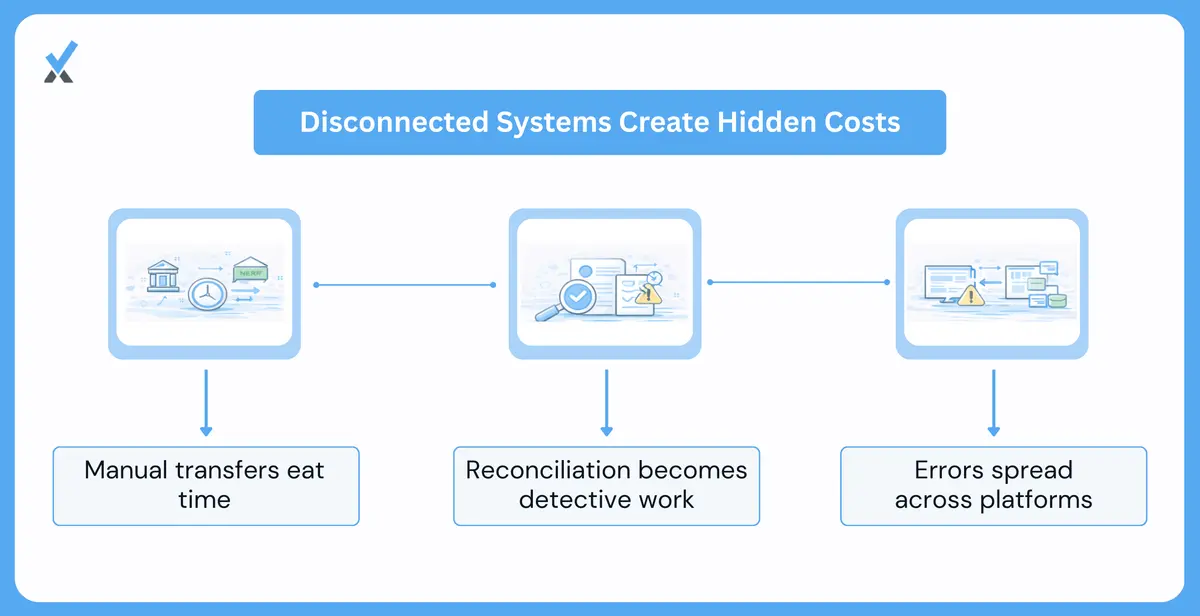
The cost of running finance on disconnected systems is rarely visible in any single line item. It hides in distributed effort, accumulated time, and problems that seem normal because they have always existed.
-
Manual data transfer between systems consumes time. Every time information moves from one system to another through human effort, time is spent. Payroll totals copied from Gusto to QuickBooks. Invoice payments reconciled from Stripe to AR aging. Vendor payments exported from Bill.com and imported to the ledger.
Each transfer might take only 15 minutes. But a firm running three or four disconnected systems might perform dozens of transfers monthly. Those 15-minute tasks accumulate into hours of work that exist only because systems do not share data directly.
-
Reconciliation across systems requires detective work. When the same data exists in multiple places, discrepancies appear. QuickBooks shows $47,000 in payroll expense. Gusto's year-to-date report shows $48,200. Which is right? Where did the $1,200 difference come from?
Answering these questions requires investigating across systems, comparing reports line by line, identifying the transactions that do not match, and determining which system has the correct information. This reconciliation work is not value-creating. It exists only because disconnected systems drift apart.
-
Errors compound when data exists in multiple places. A typo in a manual entry propagates an error. A payroll entry posted to the wrong expense account not only affects the P&L but also departmental reporting, budget variance analysis, and tax categorization. Fixing it requires corrections in multiple places.
Disconnected systems multiply error surface area. Every manual transfer is an opportunity for mistakes. Every reconciliation that does not happen is an opportunity for errors to persist undetected.
How do these hidden costs show up in daily operations?
The costs of fragmented finance tools manifest as concrete operational problems that firms experience every month.
-
Month-end close extends while systems are reconciled. A unified finance system can close books within days of the month-end. A fragmented system requires reconciling each component first: confirm payroll postings are correct, verify all payments are recorded, match invoices to revenue, and reconcile bank accounts against each system's view of cash.
This reconciliation extends close timelines. A firm that could have financials on the 5th instead waits until the 12th because three systems needed to be brought into agreement before the books could close.
-
Reporting requires manual consolidation. Seeing the total labor cost, including employees and contractors, requires pulling data from payroll and accounts payable, then combining it. Seeing the cash position, including receivables and payables, requires exporting from three systems and building a spreadsheet.
Single-system accounting produces these reports instantly because all data lives in one place. Fragmented systems require someone to build reports manually whenever they are needed. The construction takes time and introduces the possibility of error.
-
Real-time visibility becomes impossible. An integrated accounting platform can display the current cash position, updated in real time as transactions occur. A fragmented system shows cash position as of the last reconciliation, which might be days or weeks old.
Real-time visibility requires real-time data. When systems are disconnected, data is only current in each system. The consolidated view management needs exists only when someone creates it manually, which means it is always somewhat stale.
How does integration change the economics of finance operations?
The alternative to fragmented tools is not necessarily a single monolithic platform. It is systems that share data automatically, whether through native integration or through a unified finance system that handles multiple functions.
-
Data flows once and propagates automatically. In an integrated system, payroll processing and journal entries post automatically. A client payment arrives, and revenue is recognized automatically. A vendor invoice is approved, and the AP ledger updates automatically.
The human effort required to transfer data disappears. The information moves through the system without anyone copying, exporting, or importing. What took hours of manual work happens in seconds without intervention.
-
A single source of truth eliminates the need for reconciliation. When data exists in one place rather than four, reconciliation becomes unnecessary. There is no discrepancy between the payroll system and the ledger because they are the same system, or they sync in real time.
The detective work of investigating why systems disagree disappears. The anxiety about whether reports from different systems will match disappears. The version being looked at is the only version, so it is definitely correct.
-
Reporting becomes instant rather than constructed. Unified finance system reporting pulls from integrated data. Labor costs across employees and contractors are a query, not a consolidation project. The cash position, including AR and accounts payable, is a dashboard, not a spreadsheet someone builds.
This speed changes how firms use financial information. When reports take hours to construct, they are built monthly or quarterly. When reports are instant, they inform daily decisions, and the availability of information changes how the business operates.
What are the different approaches to integrating finance tools?
Moving toward integrated finance does not require replacing every tool immediately. There are different paths depending on current setup and priorities.
- All-in-one bookkeeping platforms handle multiple functions natively. Some platforms provide accounting, payroll, invoicing, and bill pay in a single system. Data integration is built in because all functions reside in a single database. This approach offers the deepest integration but may require migrating from familiar tools to unfamiliar ones.
- Integration layers connect existing tools. For firms committed to specific tools for specific functions, integration platforms can connect them. Payroll syncs to accounting automatically. Payment data flows to revenue recognition. The tools remain separate, but data flows between them automatically.
- Unified service providers manage integration directly. Some firms outsource finance operations to providers who manage the tool stack and handle integration as part of their service. The firm does not need to worry about which systems talk to which, since the provider handles it.
Each approach trades off control, cost, and complexity differently. The right choice depends on how much a firm values specific tools versus the benefits of fully connected data.
Why is the hidden tax of disconnected systems optional?
The hours a team spends moving data between systems, reconciling discrepancies, and constructing consolidated reports are not required by the nature of finance operations. The architecture of a disconnected tool stack requires them.
Firms with integrated systems do not do this work. Their finance operations are not inherently simpler. They simply do not pay the tax that disconnected systems impose.
The payroll journal entry that nobody has posted by Wednesday is a symptom. The symptom points to a structural problem: tools that do not talk to each other, requiring humans to translate between them. Solving the symptom means posting the entry. Solving the problem, built on an expert-led, AI-powered, human-in-the-loop foundation, means building a finance stack where the entry posts itself.
| Metric | Fragmented tools | Integrated system |
|---|---|---|
| Month-end close | Extends while systems are reconciled | Within days of month-end |
| Reporting | Manually constructed, hours per report | Instant, pulled from a live dashboard |
| Cash visibility | As of the last manual reconciliation | Updated in real time |
| Error correction | Fixed in multiple systems separately | Fixed once, propagates everywhere |
Does integrating finance tools mean giving up the specific tools a firm already uses?
Not necessarily. Integration layers exist specifically to connect existing tools without requiring a full platform switch. The trade-off is that this approach usually offers shallower integration than an all-in-one platform or a unified service provider managing the stack directly, so some manual checking may still be needed occasionally.
How long does it typically take to integrate a fragmented finance stack?
Connecting two or three tools through an integration layer often takes days to weeks. Migrating to a genuinely all-in-one platform is a bigger project, typically weeks to a couple of months, since historical data and workflows need to move as well.
Is a unified all-in-one platform always better than connecting existing tools?
Not always. A firm deeply invested in a specific tool, with staff trained on it and workflows built around it, may get more value from an integration layer than from a full migration. The right choice depends on how much switching cost the firm is willing to absorb for deeper integration.
The question is not whether accounting, payroll, and billing tools work individually. It is whether they work well together. If the answer is no, that hidden tax is paid every month in time, errors, and delayed visibility, and it is entirely optional.
See how Numetix accounting services keep every connected system in sync, built for professional services firms specifically.
Numetix is an AI-first accounting firm. AI runs the bookkeeping, tax, payroll, and reporting workflow. Industry experts handle the judgment, month-end close, review, and advisory. We serve founder-led service firms across law, consulting, IT, healthcare, creative, and nonprofit. Headquartered in California, serving clients nationwide.
Suggested Readings
AppFolio accounting: Best practices for 200+ door PM companies
AppFolio and QuickBooks don’t sync: Here’s how PM firms fix it
Best property management accounting software for growing PM firms
See what Numetix can do for you
Learn how the Numetix Portal streamlines communication, offers valuable insights, and saves you time so you can focus on growing your business.