The IRS classification tests that trip up service firms: How to get 1099 vs W-2 right every time
Key Takeaways
The IRS looks past what a contract says and evaluates the actual working relationship across behavioral control, financial control, and relationship type.
Requiring a contractor to follow internal processes, work set hours, or attend regular team meetings pushes behavioral control toward employee classification.
Relying on one client for all income, borrowing that client's equipment, and getting paid a fixed regular rate all point away from genuine independence.
The employer share of back payroll taxes on a single misclassified worker for one year can easily run into five figures before anything else gets added.
An open-ended contractor arrangement with no defined end date is far harder to defend than a project-based engagement with clear scope and deadlines.
Structuring contractor relationships around deliverables rather than schedules, and letting contractors serve multiple clients, is what actually holds up under IRS scrutiny.
The IRS classification tests that trip up service firms: How to get 1099 vs W-2 right every time
Quick Answer
The IRS evaluates 1099 versus W-2 status across three areas: who directs how the work gets done, whether the worker runs a genuine independent business, and how permanent and integrated the arrangement is. No single factor decides it; the agency looks at the full picture regardless of what the contract says. Misclassification can cost thousands of dollars per worker per year in back payroll taxes alone, before penalties, interest, and state-level exposure stack on top.
A specialist gets hired to support a long-running client project. She works 30 hours a week, uses the firm's project management software, attends Monday team calls, and follows the firm's deliverable templates. She gets paid as a 1099 contractor because that is how she invoiced when she started.
Then the firm gets audited. The IRS reviews the arrangement and reclassifies her as a W-2 employee. Suddenly, back payroll taxes, penalties, and interest are owed for every month she worked. The bill comes to $18,000, before the state's labor department opens its own investigation.
This scenario plays out constantly in service firms. The 1099 vs W2 classification rules are not complicated in theory. Still, the way professional service firms actually use contractors makes misclassification almost inevitable unless the lines are understood exactly.
Why do service firms get classification wrong more often than other businesses?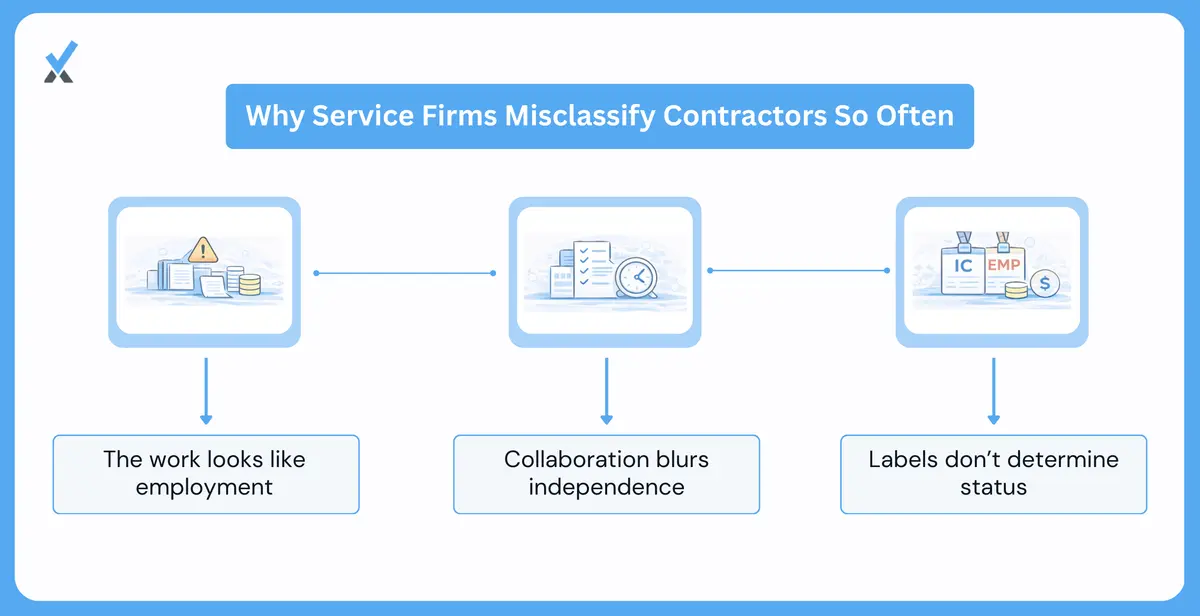
A manufacturing company hiring a contractor to repair a machine has a clear arrangement. The contractor shows up, fixes the machine, and leaves. There is no ambiguity about control, schedule, or integration into daily operations.
Service firms operate differently. The work is collaborative. Consultants, designers, writers, and specialists often embed directly into a team to deliver client projects. They join Slack channels, attend planning meetings, use the firm's tools, and follow the firm's processes. The work itself looks identical to what a full-time employee does, and that resemblance is exactly what creates classification risk.
The IRS does not care what a contract says or how the worker gets labeled. It looks at the actual working relationship. And when that relationship looks like employment, the IRS will treat it as employment regardless of the paperwork.
What are the three IRS classification tests that determine 1099 vs W-2 status?
The IRS evaluates worker classification using three categories of evidence. No single factor is decisive. The agency looks at the full picture across all three areas to determine whether a worker is an independent contractor or an employee.
-
Behavioral control: who directs how the work gets done? This is the factor that trips up service firms most frequently. Controlling not just what work the contractor delivers but how they deliver it points toward employment. Specific indicators include requiring the worker to follow internal processes or methodologies, dictating their work schedule or hours, requiring attendance at team meetings, providing detailed instructions rather than project-level objectives, and training the worker on internal systems.
A true 1099 contractor controls their own methods. The firm defines the deliverable and the deadline. The contractor decides how to get there, what tools to use, and when to do the work. The moment a firm starts managing process rather than output, the relationship starts looking like employment.
-
Financial control: does the worker have a genuine business of their own? Independent contractors typically invest in their own tools and equipment, carry their own insurance, market their services to multiple clients, and bear the risk of profit or loss on their work. Financial indicators that suggest employment include the worker relying on one firm as their sole income source, the firm providing all tools and equipment, paying a fixed hourly rate rather than project-based fees, and reimbursing all business expenses.
A contractor who works exclusively for one firm, uses that firm's equipment, and receives a guaranteed weekly payment looks functionally identical to an employee from the IRS perspective.
-
Relationship type: how permanent and integrated is the arrangement? The IRS examines whether the working relationship has characteristics of employment, such as indefinite duration, full-time commitment, and integration into core business operations. Key indicators include the worker performing services central to the firm's primary business, the engagement continuing without a defined end date, and either party treating the relationship as permanent.
A six-month contract to build a specific deliverable looks different from an open-ended arrangement where the contractor handles ongoing client work alongside employees. The longer and more integrated the relationship, the stronger the case for employee classification.
What does getting classification wrong actually cost?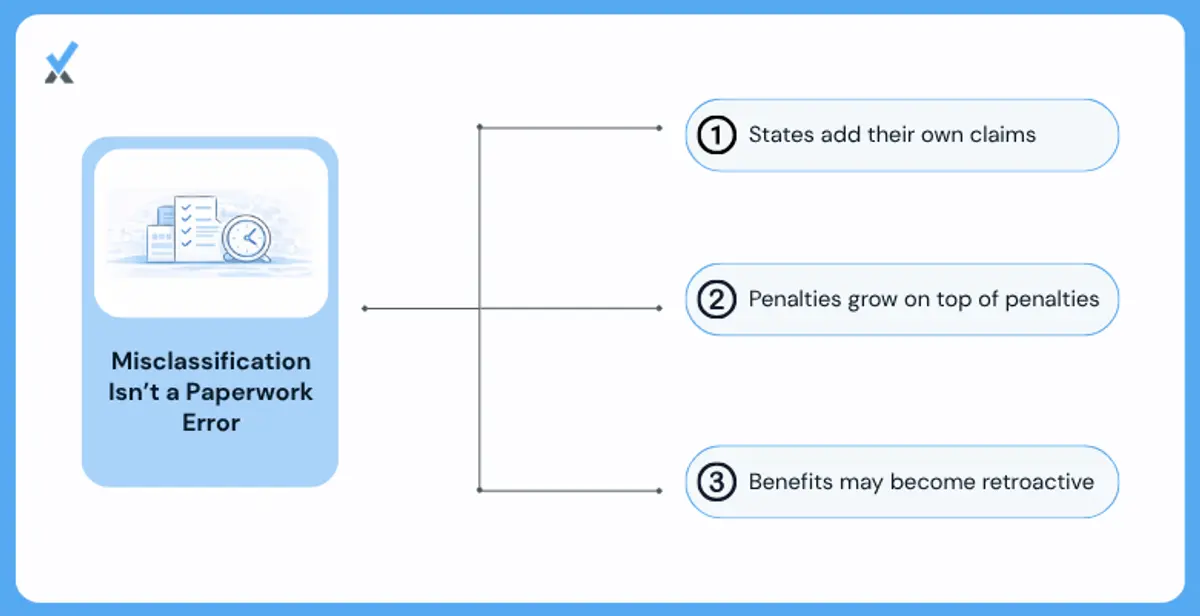
Misclassification penalties are designed to be painful enough to discourage the practice. If the IRS determines that a worker should have been classified as an employee, a firm faces several layers of financial exposure.
Back payroll taxes. The employer's share of Social Security, Medicare, and federal unemployment taxes gets owed for the entire period of misclassification. Depending on the worker's pay and the duration, this alone can run $8,000 to $15,000 per worker per year.
Penalties and interest. The IRS adds failure-to-file and failure-to-pay penalties to the back taxes, plus interest calculated from the original due dates. If the misclassification is deemed intentional, penalties increase substantially. This is exactly why working with a qualified tax professional early can help avoid costly penalties, interest, and long-term compliance issues.
State-level consequences. Most states conduct their own classification reviews, often triggered by the federal audit. State penalties for unpaid unemployment insurance, workers' compensation, and income tax withholding get added to the federal amounts.
Retroactive benefit obligations. If misclassified workers had been employees, they may be entitled to the benefits the firm offers other employees, including health insurance, retirement plan contributions, and paid time off.
Multiply these costs across several contractors over multiple years, and the total exposure can threaten a small firm's financial stability.
How should contractor relationships get structured to hold up under scrutiny?
The goal is not to avoid using contractors. Service firms depend on flexible talent. The goal is to structure those relationships so the actual working arrangement matches the 1099 classification.
Define deliverables, not schedules. Contractor agreements should specify project scope, milestones, and deadlines rather than hours, shifts, or required availability. Needing someone available 9 to 5 every day means the relationship is an employee arrangement.
Let contractors control their methods. Provide the what, not the how. Avoid requiring contractors to follow internal processes, use templates exclusively, or attend regular team meetings. If collaboration is necessary, keep it outcome-focused rather than process-directed.
Ensure contractors serve multiple clients. A contractor who works exclusively for one firm for an extended period is difficult to defend as an independent contractor. If possible, engaging contractors who actively maintain their own client base and market their services independently strengthens the classification.
Use project-based agreements with defined end dates. Open-ended contractor arrangements invite scrutiny. Structuring each engagement around a specific project with a clear scope, timeline, and completion criteria matters.
Document the relationship thoroughly. Signed contracts should reflect the actual arrangement, including provisions addressing behavioral control, financial independence, and project scope. The agreement should get updated if the relationship changes.
Is classification a compliance decision or a cost-saving shortcut?
Some firms classify workers as 1099 contractors to avoid payroll taxes, benefits costs, and administrative complexity. That calculus collapses the moment the IRS reviews the arrangement. The back taxes, penalties, and operational disruption from a reclassification far exceed any savings from the misclassification.
Treating the 1099 vs W2 classification decision as a compliance question first, applying the IRS tests honestly, structuring contractor relationships to reflect genuine independence, and hiring the person as an employee when the arrangement genuinely looks like employment, building the cost into pricing, is what an expert-led, AI-powered, human-in-the-loop approach to workforce planning actually looks like.
The firms that get this right do not just avoid penalties. They build a workforce model that scales cleanly without carrying hidden compliance risk underneath every engagement.
| Factor | Contractor signal | Employee signal |
|---|---|---|
| Behavioral control | Sets own methods and hours | Follows firm processes and schedule |
| Financial control | Multiple clients, own tools and insurance | Sole income source, firm provides tools |
| Payment structure | Project-based fees | Fixed hourly or guaranteed weekly rate |
| Relationship type | Defined project, clear end date | Open-ended, indefinite duration |
Can a worker be a 1099 contractor for part of their time and a W-2 employee for the rest?
Generally not for the same type of work with the same firm at the same time, since that setup usually just recreates the same classification risk under a different label. A worker can hold a W-2 role with one firm and separately do genuinely independent 1099 work for other clients, but splitting one working relationship into two categories rarely survives scrutiny.
What relief is available for firms that misclassified workers in good faith?
The IRS Voluntary Classification Settlement Program lets eligible employers reclassify workers going forward while paying a reduced penalty for past periods, provided the firm has consistently treated the workers as contractors and filed the required 1099s. It is generally far less costly than waiting for an audit to force the issue.
How far back can the IRS go when auditing worker classification?
The standard statute of limitations is three years from the filing date, but that window extends to six years for substantial underreporting and has no limit at all if fraud or a complete failure to file is involved. Consistent, well-documented practices matter well beyond any single audit period.
Classification built on genuine independence holds up. Classification built to save money on paper does not.
See how Numetix accounting services help structure contractor relationships correctly, for professional services firms specifically.
Numetix is an AI-first accounting firm. AI runs the bookkeeping, tax, payroll, and reporting workflow. Industry experts handle the judgment, month-end close, review, and advisory. We serve founder-led service firms across law, consulting, IT, healthcare, creative, and nonprofit. Headquartered in California, serving clients nationwide.
Suggested Readings
Healthcare payroll compliance: Overtime, shifts, and the rules that trip up practices
Stop payroll headaches: How to structure consultant pay the right way
Data management payroll services: Building clean, accurate payroll data for your service firm
See what Numetix can do for you
Learn how the Numetix Portal streamlines communication, offers valuable insights, and saves you time so you can focus on growing your business.