Why outsourcing accounting frees up a founder’s week (without losing control)
Key Takeaways
Bookkeeping work pays roughly $30 to $50 an hour on the open market, far below what a founder's billable client time is actually worth.
A $200-an-hour founder doing 10 hours of monthly bookkeeping is effectively spending $2,000 to save roughly a thousand dollars in fees.
Transaction categorization, reconciliation, receipt chasing, and payroll review typically add up to 8 to 15 hours a month, not the few hours founders usually estimate.
One lost client engagement worth $30,000 covers roughly three years of outsourced accounting, making the opportunity cost far larger than the visible outsourcing fee.
Reviewing accurate monthly statements takes about 30 minutes; producing them from scratch through manual categorization can eat 10 hours or more.
Hesitation about hiring due to unreliable month-old books can cost more market share than the bookkeeping hours ever appeared to save.
Why outsourcing accounting frees up a founder's week, without losing control
Quick Answer
Doing bookkeeping personally trades high-value founder time for low-value administrative work, and the gap widens as billable rates rise. Tracked honestly, monthly bookkeeping usually runs well into double-digit hours once categorization, reconciliation, receipts, and payroll review are counted, hours that would otherwise go toward client delivery. Outsourcing does not remove visibility; it replaces the manual work with a short monthly review, freeing the time and mental energy that actually grows the firm.
Sunday afternoon. Again. Sitting with a laptop, coffee gone cold, clicking through QuickBooks transactions from the past two weeks. Categorizing expenses. Matching receipts. Trying to remember what "SQ *DENVER JULY" was for on the credit card statement.
A business partner texted two hours ago asking whether the proposal for that healthcare client got reviewed. It has not. There is a networking event tonight worth attending. It will probably get skipped. The bookkeeping needs to get done.
Here is what most consulting founders do not calculate: the time spent doing bookkeeping costs a business far more than outsourcing ever would. Not just in dollars, though the math is brutal. In missed opportunities, delayed decisions, and the slow erosion of the energy needed for actual client work.
Founders who handle their own bookkeeping spend 8 to 15 hours monthly on tasks worth $30 to $50 an hour while sacrificing billable client work worth $150 to $300 an hour, creating an opportunity cost of $1,000 to $3,750 monthly that exceeds typical outsourcing fees of $800 to $1,500.
Here is where that time actually goes.
How much time does DIY bookkeeping actually take?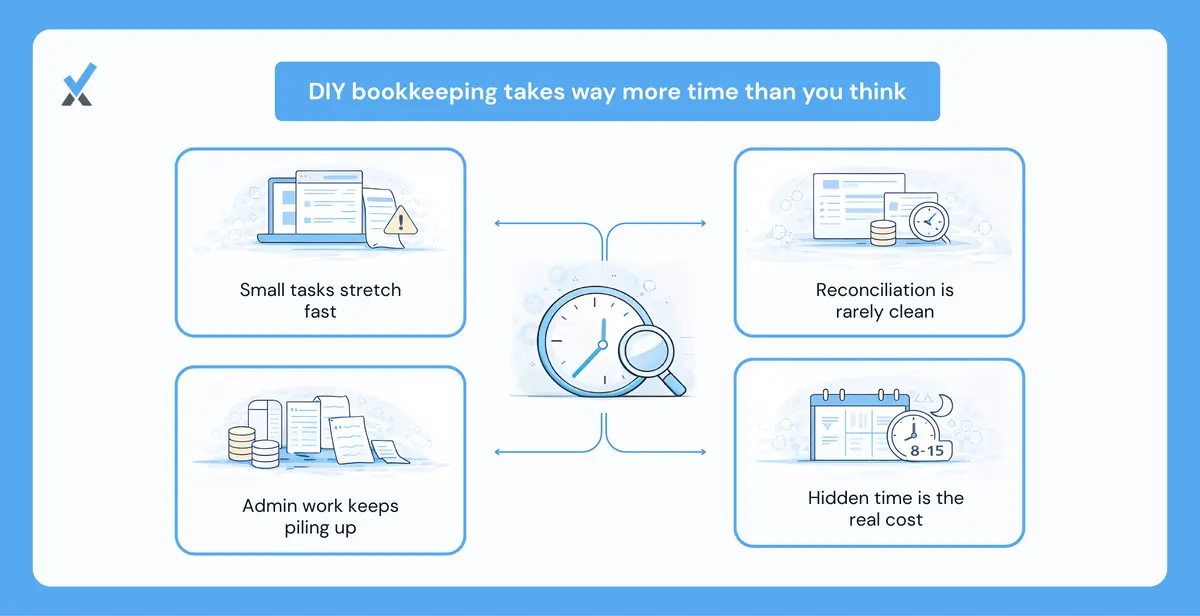
Most founders estimate they spend "a few hours a month" on bookkeeping. Tracking it honestly for 30 days usually reveals a surprise.
Transaction categorization alone takes 2 to 4 hours monthly for a consulting firm running 150 to 250 transactions. Each bank transaction gets reviewed, sorted into the right category, checked for duplicates, and fixed if it was miscategorized last month. A business card charge that might be personal needs investigating. One transaction leads to checking three others. What should take 10 minutes stretches to 45.
Account reconciliation adds another 2 to 3 hours. Matching a QuickBooks balance to bank statements sounds simple until a $347 discrepancy needs tracking down. Was it a refund posted in a different month? A check that cleared late? Statements get dug through, dates get compared, and the mental timeline of what happened gets rebuilt.
Receipt management steals 1 to 2 hours never budgeted for. Asking the team for receipts. Waiting for responses. Following up again. Organizing files. Making sure everything is documented for tax season. It is administrative quicksand.
Vendor management and bill payment take another 1 to 2 hours: reviewing bills, approving payments, scheduling ACH transfers, and updating QuickBooks to reflect what was paid. Simple tasks individually, but they accumulate.
Payroll review consumes 1 to 2 hours monthly, even with Gusto or ADP. Hours get checked for accuracy, bonuses get verified, contractor payments get confirmed as properly scheduled. When something is wrong, it gets fixed, payroll gets rerun, and the books get updated.
Then there is the hidden time nobody counts: the mental context switching that happens stopping client work to categorize a transaction, the interruption when a bookkeeping question comes in by email, the Sunday afternoon that could have gone to business development but went to reconciliation instead. This invisible overhead easily adds 2 to 3 hours monthly.
Add it up honestly. Most founders spend 8 to 15 hours per month on bookkeeping. That is 100 to 180 hours annually, nearly a whole month of work time consumed by administrative tasks that do not directly serve clients or grow the business.
How does opportunity cost destroy the supposed savings of DIY bookkeeping?
"But I am saving $1,000 a month by doing it myself."
Is that actually true?
Running the actual math: say a founder bills clients at $200 an hour. The 10 hours spent monthly on bookkeeping represent $2,000 in potential billable work. That is $2,000 in founder time spent to save $1,000 in outsourcing fees. That is a terrible trade.
Maybe capacity is already maxed out and no more client work could be taken on anyway. Fine. What else could those 10 hours produce? Business development that lands a $60,000 client engagement? Strategic planning that improves the delivery model? Team training that increases billable efficiency by 15%?
Even non-billable founder work generates multiples of value compared to transaction categorization. Building client relationships, refining service offerings, or solving operational bottlenecks creates business value worth far more than $100 an hour. Bookkeeping tasks are valuable, but they are worth maybe $30 to $50 an hour at market rate.
That is trading $200-an-hour work for $40-an-hour work and calling it savings.
Here is another angle: how many consulting engagements got turned down in the past year for lack of capacity? Just one lost project worth $30,000 pays for three years of outsourced accounting. The opportunity cost is not theoretical. It is real revenue left on the table because the calendar was full of administrative tasks instead of client delivery.
And there is the energy cost nobody talks about. Bookkeeping on a Sunday afternoon drains mental reserves. Monday starts already tired, annoyed, and behind. Client calls get shorter. Proposals get less thorough. Strategic thinking gets fuzzier. The cost compounds beyond just the hours.
How does manual bookkeeping actually block growth?
Scaling a consulting firm while doing its own books does not work. The math does not hold up.
Hiring decisions often get avoided due to a lack of confidence in cash flow visibility. When books are a month behind, profitability feels likely but is not certain, and it is unclear which clients or projects are actually driving it. So the decision to bring in a junior consultant, who could free up capacity to land bigger clients, gets held off.
That hesitation costs something real. Competitors with clear financial visibility make aggressive hiring decisions, take market share, and scale faster, while a firm stuck in wait-and-see mode is held back by financial data that is not reliable or timely enough to support confident decisions.
Client delivery suffers when mental energy is drained by admin work. Creative problem-solving gets harder. Strategy sessions get rushed through to get back to expense categorization. Clients sense the difference between a founder who is fully present and one mentally juggling bookkeeping stress.
Strategic opportunities get ignored because the bandwidth does not exist. A potential partnership presents itself. A client wants to discuss expanding scope. A network invitation to speak at a conference arrives. The answer is no, for lack of time. But it is not really a lack of time. It is time spent on tasks someone else could do, while opportunities only the founder can pursue get missed.
Late or sloppy books, without automated bank feed integration to keep them current, prevent informed decision-making. Being constantly behind on reconciliation means not knowing the real cash position, not being able to forecast accurately, and delaying decisions that need data. The firm ends up operating on gut feeling instead of financial clarity. That works until it does not.
Does outsourcing actually mean losing control?
The objection is familiar: "But I need to know what is happening with my money."
Outsourcing accounting does not mean losing visibility. It means stopping the manual work and starting to review the results instead. That is actually more control, not less.
Outsourcing to a good provider produces accurate financial statements every month showing exactly where the money went. Reviewing them takes 30 minutes instead of the 10 hours it took to produce them. Questions about unusual expenses still get asked. Decisions still get made, based on clean data instead of rough estimates.
Bills still get approved before payment. Payroll still gets reviewed before it runs. Every transaction still shows up categorized in QuickBooks. The difference is that someone else does the categorization work, and the founder just verifies it makes sense.
That is not losing control. That is gaining leverage.
Consider it differently: most founders already outsource their tax returns to a CPA. That does not mean losing control of taxes. It means a specialist handles the technical work while the founder reviews the output and makes strategic decisions. Bookkeeping works the same way.
Founders who resist outsourcing accounting often discover something interesting once they finally make the switch. They feel more in control, not less, because now they are getting timely, accurate financial data they can actually use to run the business, instead of scrambling to create it themselves.
A founder's time is worth more than transaction categorization. Their energy is worth more than receipt chasing. The business is worth more than the $1,000 supposedly saved by doing the bookkeeping personally, especially when the alternative runs on an expert-led, AI-powered, human-in-the-loop process built for exactly this handoff.
| Task | Time monthly | Common trap |
|---|---|---|
| Transaction categorization | 2 to 4 hours | One flagged charge triggers checking three others |
| Account reconciliation | 2 to 3 hours | A small discrepancy triggers a full timeline rebuild |
| Receipt management | 1 to 2 hours | Chasing the team eats more time than filing itself |
| Vendor and bill payment | 1 to 2 hours | Individually simple tasks accumulate |
| Payroll review | 1 to 2 hours | Errors mean a rerun, not just a correction |
| Hidden context switching | 2 to 3 hours | Rarely tracked, but real time and focus lost |
How quickly does an outsourced provider typically get up to speed on a firm's books?
Most providers reach full accuracy within the first 30 to 60 days as they learn a firm's specific vendors, chart of accounts, and recurring transaction patterns. The first month usually involves the most back-and-forth; after that, the review process settles into the roughly 30-minute monthly cadence.
What happens to control over spending decisions after outsourcing?
Approval authority typically stays with the founder. A good provider categorizes and reconciles transactions, but bill payments, payroll runs, and unusual expenses still route through founder approval, so nothing gets spent without sign-off, only the manual entry work changes hands.
Is DIY bookkeeping ever the right call for a very early-stage firm?
Sometimes, briefly. In the first few months with very low transaction volume, the time cost is small enough that DIY can make sense. The math tends to flip quickly once monthly transaction count and billable rate both climb, which is usually within the first year for a growing consulting firm.
The real math rarely favors doing it alone. Calculating the actual opportunity cost is what makes the decision obvious.
See how Numetix bookkeeping services hand back that time, built for professional services firms specifically.
Numetix is an AI-first accounting firm. AI runs the bookkeeping, tax, payroll, and reporting workflow. Industry experts handle the judgment, month-end close, review, and advisory. We serve founder-led service firms across law, consulting, IT, healthcare, creative, and nonprofit. Headquartered in California, serving clients nationwide.
Suggested Readings
When does a medical or dental practice need a fractional or outsourced CFO?
Should a nonprofit hire an in-house bookkeeper or outsource its accounting?
Outsourced trust accounting for property management companies
See what Numetix can do for you
Learn how the Numetix Portal streamlines communication, offers valuable insights, and saves you time so you can focus on growing your business.