The hidden loss in your firm: How to find the service line that looks busy but isn’t profitable
Key Takeaways
A $420,000 quarter in one practice area produced only $38,000 in cash contribution once fully loaded costs were counted, while a smaller $280,000 line produced $97,000.
Shared costs like payroll, software, and rent rarely get allocated to specific service lines, which makes every practice area look equally efficient on paper.
A service line billing $100,000 a month with a 75-day collection cycle has roughly $250,000 in receivables permanently locked up, unusable for payroll or growth.
High utilization with shrinking margins usually means labor costs are outpacing billing rates, or scope creep is quietly eating into realized revenue.
Receivables growing faster than revenue for one practice area is a sign clients are paying more slowly, not that the line is unhealthy on paper.
A quarterly spreadsheet analysis shows where cash stood weeks or months ago, not where it stands right now when a decision actually needs to be made.
The hidden loss in your firm: How to find the service line that looks busy but is not profitable
Quick Answer
Service line profitability analysis stacks four layers per practice area, realized revenue after write-downs, direct labor cost by allocation, direct operating expenses, and cash conversion timing, to reveal which lines actually fund the firm versus which ones quietly drain it. A busy practice area with large engagements and slow-paying clients can generate less cash contribution than a smaller, faster-paying one. Real-time dashboards catch this trend as it develops instead of a quarter later.
A strategy consulting practice billed $420,000 last quarter. An HR advisory practice billed $280,000. On the surface, strategy looks like the star. It has more clients, more proposals in the pipeline, and more hours logged. The team views it as the firm's growth engine.
But when the cash is traced to where it actually goes, the picture flips. Strategy requires two senior consultants and a project manager on every engagement. Travel expenses run high. Clients negotiate extended payment terms because the projects are large. After fully loaded costs, the $420,000 in revenue produced $38,000 in cash contribution last quarter.
Meanwhile, HR advisory runs leaner. Smaller teams, shorter engagements, faster payment cycles. That $280,000 generated $97,000 in cash contribution over the same period.
The busiest service line in the firm is quietly consuming cash while the quieter one funds operations. Without service line profitability analysis, this would never be visible.
Why does revenue by service line hide the real story?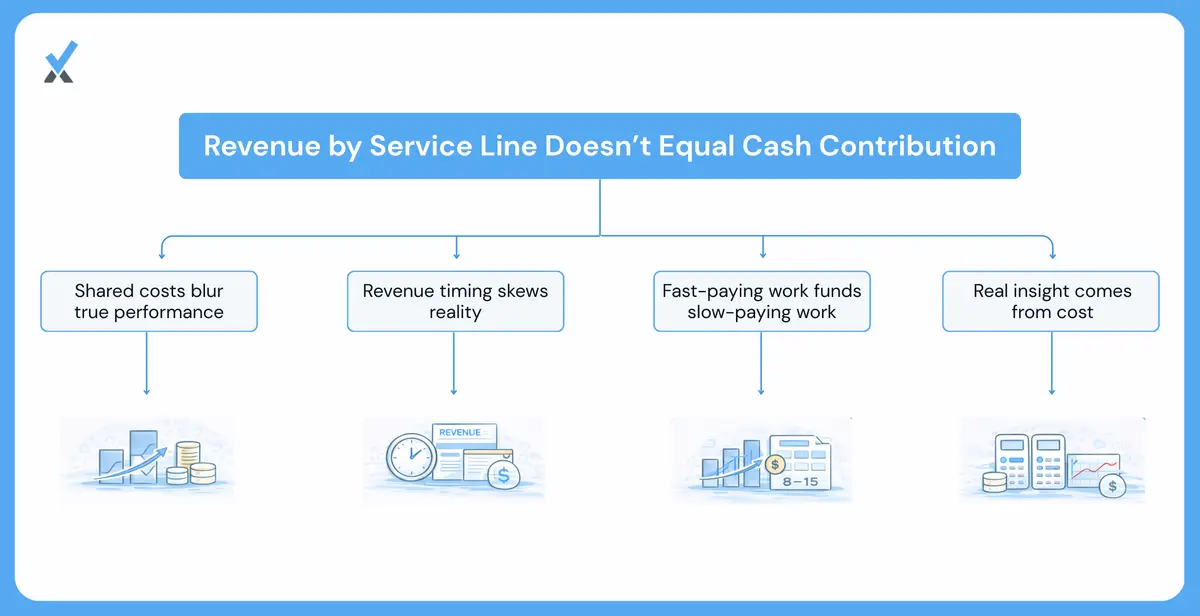
Most service firms track revenue by practice area. It is the default view in QuickBooks, the metric that shows up in partner meetings, and the number founders use to decide where to invest next. But revenue alone says nothing about which service lines contribute cash and which ones consume it.
Two factors create this blind spot.
-
Costs are rarely allocated to specific service lines. Payroll, software, rent, insurance, and overhead get lumped into general expenses. A service line can appear profitable because its direct costs look low, while in reality, it consumes a disproportionate share of shared resources. A senior consultant who spends 70% of her time on strategy engagements has her full salary listed under a general line item, making every practice area look equally efficient.
-
Revenue timing varies dramatically between service lines. A practice area with large project-based engagements might recognize $150,000 in revenue this month but not collect payment for 60 to 90 days. A practice area billing smaller monthly retainers collects cash within 15 to 30 days. On an accrual basis, both look healthy. On a cash basis, one is funding the firm and the other is borrowing from it.
What does a real service line profitability analysis actually look like?
Moving from revenue reporting to genuine practice area cash flow analysis requires breaking down four layers of financial data for each service line.
Layer 1: Direct revenue and billing realization. Start with gross revenue billed, then subtract write-downs, discounts, and unbilled time. This gives realized revenue, which is what clients actually owe. Many service firms discover that their busiest practice areas also have the highest write-down rates because scope creep is harder to control on complex engagements.
Layer 2: Direct labor costs. Assign actual compensation costs based on time allocation, not headcount. If a consultant splits time across two practice areas, their cost should split proportionally. Include base salary, benefits, payroll taxes, and any variable compensation tied to that service line's performance.
Layer 3: Direct operating expenses. Travel, specialized software, subcontractors, client entertainment, and any costs that exist specifically because that service line exists. These are expenses that would disappear tomorrow if that practice area shut down.
Layer 4: Cash conversion timing. This is where most analyses stop too early. Calculating the average days to collect payment for each service line matters: a practice area with $100,000 in monthly revenue and a 75-day collection cycle has $250,000 in receivables permanently locked in. That is $250,000 unavailable for payroll, growth, or reserves, even though the P&L says it was earned.
When these four layers are stacked, the contribution picture changes dramatically. Service lines that looked strong on revenue often look very different on cash contribution.
What are the warning signs that a service line is draining cash?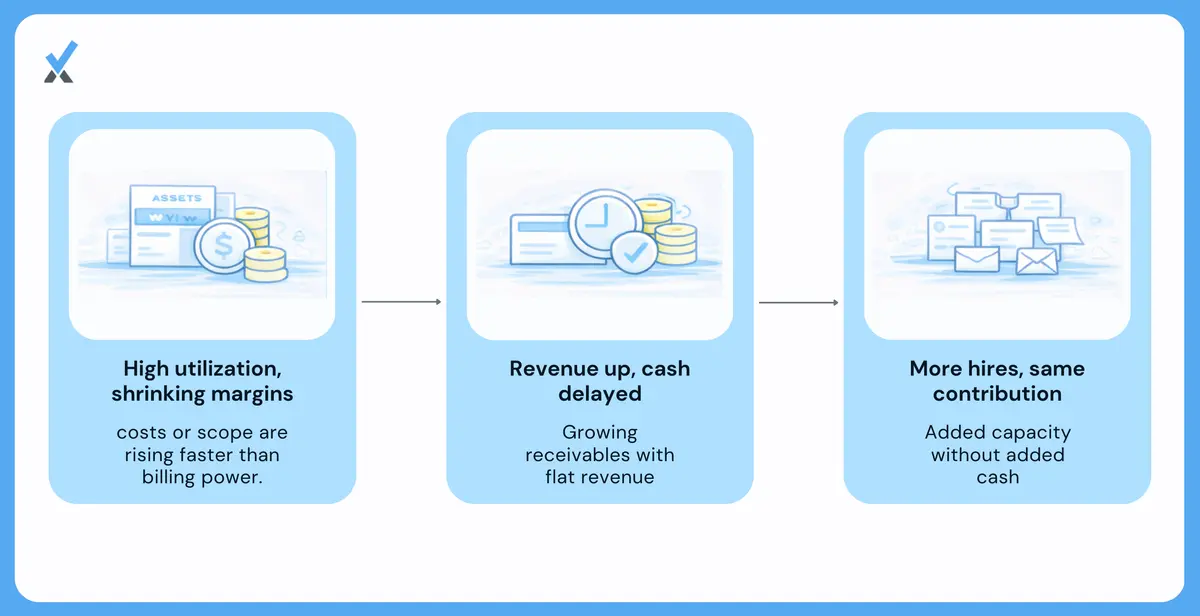
A full financial model is not always necessary to spot trouble. These patterns indicate a practice area may be consuming more cash than it contributes.
Utilization is high, but margins keep shrinking. The team is busy and billing hours, yet the service line's contribution to the firm is flat or declining. This usually means labor costs are rising faster than billing rates, or scope creep is eating into realized revenue.
Receivables for one practice area grow faster than revenue. If a service line's outstanding receivables keep climbing quarter over quarter while revenue stays stable, clients are paying more slowly. The service line is generating accounting revenue but not generating cash.
Resources keep getting added, but cash contribution stays flat. Hiring another consultant or project manager for a practice area should increase capacity and revenue. If cash contribution does not grow proportionally, the incremental cost of serving that market exceeds the incremental revenue it generates.
How do real-time dashboards make service line cash flow visible?
The challenge with service line profitability analysis is not the math. It is the frequency. Running this analysis once a quarter in a spreadsheet gives a historical snapshot, useful but already outdated by the time anyone acts on it.
Real-time financial dashboards that sync with accounting and time-tracking systems change the equation. When labor costs, billing data, expense allocations, and collection timelines update automatically, each practice area's cash position becomes visible as it evolves, not months after the fact.
This visibility transforms decision-making. Instead of discovering that a service line lost money last quarter, the trend becomes visible as it develops. Pricing can be adjusted, scope controls tightened, or resources shifted before a cash-draining practice area pulls down the rest of the firm.
How does a firm stop funding its weakest service line with its strongest one?
Every service firm has practice areas that punch above their weight in cash contribution and others that quietly depend on the rest of the business to cover their shortfalls. The problem is not that these imbalances exist. The problem is that most founders cannot see them.
Building the habit of analyzing service line profitability beyond revenue, mapping the full cost structure, tracking cash conversion timing, and watching for the warning signs, delivered with an expert-led, AI-powered, human-in-the-loop process that keeps this data current, is what lets decisions get made based on where cash actually flows, not where the busiest activity occurs.
Because the service line keeping a firm financially healthy might not be the one filling up the calendar, and the one filling up the calendar might be the reason cash reserves never seem to grow.
| Layer | What it measures | Common blind spot |
|---|---|---|
| 1. Realized revenue | Billed revenue minus write-downs and discounts | Busiest lines often have the highest write-downs |
| 2. Direct labor | Compensation by actual time allocation | Salaries lumped into general overhead |
| 3. Direct operating expenses | Travel, software, subcontractors specific to the line | Costs that would vanish if the line closed |
| 4. Cash conversion timing | Days to collect payment per service line | Revenue on the P&L that is not yet cash |
How often should a firm actually run service line profitability analysis?
Monthly is the practical minimum for catching a draining service line before it does real damage, since a quarterly cadence can let a full quarter of cash erosion go unnoticed. Firms with real-time dashboards syncing accounting and time-tracking data effectively get this continuously rather than as a periodic exercise.
Should an unprofitable service line always get cut?
Not necessarily. Some lines are strategic loss leaders that open doors to more profitable work, or are still building toward scale. The analysis exists to make that trade-off a deliberate decision rather than a hidden one, so a firm can choose to keep subsidizing a line on purpose instead of by accident.
Does this kind of analysis require different accounting software?
Not usually. Most of it can run on existing accounting and time-tracking tools once costs and time are tagged by service line; the harder part is typically the process discipline of consistent tagging, not a software gap.
The busiest service line and the most profitable one are not always the same line. Only real cash-level visibility shows which is which.
See how Numetix accounting services build service line profitability visibility in, for professional services firms specifically.
Numetix is an AI-first accounting firm. AI runs the bookkeeping, tax, payroll, and reporting workflow. Industry experts handle the judgment, month-end close, review, and advisory. We serve founder-led service firms across law, consulting, IT, healthcare, creative, and nonprofit. Headquartered in California, serving clients nationwide.
Suggested Readings
The nonprofit overhead myth
Fund accounting for a nonprofit in QuickBooks Online: the setup and its limits
What a bar auditor wants to see in a trust reconciliation report
See what Numetix can do for you
Learn how the Numetix Portal streamlines communication, offers valuable insights, and saves you time so you can focus on growing your business.