The workflow automation that replaced 6 hours of weekly bookkeeping and payroll tasks at one consulting firm
Key Takeaways
-
A founder billing $300 an hour who spends six hours weekly on admin work gives up roughly $90,000 a year in potential billable revenue.
-
Modern accounting systems typically auto-categorize 80 to 90 percent of transactions after a few months of training, leaving only real exceptions for review.
-
Automated payroll handles routine runs completely, reducing founder involvement to approving changes and reviewing exception reports rather than processing each cycle.
-
Delegating and automating shrinks task time at each step: what takes a founder six hours takes a bookkeeper two, and automation thirty minutes.
-
Reclaiming hours does not automatically create value; the freed time has to be deliberately redirected toward client work or business development.
-
One founder's shift from six hours to thirty minutes came from four steps: documenting tasks, automating what could be automated, delegating the rest, and protecting the reclaimed time.
The workflow automation that replaced 6 hours of weekly bookkeeping and payroll tasks at one consulting firm
Quick Answer
Workflow automation replaces a founder doing bookkeeping and payroll with a founder reviewing exceptions: accounting systems auto-categorize 80 to 90 percent of transactions, payroll runs on schedule without manual triggering, and compliance deadlines track themselves. One founder went from six hours a week to thirty minutes by documenting her tasks, automating what could be automated, delegating the rest, and redirecting the freed time toward client work instead of more admin.
Sarah runs a twelve-person consulting firm. Last year, she spent six hours every week on bookkeeping and payroll. Sunday evenings meant categorizing transactions. Every other Friday meant running payroll and double-checking withholdings. Random weeknights meant chasing receipts and reconciling credit card statements.
This year, she spends thirty minutes. She reviews a dashboard, approves exceptions, and moves on. The transactions are categorized automatically. Payroll runs on schedule without her having to trigger it. Receipts are uploaded to the system by her team's mobile app. Reconciliations happen in the background.
Six hours became thirty minutes. That is not a marginal improvement. That is a fundamental change in how the business operates and where Sarah spends her time.
What hidden costs does founder time on admin tasks really carry?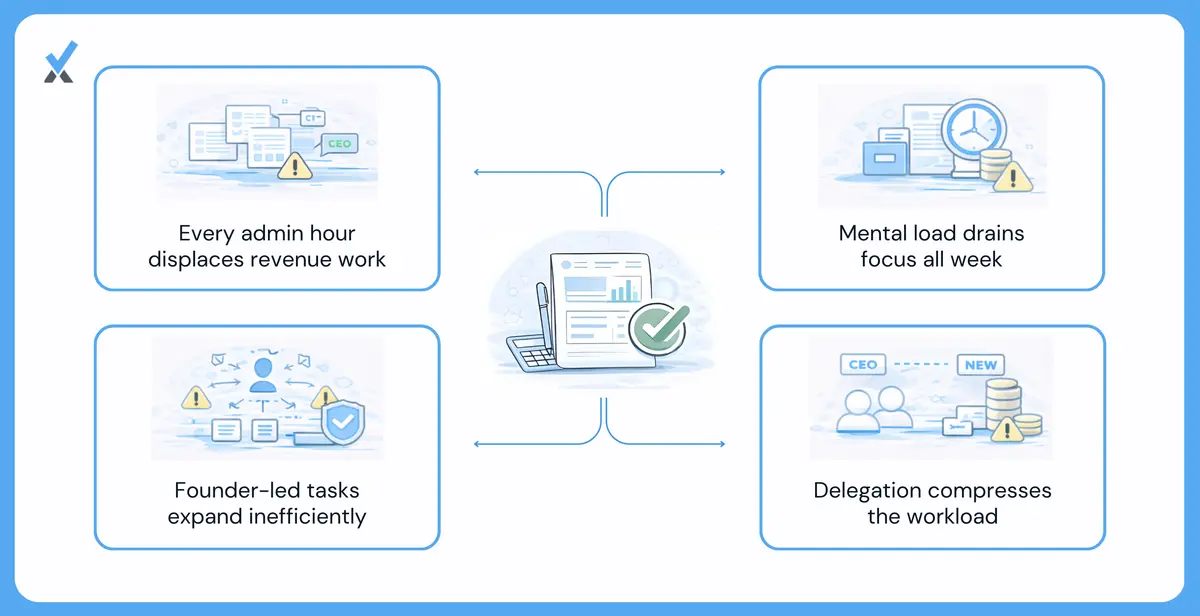
The obvious cost of founder time management problems is the hours themselves. Six hours per week is 300 hours per year. That is nearly eight full work weeks spent on bookkeeping and payroll, rather than on client work or business development.
But the hidden costs are often larger than the obvious ones.
-
Opportunity cost of time not spent on revenue activities. Every hour a founder spends categorizing transactions is an hour not spent closing a new client, delivering billable work, or building relationships that generate referrals. For a founder whose billable rate is $300 per hour, six hours of admin work represents $1,800 per week in potential revenue, or roughly $90,000 per year.
Even if the founder is not directly billable, their time has value. Business development, strategic planning, and team leadership all generate returns that admin tasks cannot match.
-
Mental load and context switching drain. Admin tasks do not just consume the hours they occupy. They create cognitive overhead throughout the week. A founder who knows payroll is due thinks about payroll during client meetings. A founder with unreconciled transactions carries that mental to-do list everywhere.
This mental load fragments attention and reduces the quality of work on higher-value activities. The founder is never fully present because part of their mind is tracking administrative obligations.
-
The work expands to fill available time. When the founder does the bookkeeping, it takes however long the founder has available. There is no external pressure to be efficient. A task that should take thirty minutes stretches to two hours because the founder gets interrupted, goes down a rabbit hole, or lacks the systems to move faster.
Delegate back office tasks to someone whose job is efficiency, and the work compresses. What took the founder six hours takes a capable bookkeeper two hours. What takes a capable bookkeeper two hours takes automation thirty minutes.
Which admin tasks can actually be automated or delegated?
The admin work that consumes founder time is neither unique nor strategic. It is repetitive work that follows predictable patterns. This makes it ideal for automation and delegation.
-
Transaction categorization and reconciliation. Every month, bank and credit card transactions need to be categorized: this charge is office supplies, that one is travel, this subscription is software. The patterns are consistent. The same vendors appear repeatedly. The same expense types recur month after month.
Modern accounting systems learn these patterns. After a few months of training, they automatically categorize 80% to 90% of transactions, and the remaining exceptions are flagged for review rather than requiring the founder to touch every transaction. Reconciliations run automatically against bank feeds, surfacing discrepancies without manual matching.
-
Payroll processing and tax filings. Payroll follows a schedule. Employees receive the same pay on the same dates, with the same withholdings. The complexity is in the setup and the edge cases, not in the routine runs.
Automated payroll systems handle the routine completely. Salaries are calculated, taxes withheld, deposits scheduled, and pay stubs generated without human intervention. The founder's involvement reduces to approving changes and reviewing exception reports.
Tax filings follow similar patterns. Quarterly estimates, annual filings, and payroll tax remittances all have known deadlines and known calculations. Systems can prepare filings automatically and either submit them directly or queue them for one-click approval.
-
Compliance tracking and deadline management. The anxiety many founders feel about compliance stems from the manual tracking of obligations. Was the quarterly estimate filed? Is the annual report due this month? When does the business license renewal happen?
Compliance management systems automatically track these deadlines, send reminders in advance, and often handle the filings directly. The founder stops worrying about what might be missed because the system surfaces obligations before they become urgent.
How does the founder's role change once tasks are automated?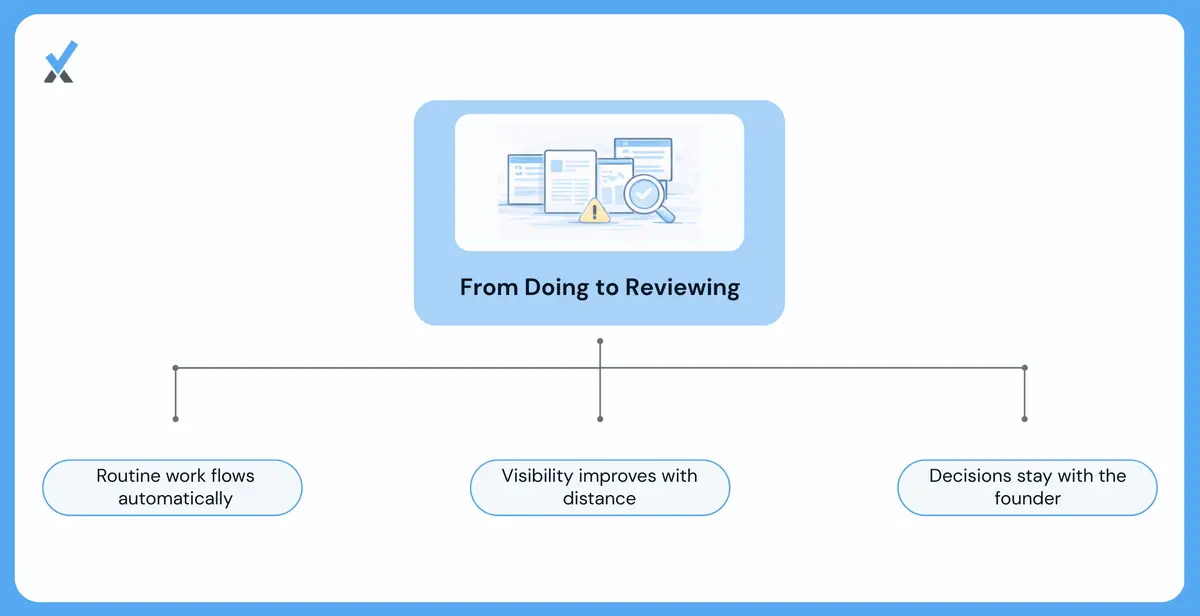
Reducing administrative tasks does not mean the founder ignores financial operations. It means the founder's involvement changes from execution to oversight.
-
Exception-based involvement replaces routine processing. In an automated workflow, the founder does not categorize every transaction. They review transactions that the system could not confidently categorize. They do not process every payroll run. They approve when something changes.
This exception-based model means the founder touches only what requires judgment, while the routine flows without interruption. Founder time goes to the decisions that actually need a founder.
-
Oversight of outputs rather than creation of outputs. A founder who does the bookkeeping sees every transaction in detail but may never step back to see the patterns. A founder who reviews the bookkeeping sees summarized outputs that reveal trends and anomalies.
This shift often improves financial visibility. The founder who spent six hours in the weeds gains thirty minutes of perspective. The dashboard that summarizes cash flow, expenses by category, and budget variances tells a clearer story than the transaction-by-transaction view ever could.
-
Strategic decisions remain with the founder. Automation and delegation handle execution, but the founder retains decision-making authority over matters that require business context, such as approving a large expense, handling an unusual situation, and deciding whether to adjust pricing or staffing.
These decisions cannot be automated. They require the founder's judgment about strategy, risk, and priorities. But they do not require the founder to also do the processing that leads up to the decision.
What did the actual path from six hours to thirty minutes look like?
Sarah's transformation did not happen overnight. It required intentional changes to how her firm handled back-office work.
- First, she documented what she was actually doing. The six hours per week were not one task. There were dozens of small tasks scattered across the week: categorizing transactions, reconciling accounts, running payroll, chasing receipts, filing compliance documents. Each task needed to be visible before it could be addressed.
- Second, she automated what could be automated. Bank feed integrations eliminated manual data entry. Categorization rules handled recurring transactions. Scheduled payroll runs removed the need for manual triggering. Compliance calendars tracked deadlines automatically.
- Third, she delegated what could not be automated. The exception review went to a bookkeeper, who escalated only what required founder judgment. Compliance filings went to an accountant who handled submissions directly. The founder's involvement shifted from execution to approval and oversight.
- Fourth, she protected the reclaimed time. The six hours that became available did not automatically fill with high-value work. Sarah had to consciously redirect that time to business development and client delivery, rather than letting other administrative tasks fill the gap.
| Task | Before automation | After automation |
|---|---|---|
| Weekly time cost | Six hours | Thirty minutes |
| Transaction categorization | Founder categorizes manually, Sunday evenings | 80 to 90 percent automatic, exceptions only |
| Payroll | Founder triggers and checks withholdings | Runs on schedule, founder approves changes |
| Founder role | Doing the processing | Reviewing exceptions and dashboards |
How long does it typically take to go from manual bookkeeping to a mostly automated workflow?
Most of the shift happens within one to two accounting system training cycles, roughly two to three months, since categorization accuracy improves as the system learns a firm's specific vendors and patterns. The documentation and delegation steps can start immediately and do not need to wait on automation.
Does automating bookkeeping and payroll increase the risk of errors going unnoticed?
Not when it is set up correctly. Automated systems flag exceptions rather than silently processing everything, and a human still reviews anything the system cannot confidently categorize. The risk usually runs the other way: manual processes done under time pressure are where errors go undetected longest.
What is the first task a founder should automate or delegate?
Transaction categorization is usually the best starting point, since it is the highest-volume, most repetitive task and most accounting platforms already support automatic rules for it. Payroll and compliance tracking tend to follow once categorization is stable, trusted, and running with minimal exceptions each month.
Every founder who spends hours on bookkeeping and payroll tasks is making a choice, even when it does not feel like one. The consulting firm founder who reclaims six hours per week gains 300 hours per year for the client work, business development, and strategic thinking that actually grows the business, built on the same expert-led, AI-powered, human-in-the-loop model behind Sarah's shift.
See how finance and accounting outsourcing services give founders their time back, built for professional services firms specifically.
Numetix is an AI-first accounting firm. AI runs the bookkeeping, tax, payroll, and reporting workflow. Industry experts handle the judgment, month-end close, review, and advisory. We serve founder-led service firms across law, consulting, IT, healthcare, creative, and nonprofit. Headquartered in California, serving clients nationwide.
Suggested Readings
AppFolio accounting: Best practices for 200+ door PM companies
AppFolio and QuickBooks don’t sync: Here’s how PM firms fix it
Best property management accounting software for growing PM firms
See what Numetix can do for you
Learn how the Numetix Portal streamlines communication, offers valuable insights, and saves you time so you can focus on growing your business.