Percentage of completion explained for service firms: When it works and how to apply it
Key Takeaways
The percentage-of-completion method recognizes revenue based on how much of a project is done, not when the contract closes or invoices go out.
Total revenue recognized never changes under this method; only the timing shifts, so an eight-month, $320,000 contract still totals $320,000 at completion.
Input-based measurement uses hours worked against budgeted hours; output-based measurement uses completed milestones, and firms should pick one method and apply it consistently.
The method fits long engagements with reliably measurable progress and contract terms that support progressive billing, not short or highly uncertain projects.
A completion percentage that exceeds 100% signals the original hour budget was wrong or scope expanded without a price adjustment.
Small differences between recognized revenue and actual contract value at project close are normal; large differences mean the measurement method needs refinement.
Percentage of completion explained for service firms: When it works and how to apply it
Quick Answer
The percentage-of-completion method recognizes revenue in proportion to how much of a long-term project is actually done each period, calculated as contract value times completion percentage minus revenue already recognized. It suits engagements spanning multiple reporting periods where progress can be reliably measured, using either hours worked against budget or completed milestones. Total revenue never changes, only its timing: a $320,000 project still totals $320,000, spread across the months the work happened.
A firm lands an eight-month strategy engagement worth $320,000. The work progresses steadily throughout the project, with the team delivering continuous value from month one through completion.
How should this revenue appear on financial statements? Recognizing $320,000 in month eight when the project closes means months one through seven show zero revenue despite significant work performed. Recognizing $40,000 per month regardless of progress creates artificial smoothing that may not reflect reality.
The percentage-of-completion method offers a third approach: recognizing revenue based on the extent of completion. If the project is 25% done at the end of month two, 25% of revenue gets recognized. The financials match the work, period by period.
How does the percentage-of-completion method match revenue to the work performed?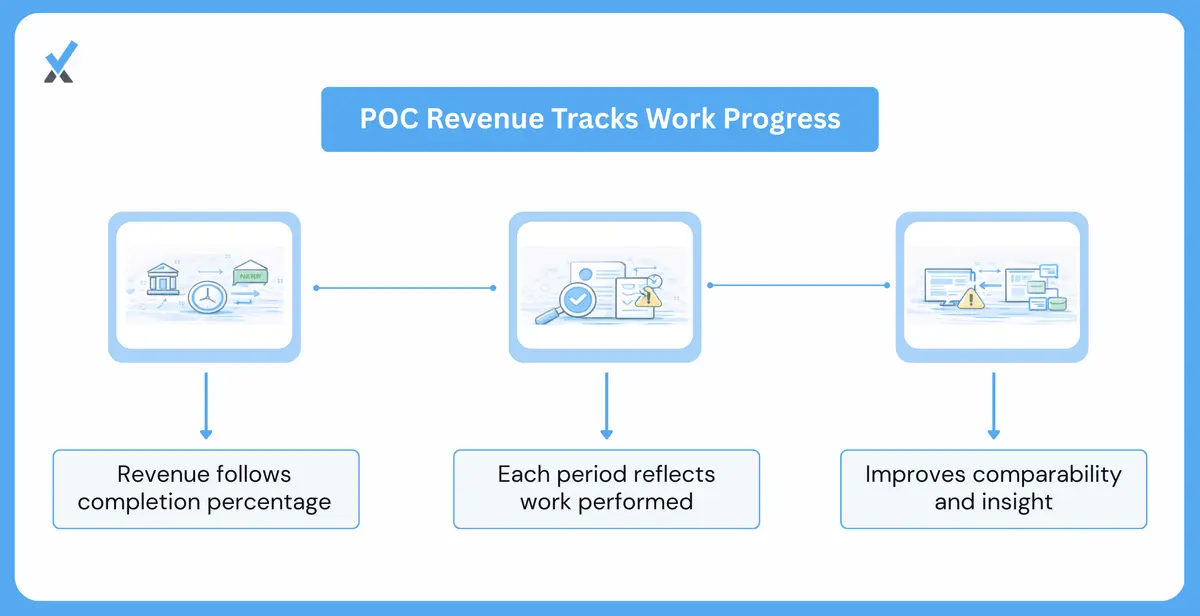
POC revenue recognition is based on a simple principle: revenue should be recognized in the period when the related work occurs. For long-term engagements, this means recognizing revenue progressively as work progresses.
-
Revenue is recognized based on the completion percentage. At each reporting period, the firm assesses what percentage of the project is complete. If a $320,000 project is 30% complete, cumulative revenue recognized is $96,000. If the previous period showed 20% complete with $64,000 recognized, this period's revenue is $32,000, the incremental change.
The calculation is straightforward: contract value multiplied by completion percentage equals cumulative revenue to recognize. Subtract what was recognized in prior periods, and the remainder is current period revenue.
-
Each period reflects work done in that period. The power of progressive revenue recognition is that each month's or quarter's financials reflect that period's activity. A month with heavy project work shows higher revenue. A month when the project was on hold shows lower revenue. The income statement matches operational reality.
This matching enables meaningful period-over-period comparison. Revenue trends reflect work trends. Margin analysis reflects actual project economics for that period. The financials are useful to management, not just for compliance.
-
Total revenue equals contract value when complete. At project completion, cumulative recognized revenue equals the contract value, assuming no changes to scope or price. The percentage-of-completion method does not change total revenue; it changes only the timing of that revenue recognition over the project duration.
The method is about timing allocation, not revenue creation. The $320,000 contract generates $320,000 in total revenue, whether recognized all at completion or spread across eight months. The question is which approach produces more accurate period financials.
When is the percentage-of-completion method actually appropriate?
Not every engagement suits percentage-of-completion accounting. The method works well in certain circumstances and poorly in others.
-
Long-term engagements spanning multiple periods. A two-week project does not need progressive recognition. The effort is concentrated, and recognizing at completion creates minimal distortion. An eight-month project is different. Waiting until completion to recognize revenue creates eight months of misleading financials.
The threshold for "long-term" is judgment-based, but engagements spanning multiple reporting periods, months or quarters, are reasonable candidates. The longer the engagement relative to the reporting cycle, the stronger the case for using the percentage-of-completion method.
-
Reliable measurement of progress is possible. The method requires knowing how complete the project is. For some engagements, this measurement is straightforward. For others, it is difficult or subjective.
Projects with defined phases, measurable milestones, or hour-based scopes lend themselves to progress measurement. Projects with ambiguous deliverables or highly variable scope make progress assessment unreliable. If the completion percentage cannot be reasonably estimated, the method becomes difficult to apply accurately.
-
Contract terms support progressive recognition. The engagement structure should align with progressive recognition. Fixed-fee projects with a defined scope work well. Time-and-materials projects naturally align because hours worked directly measure progress. Projects with heavy contingencies or highly uncertain outcomes may not suit the method.
The contract should also support the billing that follows recognition. Recognizing 40% of revenue while contract terms only allow billing at completion creates an unbilled revenue asset that may carry risk if the project does not complete.
What does correct implementation actually require?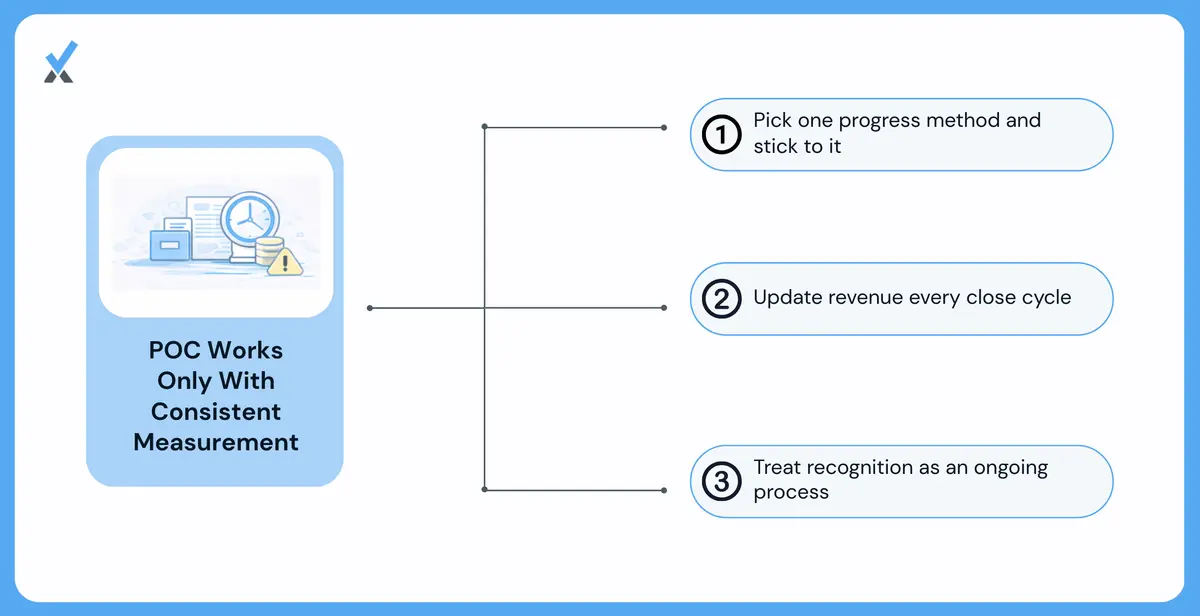
Completion percentage accounting sounds simple: estimate completion, multiply by contract value, and recognize revenue. In practice, several decisions and processes make it work correctly.
-
Choose an appropriate progress measurement method. Two primary approaches exist for measuring completion.
Input-based measurement uses effort expended as the progress indicator. If the project budget is 800 hours and 320 hours have been worked, the project is 40% complete. This approach is simple to calculate when time tracking is accurate, but it assumes effort correlates with progress. A project can consume hours without making proportional progress.
Output-based measurement uses deliverables or milestones as the progress indicator. If five of ten defined milestones are complete, the project is 50% complete. This approach ties progress to actual deliverables but requires well-defined milestones and judgment about partial completion.
Many service firms use input-based measurement because time tracking data already exists. The key is consistency: choose a method and apply it uniformly across engagements.
-
Calculate and record revenue at each close. Monthly or quarterly, the completion percentage for each project gets calculated using POC to determine the revenue to recognize. The process involves several steps:
Assess current completion percentage using the chosen method
Calculate cumulative revenue to recognize (completion % × contract value)
Compare to prior cumulative recognition
Record the incremental revenue for the current period
This calculation should be part of the standard close process. Long-term service revenue recognition is not a year-end adjustment; it is ongoing period-by-period accounting.
-
Reconcile to actual results at completion. When projects are complete, cumulative recognized revenue should be verified against the actual contract value, adjusted for any scope changes. Differences may arise from estimation errors during the project.
Small differences are normal and can be recognized in the final period. Large differences suggest the progress measurement method needs refinement. Tracking these differences improves estimation accuracy over time.
What does the calculation look like in a real example?
Consider the $320,000 eight-month engagement using input-based measurement:
The project budget is 1,600 hours. At the end of month two, 380 hours have been logged. Completion percentage: 380 ÷ 1,600 = 23.75%.
Revenue to recognize cumulatively: $320,000 × 23.75% = $76,000.
If month one recognized $38,000 (based on 12% completion), month two recognizes $38,000 ($76,000 cumulative minus $38,000 prior).
Each month, the calculation repeats with updated hours. At project end, total hours should approximate 1,600, and total revenue recognized should equal $320,000.
If the project runs over budget by 1,800 hours, the completion percentage calculation shows a value over 100% because the hours exceed the budget. This signals that either the budget estimate was wrong or the scope was expanded without a price adjustment. The reconciliation at completion addresses the discrepancy.
When should a firm avoid using percentage-of-completion?
The method is not universally appropriate. Short engagements that complete within a single reporting period do not need it. Engagements with highly uncertain outcomes may not support reliable progress estimation. Projects with a significant risk of non-completion may be better served by completed contract accounting, which recognizes revenue only upon completion.
The choice between methods is a judgment call based on engagement characteristics and a firm's ability to reliably measure progress. Consistency matters: once a method is chosen for a type of engagement, it should apply consistently to similar engagements.
| Characteristic | Percentage-of-completion | Completed contract |
|---|---|---|
| Best for | Long engagements, measurable progress | Short or highly uncertain projects |
| Revenue timing | Recognized period by period | Recognized entirely at completion |
| Requires | Reliable progress measurement | No progress measurement needed |
| Risk if misapplied | Inaccurate period financials | Understates activity during the project |
Does the percentage-of-completion method require GAAP compliance, or is it optional?
Under GAAP and the ASC 606 revenue recognition standard, percentage-of-completion (recognizing revenue over time) is required when specific criteria are met, rather than being a discretionary choice. A firm's accountant should confirm which engagements meet those criteria rather than defaulting to whichever method feels simpler.
What happens to recognized revenue if a client cancels a project mid-way?
Revenue already recognized based on completed work generally stands, since it reflects value actually delivered. What typically needs adjustment is any unbilled revenue asset built up if billing had not yet caught up to recognition, which may need to be written off or renegotiated as part of the cancellation terms.
Can a firm use percentage-of-completion for some projects and completed-contract for others?
Yes, as long as the choice is applied consistently within similar engagement types rather than switched project by project based on convenience. A firm might reasonably use percentage-of-completion for long fixed-fee engagements and completed-contract for short, well-defined projects with a fixed deliverable date.
Revenue should reflect the work. The month a team puts in heavy project effort is the month that effort should generate revenue, tracked with the same expert-led, AI-powered, human-in-the-loop discipline behind every close.
See how Numetix accounting services handle revenue recognition, built for professional services firms specifically.
Numetix is an AI-first accounting firm. AI runs the bookkeeping, tax, payroll, and reporting workflow. Industry experts handle the judgment, month-end close, review, and advisory. We serve founder-led service firms across law, consulting, IT, healthcare, creative, and nonprofit. Headquartered in California, serving clients nationwide.
Suggested Readings
Which accounting firms specialize in dental practices?
Nonprofit revenue recognition: grants vs contributions vs exchange transactions
How often do IOLTA trust accounts need to be reconciled?
See what Numetix can do for you
Learn how the Numetix Portal streamlines communication, offers valuable insights, and saves you time so you can focus on growing your business.