Financial vs managerial accounting: What's the difference and why it matters
Key Takeaways
Financial accounting follows GAAP and reports what already happened, built for banks, investors, and the IRS rather than day-to-day decisions.
Managerial accounting has no external rules or standard format; the only test is whether a report actually helps a founder decide something.
A P&L can show $240,000 in profit while hiding that three clients generating 60 percent of revenue produce only 35 percent of it.
Managerial reports look forward as well as back, turning historical data into runway projections, break-even models, and hiring scenarios.
Financial accounting is non-negotiable for staying compliant and fundable; managerial accounting is what makes a founder feel actually in control.
Most early-stage firms run on financial accounting alone until they realize they have plenty of numbers but no answers to the questions that matter.
Financial vs managerial accounting: What is the difference and why it matters
Quick Answer
Financial accounting follows GAAP to produce standardized, backward-looking reports like the P&L and balance sheet for banks, investors, and the IRS. Managerial accounting has no external rules and instead answers internal questions: which clients are profitable, how much cash runway remains, and whether a hire is affordable next quarter. A firm can look profitable on paper while a managerial report shows its biggest client barely breaking even.
A bookkeeper sends a profit-and-loss statement every month. A fractional CFO shows project margin reports and cash runway projections. Both involve numbers from the business. Both claim to help make better decisions.
But they feel completely different. One looks like a formal document you would hand to a bank. The other looks like a custom dashboard built around how a founder actually thinks about the business.
That difference is not random. It reflects two fundamentally distinct types of accounting: financial accounting and managerial accounting. Understanding what each one does, and what it cannot do, is the difference between having numbers and actually using them to run a company.
What does financial accounting actually tell you?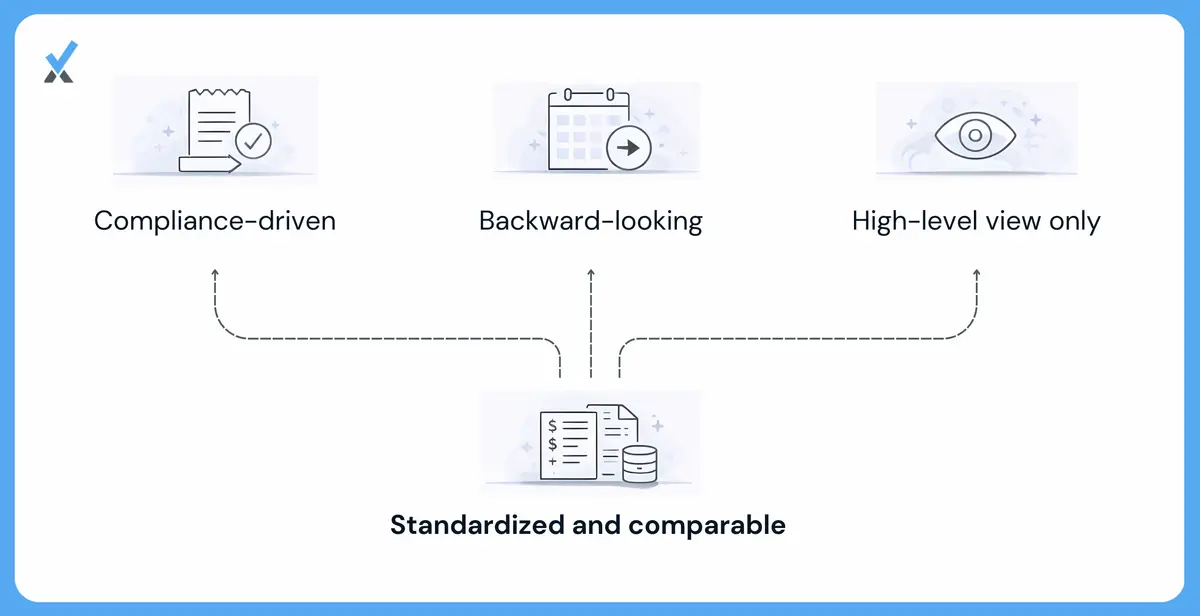
Financial accounting is what most people picture when they hear the word accounting. It produces the official reports that external parties rely on: a profit and loss statement, balance sheet, and cash flow statement.
These reports follow standardized rules. In the United States, that means Generally Accepted Accounting Principles, or GAAP. The rules exist so that anyone reading the financials, whether an investor, a lender, or the IRS, can compare them against other businesses and trust that the numbers mean the same thing.
Financial accounting uses include:
Filing taxes accurately and on time
Providing statements to banks for loans or lines of credit
Sharing financials with investors during fundraising or due diligence
Meeting compliance requirements for audits or regulatory filings
The key characteristic of financial accounting is that it looks backward. It reports what already happened: last quarter's revenue, last year's expenses, the profit made or the loss absorbed. This historical focus is essential for accountability and compliance, but it limits the usefulness of financial statements for forward-looking decisions.
Financial accounting also aggregates information at the company level. A P&L shows total revenue and total expenses. It does not show which client was most profitable, which service line is losing money, or whether margins are improving or eroding project by project. That level of detail requires a different approach.
What does managerial accounting actually tell you?
Managerial accounting exists to serve internal decision-makers. There are no external rules, no GAAP requirements, no standardized formats. The only test is whether the information helps make better choices.
Where financial accounting is structured for outsiders, managerial accounting is structured around the questions a founder actually asks. How profitable is this client? Should the firm hire another consultant or use contractors? What happens to runway if revenue drops 15 percent? Can the firm afford to raise salaries next quarter?
The management accounting purpose shows up in outputs like:
Project-level and client-level profitability reports
Cash flow forecasts and runway projections
Pricing models and break-even calculations
Scenario planning for hiring, expansion, or downturns
Managerial accounting looks forward as much as it looks backward. It uses historical data to project, model, and plan. A financial statement shows that a firm made $80,000 in profit last quarter. A managerial report shows that at the current utilization rate and these margins, the firm has 7.3 months of runway and should delay the hire planned for Q3.
The information is also customized to the business. A consulting firm's managerial accounting might track utilization rates and revenue per consultant. A creative agency might track project profitability by client type. A legal practice might track realization rates and billable hour efficiency. None of these metrics appear on a standard financial statement, but all are essential to running the business well.
Why does the distinction matter for growing firms?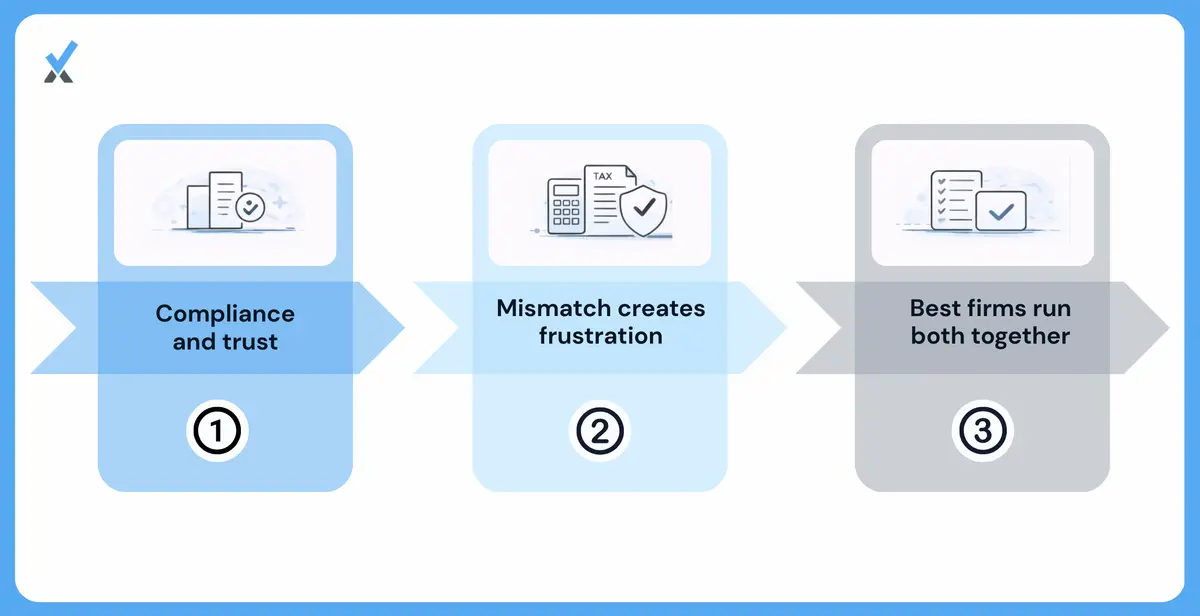
Understanding accounting types explained this way reveals a gap that trips up many business owners. They receive financial statements and expect those statements to answer operational questions. When the P&L fails to explain why cash feels tight even though it shows a profit, frustration sets in.
The frustration is not a sign that the accountant is doing something wrong. It is a sign that financial accounting is being asked to do managerial accounting's job.
Here is how the two types work together:
Financial accounting keeps a firm compliant and credible. Without accurate GAAP-based financials, a firm cannot file taxes correctly, secure a loan, or pass due diligence during a fundraise. Every business needs this foundation. It is non-negotiable.
Managerial accounting keeps a firm informed and agile. Without internal reports tailored to its decisions, the business runs on intuition. A founder might feel like things are going well but cannot prove it, might sense that a client relationship is unprofitable but cannot quantify it. The data exists in the financial records, but financial accounting does not surface it in a useful form.
The firms that feel most in control of their numbers are those with both systems working. Their bookkeeper or accountant produces clean, compliant financial statements. Their CFO or advisory partner produces managerial reports that answer the specific questions their business faces.
What does this distinction look like in practice?
Consider a consulting firm with $2 million in revenue. Its financial statements show $240,000 in net income for the year. By every standard measure, it is profitable.
But when it builds managerial reports that break down profitability by client, something important surfaces. Three clients account for 60% of revenue but only 35% of profit. Two small clients once considered "not worth the effort" actually deliver 50% margins. And one flagship client served for four years is barely breaking even after accounting for the senior time required to manage the relationship.
None of this information appears on the financial statements. The P&L shows total revenue and total expenses. It does not reveal that the business would be more profitable if it fired its biggest client and doubled down on its smaller clients.
That insight comes from managerial accounting. And it is the kind of insight that changes how a founder runs the business.
How does a firm get both types of accounting right?
Financial vs managerial accounting is not an either-or choice. A firm needs financial accounting to stay legal, fundable, and credible. It needs managerial accounting to stay informed, strategic, and in control.
Most early-stage firms start with financial accounting only because that is what compliance requires. The shift to adding managerial accounting usually happens when a founder realizes they have plenty of numbers but cannot actually answer the questions that matter for their decisions.
If the financial statements leave a founder feeling informed but not empowered, the issue is probably not the quality of those statements. The problem is that a different type of accounting, delivered with an expert-led, AI-powered, human-in-the-loop process, needs to be layered on top.
| Dimension | Financial accounting | Managerial accounting |
|---|---|---|
| Audience | Banks, investors, the IRS | Founders and internal decision-makers |
| Rules | GAAP, standardized format | None, built around the questions asked |
| Time orientation | Backward-looking | Forward-looking as well as backward |
| Example output | P&L, balance sheet, cash flow statement | Client profitability, runway model, break-even analysis |
Does a small firm need managerial accounting, or is financial accounting enough at first?
Financial accounting alone is usually enough in the earliest stage, when compliance is the main concern and the founder can still hold most of the business context in their head. Managerial accounting tends to become necessary once client count, headcount, or service lines grow past the point where that intuition stays reliable.
Who typically produces managerial accounting reports, a bookkeeper or someone else?
A bookkeeper's role is usually limited to producing the clean underlying data. Managerial reports themselves are typically built by a fractional CFO, controller, or advisory partner who interprets that data against the specific decisions a founder is facing at that stage of the business.
Can managerial accounting reports ever conflict with what the financial statements show?
They should not conflict on the underlying numbers, since both draw from the same records, but they can tell very different stories. A firm can be profitable on the P&L while a managerial report shows a specific client or service line quietly losing money.
The numbers needed to run a business are different from the numbers needed to report it, and both matter.
See how Numetix accounting services cover both sides, built for professional services firms specifically.
Numetix is an AI-first accounting firm. AI runs the bookkeeping, tax, payroll, and reporting workflow. Industry experts handle the judgment, month-end close, review, and advisory. We serve founder-led service firms across law, consulting, IT, healthcare, creative, and nonprofit. Headquartered in California, serving clients nationwide.
Suggested Readings
Which accounting firms specialize in dental practices?
Nonprofit revenue recognition: grants vs contributions vs exchange transactions
How often do IOLTA trust accounts need to be reconciled?
See what Numetix can do for you
Learn how the Numetix Portal streamlines communication, offers valuable insights, and saves you time so you can focus on growing your business.