DIY tax software vs. business reality: The costs most owners don't see
Key Takeaways
Tax software accepts whatever gets entered without questioning it; a miscategorized expense or an unclaimed deduction simply gets calculated as-is, no flag raised.
Real tax savings usually come from decisions made throughout the year, entity structure, retirement contributions, purchase timing, not from accurate data entry in April.
Switching how a company gets taxed can be worth thousands a year in savings, yet no software prompts an owner to even consider the option.
A professional reviewing a return for the first time often uncovers deductions missed for years; that single review can outweigh several years of fees.
Wrestling with a return at a high billable rate for a full workweek's worth of hours often costs more in lost time than hiring it out would.
The businesses that actually fit simple DIY software are rare; employees, contractors, multiple states, or growth ambitions quickly exceed what input-based software handles.
DIY tax software vs. business reality: The costs most owners do not see
Quick Answer
DIY tax software processes whatever gets entered but cannot question assumptions, flag a missed deduction, or evaluate the entity structure the way a professional would. The real comparison is not the sticker price of software against a preparer fee; it is years of missed deductions, unknowingly aggressive positions, and the opportunity cost of hours spent wrestling with a return instead of billable work. Software works fine for simple situations, but most growing businesses outgrow it quickly.
TurboTax or H&R Block software gets used for years. Personal taxes are straightforward: plug in a W-2, answer some questions, click submit. When the business started, using similar software for business taxes felt like a logical next step.
The price was right. The interface was familiar. And the software promised it could handle business returns just as well as personal ones.
But something feels off. The questions are more complex, and the answers are not always clearly correct. There is a vague sense of missing deductions, of strategies or structures that could save money, but the software never mentions them.
That vague sense is worth paying attention to. The cons of tax preparation websites for business owners go far beyond the obvious accuracy concerns. The real costs are invisible until the gap becomes visible.
Why can DIY software process inputs but never question assumptions?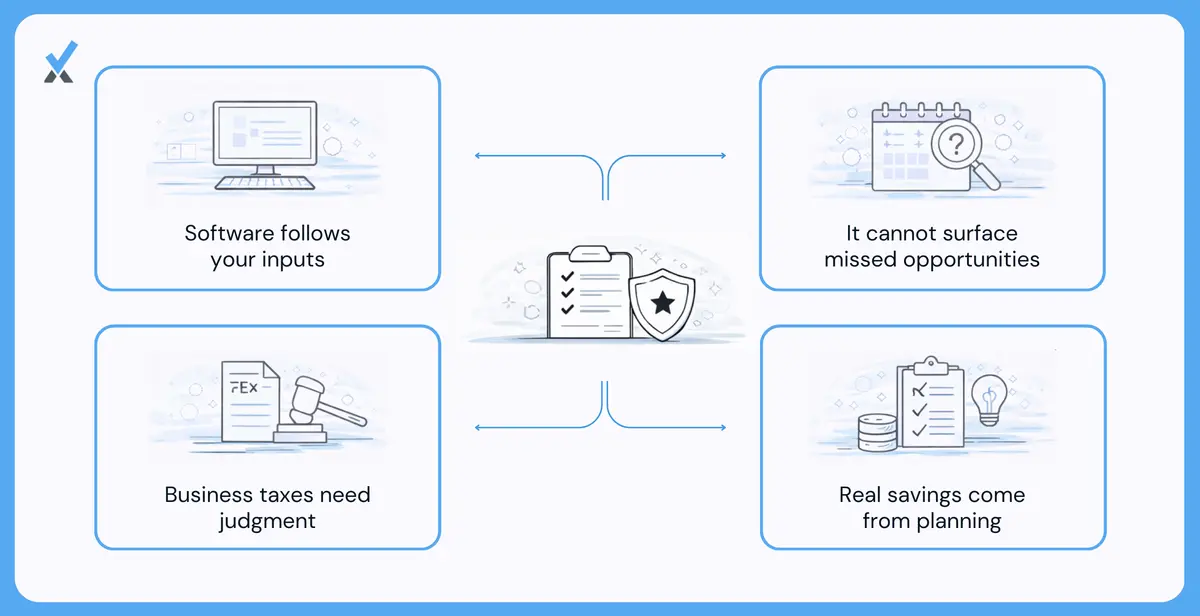
Tax software is fundamentally reactive. It asks questions, accepts the answers, and calculates results based on what gets provided. It cannot do what a human professional does: notice that the answers suggest a problem, ask follow-up questions, or recommend a different approach entirely.
The software follows your lead, even when you are wrong. A miscategorized expense gets accepted as entered. A deduction that was never known to exist cannot be flagged by the software. An outdated or incomplete understanding of a tax rule gets calculated exactly as misunderstood.
This limitation matters more for business taxes than personal taxes. A W-2 employee has limited complexity. A business owner making decisions about entity structure, retirement contributions, equipment purchases, contractor payments, and multi-state operations faces dozens of judgment calls that the software cannot help with.
Tax planning requires proactive expertise. The most significant savings in business taxes do not come from accurate data entry. They come from strategic decisions made throughout the year: a large equipment purchase before year-end to accelerate depreciation, adjusting the salary versus distribution mix as an S-corp owner, or establishing a retirement plan that provides both tax savings and wealth building.
DIY tax software problems include the inability to surface these questions. The software handles the return it is given. A professional asks whether the return being filed is the best one possible given the circumstances.
Entity structure optimization is invisible. Many business owners operate under an entity structure that made sense when they started, but now costs them money. An LLC taxed as a sole proprietor might save thousands annually by electing S-corp treatment. A business owner approaching certain thresholds might benefit from different retirement plan structures.
TurboTax limitations include the inability to evaluate whether the current structure is optimal. The software files the return under whatever entity type gets selected. It does not flag that a different selection might reduce the tax burden by $8,000 per year.
Why are uncaught errors more expensive than the fees avoided?
The apparent savings from DIY tax preparation disappear quickly when errors compound. And with business taxes, mistakes are more common and more costly than most owners realize.
-
Missed deductions compound year after year. A home office deduction that went unclaimed was missed last year, and the year before. Health insurance premiums that could have been deducted as a self-employed person are gone forever if never claimed. Vehicle mileage that was not properly tracked makes the deduction unclaimable.
A professional reviewing a business owner's situation for the first time often identifies deductions that have been missed for years. That single conversation can recover more than several years of professional fees.
-
Incorrect treatment creates future liability. Some tax positions are judgment calls. How an expense gets treated, a worker gets classified, or revenue gets recognized involves interpreting rules that are not always black-and-white. DIY software accepts whatever treatment gets selected without evaluating whether it will survive IRS scrutiny.
Self-prepared tax risks include taking aggressive positions without realizing they are aggressive. A professional knows which positions are safe, which are defensible, and which invite audit attention. That knowledge shapes how returns are prepared in ways that software cannot replicate.
-
Audit exposure increases without professional review. The IRS examines specific patterns that correlate with errors or fraud: unusually high deductions relative to income, specific expense categories that are frequently abused, and round numbers that suggest estimation rather than documentation.
A professional preparing a return understands these patterns and ensures legitimate deductions get presented in a way that does not trigger unnecessary scrutiny. Online tax prep issues include the absence of this protective layer. A return can be completely compliant and still invite an audit because of how it was assembled.
What is the real comparison between software cost and accountant cost?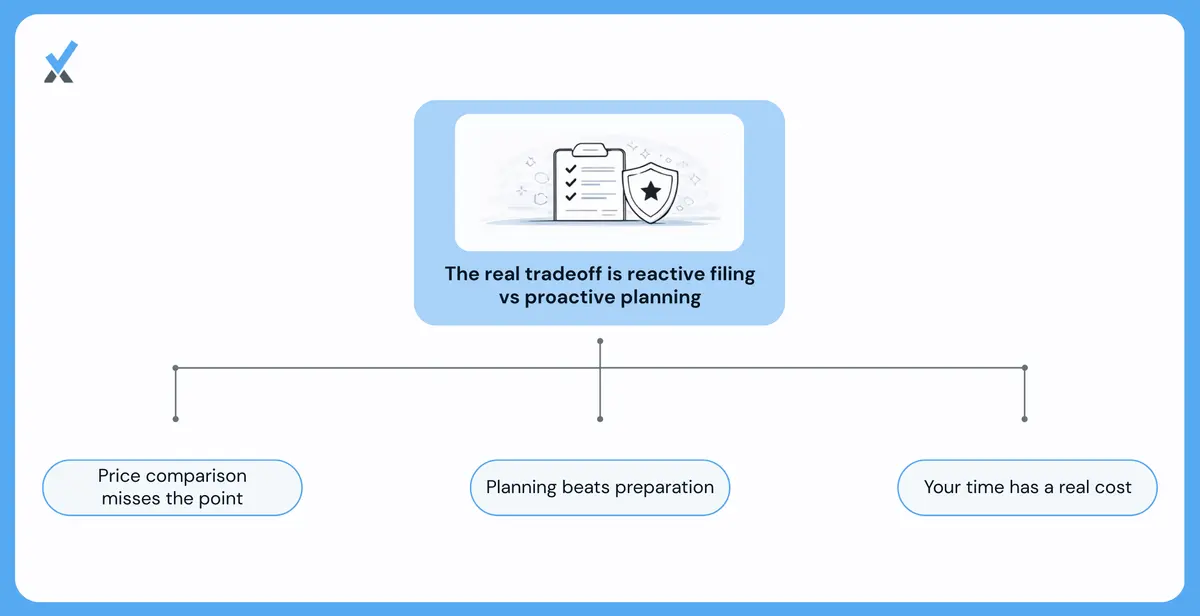
When business owners evaluate tax software versus an accountant, they typically compare the $150 software subscription against the $2,000 professional fee. The professional seems expensive. But that comparison misses most of what the professional provides.
Professional value includes planning, not just preparation. Tax preparation looks backward at what already happened. Tax planning looks ahead at decisions not yet made. A professional who reviews a client's situation quarterly can identify opportunities before they expire. A software package opened in April can only work with decisions already locked in. The value of moving from reactive filing to proactive planning often exceeds the preparation fee by multiples.
Time has an opportunity cost. The hours spent wrestling with business tax software are hours not spent on client work, business development, or strategic planning. A founder billing $200 an hour who spends 15 hours on tax preparation is looking at a $3,000 time cost, more than most professional fees. Even without billable work during those hours, the mental energy consumed drains capacity from everything else.
Peace of mind has tangible value. The business owners who sleep best during tax season are not the ones who saved the most on preparation fees. They are the ones who know their returns were prepared correctly by someone who understands their situation, reviewed their strategy, and will stand behind the work if questions arise.
That confidence is worth something. The alternative is the low-grade anxiety of wondering whether it was done right, whether something got missed, and whether a letter might arrive someday asking questions that cannot be answered.
When does DIY tax software actually stop working?
DIY tax software is not useless. For simple personal returns, it works fine. For straightforward businesses with minimal complexity, it may be adequate.
But the businesses that fit that description are rare. The moment employees, contractors, multiple states, equipment, retirement plans, or growth ambitions enter the picture, the complexity exceeds what input-based software can handle.
The cons of tax preparation websites are not about the software being harmful in its operations. The software is acceptable for data entry and calculation. The problem is that business taxes require more than data entry and calculation. They require judgment, strategy, and expertise, delivered with the same expert-led, AI-powered, human-in-the-loop rigor a good preparer brings, that no software can provide on its own.
The owners who continue using DIY software for complex business returns are not saving money. They are just deferring the cost until they discover what they missed. By then, the missed opportunities are gone, and the errors have compounded.
| Dimension | DIY software | Professional preparer |
|---|---|---|
| Approach | Reactive, processes what is entered | Proactive, questions and plans ahead |
| Entity structure review | Not evaluated | Assessed for optimization opportunities |
| Deduction discovery | Limited to what the user already knows | Surfaces deductions the owner may not know exist |
| Audit risk awareness | None built in | Positions assessed for defensibility |
At what point does a business typically outgrow DIY tax software?
The tipping point usually arrives with the first employee, the first contractor requiring 1099 filings, operations in a second state, or the first year net income grows enough to make entity structure genuinely matter. Any one of these adds enough judgment-based complexity that software alone stops being sufficient.
Can DIY software and a professional preparer be used together?
Sometimes, for very simple situations where software handles routine data entry and a professional gets consulted periodically for strategic questions. But for most growing businesses, the value of a professional comes from reviewing the whole picture together, which a split approach tends to undermine.
Is DIY tax software ever actually the right call?
Yes, for a genuinely simple sole proprietorship with no employees, no contractors, a single state, and straightforward income, software can be perfectly adequate. The right call depends on matching the tool to the actual complexity of the business, not on price alone.
The cost of DIY software is not the subscription price. It is everything missed along the way.
See how Numetix tax services pair preparation with real planning, for professional services firms specifically.
Numetix is an AI-first accounting firm. AI runs the bookkeeping, tax, payroll, and reporting workflow. Industry experts handle the judgment, month-end close, review, and advisory. We serve founder-led service firms across law, consulting, IT, healthcare, creative, and nonprofit. Headquartered in California, serving clients nationwide.
Suggested Readings
Missed the September 15 tax deadline: What happens next and how to reduce the penalty
September 15 tax deadline 2026: What small business owners need to file or pay today
Medical practice 1099 filing: Managing contractor clinicians without year-end chaos
See what Numetix can do for you
Learn how the Numetix Portal streamlines communication, offers valuable insights, and saves you time so you can focus on growing your business.