Tracking reimbursable expenses: How service firms stop leaving billable money on the table
Key Takeaways
-
Firms typically fail to bill 3 to 8 percent of reimbursable expenses, and every unbilled dollar is pure lost profit, not just missed revenue.
-
Forty active engagements leaking just $200 each in unbilled expenses monthly adds up to roughly $100,000 in lost profit a year.
-
Expenses typically slip through three failure points: never tagged as billable, tagged but excluded from the invoice, or written off for lack of documentation.
-
Defaulting every client-related expense to billable, rather than requiring someone to remember to flag it, closes the most common leak.
-
Automating the flow from tagged expense to invoice removes the manual step where most reimbursable costs get dropped.
-
Capturing receipt documentation at the moment of purchase, not weeks later, is what lets a firm defend and collect every dollar billed.
Tracking reimbursable expenses: How service firms stop leaving billable money on the table
Quick Answer
Tracking reimbursable expenses means treating every client-related cost as billable by default, then routing it automatically from expense capture to invoice with documentation attached at the point of purchase. Most service firms lose 3 to 8 percent of reimbursable expenses to gaps between spending and billing, money that carries no additional cost to collect. Fixing the process, not chasing clients harder, typically recovers thousands of dollars per month within one billing cycle.
A consultant flew to Chicago for a client meeting. The flight cost $420. The hotel was $380 for two nights. Ground transportation added another $85. All of these expenses are reimbursable under the engagement agreement.
But when the monthly invoice went out, only the hotel appeared. The flight was on a corporate card that nobody reconciled to the project. The ground transportation receipts never got submitted. The firm spent $885 on the client's behalf and billed $380.
This happens every month at most consulting firms, not with every expense, but with enough of them that the cumulative loss is meaningful. Tracking reimbursable expenses systematically is not about administrative perfection. It is about capturing revenue already earned.
Why do unbilled reimbursable expenses represent meaningful lost revenue?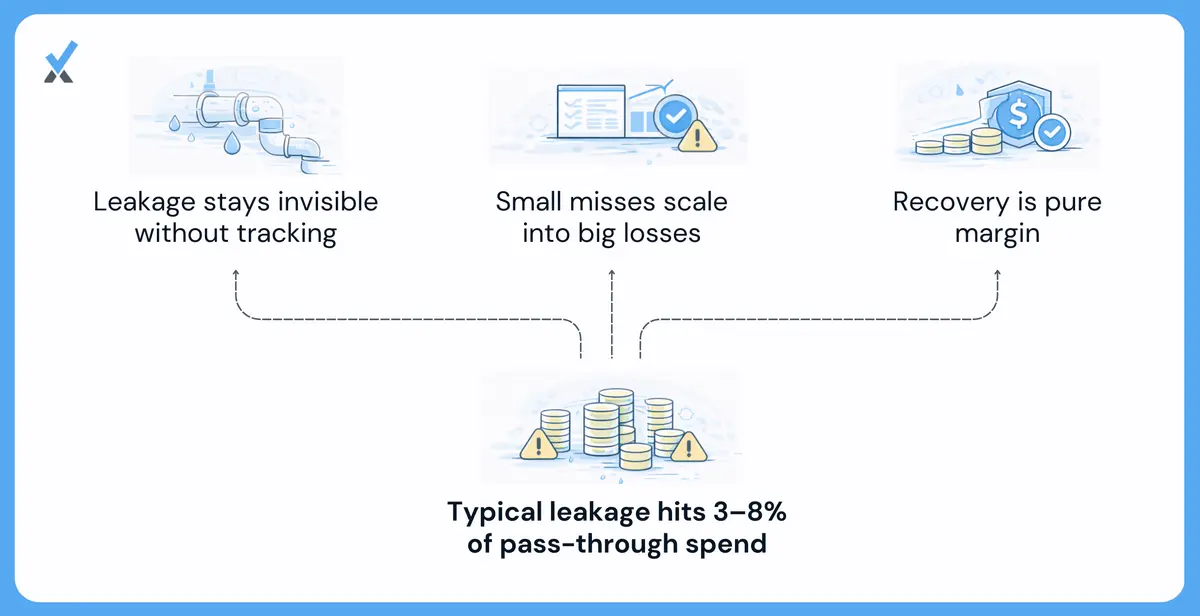
The money lost to poor reimbursable expense management is invisible until someone looks for it, and most firms never look. Three patterns explain why the leakage is easy to miss and expensive to ignore once measured.
-
The leakage is invisible until measured. Invoices show what a firm billed. They do not show what it could have billed but did not. The flight that was never passed through to the client does not appear as a removed line item. It simply never existed on the invoice.
This invisibility makes the problem easy to ignore. There is no report showing unbilled reimbursable expenses, only revenue and expenses, with the gap between what was spent and what was recovered hiding in aggregate numbers.
-
Small expenses add up across many engagements. A single missed $50 parking receipt does not matter. But a firm running 40 active engagements with $200 in expenses slipping through the cracks on each one every month loses $8,000 monthly. Annualized, that is nearly $100,000.
The 3 to 8 percent leakage rate firms typically experience on reimbursable expenses translates to real money. A $2 million firm that should bill $150,000 in annual pass-through expenses but captures only $130,000 has lost $20,000 in pure profit.
-
The loss is pure margin, since costs have already been incurred. This is not revenue that requires additional work to earn. The work is done. The expense was paid. The only remaining step is billing the client, which the engagement agreement already permits.
Every unbilled reimbursable dollar flows directly to the bottom line when captured. There is no cost of goods sold, no additional labor, and no incremental overhead. It is money the firm already owned and let slip away.
Where do expenses typically slip through the cracks?
Pass-through expense accounting fails in specific, identifiable ways. Understanding where expenses get lost is the first step toward capturing them, and it usually happens at one of three predictable points.
-
Failure point 1: Not identified as billable at the time of purchase. Someone books a flight for a client's trip. The expense is charged to a corporate card. At month-end, it is categorized as a travel expense but not tagged to a client, so it becomes overhead rather than a billable cost.
This failure occurs when the default assumption is that expenses are internal unless otherwise marked. The person incurring the expense may not know it is billable, and the person categorizing expenses may not have visibility into which trips served which clients.
-
Failure point 2: Tagged but not included in the invoice workflow. The expense is correctly identified as billable and tagged to the right client, but the invoice goes out without it because the billing process does not pull from the expense system. Someone has to manually add reimbursable expenses to invoices, and that step gets skipped.
This failure happens when expense capture and invoicing are disconnected processes. The expense exists in one system. The invoice is created in another. The link between them depends on human memory and manual transfer.
-
Failure point 3: Included but written off due to missing documentation. The expense appears on the invoice, but the client questions it. Where is the receipt? What was this for? Without documentation, the firm writes off the expense rather than defending it, even though the client was willing to pay.
This failure happens when documentation is not captured at the time of the transaction. Reconstructing a backup three weeks after an expense is difficult, and defending a charge without documentation is harder still.
How does systematic capture fix these failure points?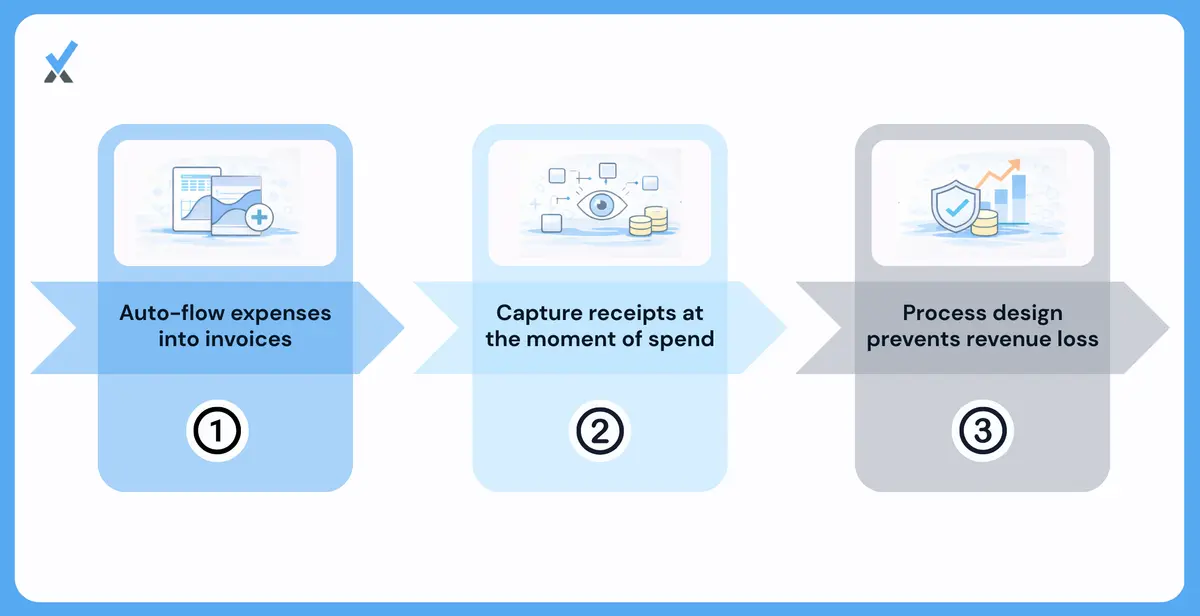
Billable expense capture that actually works addresses each failure point with a specific process and, where possible, automation, rather than relying on individual memory to catch what slips through.
-
Default to billable for client-related expenses. When a consultant incurs an expense during a client engagement, the default assumption should be that it is reimbursable. The burden should be on proving an expense is internal, not on remembering to mark it billable.
This default changes behavior. Instead of expenses slipping through because nobody tagged them, expenses only become overhead when explicitly reclassified. The consultant booking a flight is prompted to assign a client; skipping the prompt flags the expense for review rather than defaulting it to internal.
-
Automate the flow from expense to invoice. Tagged reimbursable expenses should flow to invoices without manual intervention. When an invoice for a client is generated, all reimbursable expenses tagged to that client and not yet billed should be automatically included.
This automation eliminates the second failure point. The billing person does not need to remember to check the expense system. The system presents billable expenses during the invoice workflow, so removing an expense requires a conscious decision while including it is the default.
-
Capture documentation at the point of transaction. Reimbursable cost tracking must include receipt capture as part of the standard process. The receipt photograph should happen at the restaurant, not three weeks later when the client asks for backup.
Mobile expense apps make this easy. The consultant photographs the receipt while still at the table, tags it to the client, and moves on. The documentation exists from the moment the expense occurs, so when the client requests backup, the receipt is already attached to the line item.
Why do the economics favor investing in better capture?
Improving billable expense capture does not require expensive systems or a significant time investment. It requires process clarity and basic tooling, most of which a firm already has access to.
-
Define which expense types are reimbursable by default.
-
Configure the expense system to prompt for client assignment on those categories.
-
Connect expense data to the invoicing workflow so tagged expenses appear automatically.
-
Train consultants to expect receipts to be captured immediately, not reconstructed later.
These changes take days to implement, not months. The return shows up in the next billing cycle as expenses that would have been missed instead appearing on invoices.
For most firms, improving reimbursable expense capture from 70 to 95 percent captures thousands of dollars in annual revenue that requires no additional sales, deliveries, or overhead. It simply requires not losing money already earned.
Why does failing to bill these expenses mean subsidizing your clients?
Every reimbursable expense a firm fails to bill is a gift to the client at the firm's expense: their travel, their software, their subcontractor, all paid for and never recovered. The engagement agreement entitles the firm to those costs back, but recovery only happens if the expense makes it onto an invoice.
Tracking reimbursable expenses is not about being aggressive with clients. It is about being accurate. The client agreed to reimburse these costs and expects to pay them. The only reason they do not is that nobody asked.
The flight that disappeared, the software subscription absorbed as overhead, the subcontractor invoice that never passed through: each one represents money spent serving a client that was never recovered. The cumulative loss across a year of engagements is substantial.
| Failure point | Without a process | With systematic capture |
|---|---|---|
| Tagging at purchase | Defaults to internal, easy to miss | Defaults to billable, exceptions reviewed |
| Expense to invoice | Manual transfer, frequently skipped | Automatic pull into every invoice |
| Documentation | Reconstructed weeks later, often lost | Captured at point of purchase |
| Typical capture rate | Roughly 70 percent | Roughly 95 percent |
How quickly can a firm expect to see results after fixing expense capture?
Most firms see previously missed expenses appearing on invoices within the very next billing cycle. Because the fix is procedural rather than a system overhaul, there is no multi-month implementation lag between putting the default-to-billable rule in place and the revenue showing up.
Should a firm bill for every small reimbursable expense, even a $10 parking fee?
Yes, if the engagement agreement covers it. The economics favor billing everything the agreement allows, since automation removes the manual cost of processing small items. Selectively skipping small expenses reintroduces the judgment calls that caused the leakage in the first place.
What is a reasonable target capture rate for reimbursable expenses?
Firms with a defined process and automated expense-to-invoice flow typically reach 90 to 95 percent capture. Below 80 percent usually signals that expenses are still being tagged manually rather than defaulting to billable at the point of purchase.
Clients are not taking advantage of a firm that under-bills reimbursable expenses. The process is. Fixing it, with the same expert-led, AI-powered, human-in-the-loop rigor Numetix applies to every engagement, is what lets that revenue start appearing on invoices where it belongs.
See how real-time expense tracking handles capture automatically, or explore how this fits professional services firms specifically.
Numetix is an AI-first accounting firm. AI runs the bookkeeping, tax, payroll, and reporting workflow. Industry experts handle the judgment, month-end close, review, and advisory. We serve founder-led service firms across law, consulting, IT, healthcare, creative, and nonprofit. Headquartered in California, serving clients nationwide.
Suggested Readings
Unbilled revenue tracking: The money your service firm has earned but hasn't invoiced yet
What your accounts receivable aging report reveals about which clients are actually hurting your cash flow
Why tracked hours never reach the invoice: The billing workflow gaps most service firms don't see
See what Numetix can do for you
Learn how the Numetix Portal streamlines communication, offers valuable insights, and saves you time so you can focus on growing your business.