Monthly bookkeeping services: Why consistency drives financial confidence
Key Takeaways
-
Reconstructing three months of untouched books typically takes more than three times the effort of a single consistent monthly close.
-
A miscategorized entry left uncorrected for months multiplies its damage across every report built on that data before anyone catches it.
-
Firms with current books can act on hiring, pricing, and purchase decisions immediately, while sporadic bookkeeping forces costly delays.
-
Monthly bookkeeping typically costs $300 to $1,500 depending on transaction volume, and usually pays for itself through lower year-end CPA fees.
-
A close finished seven to fifteen days after month-end is a reasonable benchmark; a thirty day close defeats much of the point of paying monthly.
-
Subscription bookkeeping providers scale with a growing firm's complexity, so growth never forces starting over with a brand new provider.
Monthly bookkeeping services: Why consistency drives financial confidence
Quick Answer
Monthly bookkeeping services replace the boom-and-bust cycle of catching up every few months with a fixed, predictable close, usually finished within seven to fifteen days of month-end. That rhythm keeps errors small, keeps quarterly tax estimates and payroll reconciliation accurate, and turns year-end into one more routine close instead of a scramble. Firms typically pay $300 to $1,500 a month for this, recovering the cost through lower CPA fees and faster decisions.
You know the pattern. Business gets busy, and bookkeeping falls behind. Months pass. Then tax season approaches or a financial decision looms, and suddenly there is a scramble to reconstruct three months of transactions from bank statements and scattered receipts.
The catch-up happens. The immediate crisis passes. And then the cycle repeats.
This boom-and-bust approach to bookkeeping is common among professional service firms. It feels efficient in the moment because nobody is "wasting time" on books when client work demands attention. But the hidden costs accumulate: decisions delayed because numbers are not current, errors that compound over months, and the stress of never quite knowing where the business stands financially.
Monthly bookkeeping services break this cycle. The consistency they provide is not about rigid schedules for their own sake. It is about creating the reliable financial foundation that growing firms need to make confident decisions and scale without extra hires.
Why does sporadic bookkeeping fail growing firms?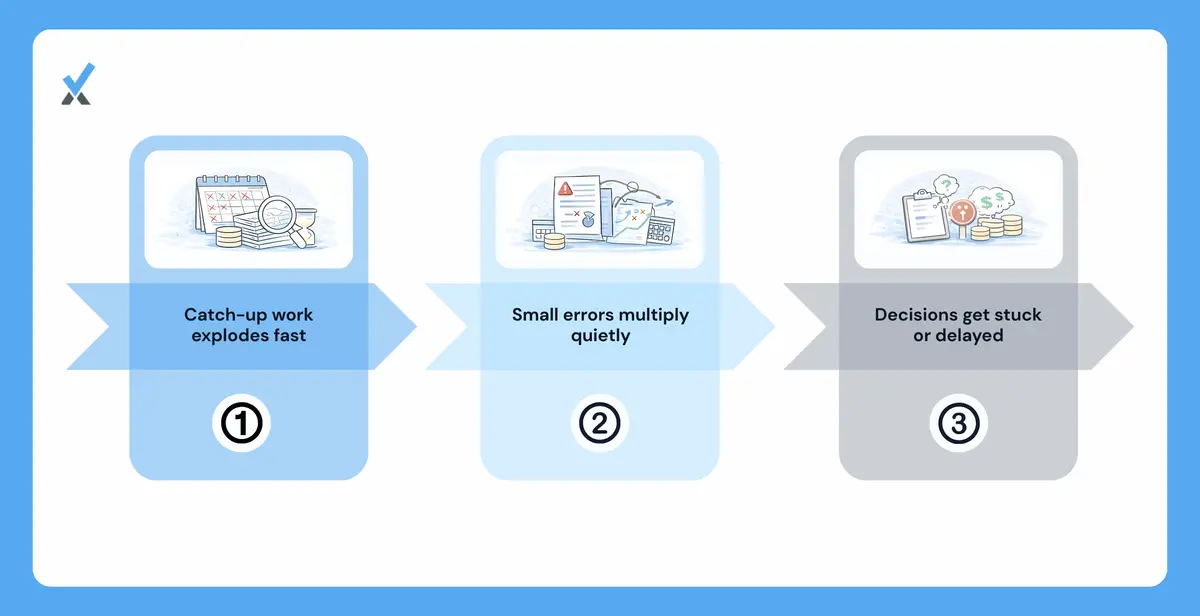
Inconsistent approaches create problems that compound over time, often in ways that are not obvious until significant damage is done. Four patterns show up repeatedly.
-
Catch-up chaos consumes far more resources than consistent maintenance. Reconstructing three months of transactions takes more than three times as much effort as reconstructing one month. Context is lost. Memories fade. Documentation disappears. What should take hours stretches into days, often at the worst possible time.
-
Errors compound when books sit untouched. A miscategorized transaction in January affects every report built on that data. A missing invoice in February throws off accounts receivable for months. By the time someone reviews the books in April, these errors have multiplied and intertwined, making correction far more complex than prevention would have been.
-
Decision delays cost real money. A firm may want to hire but cannot confidently assess whether it can afford the salary. It may need to evaluate a pricing change but lack current margin data, or consider a significant purchase without knowing its actual cash position. Every delayed decision while waiting for updated books carries an opportunity cost.
-
Reconciliation nightmares emerge when bank statements, credit cards, payroll records, and accounting systems drift apart. Monthly reconciliation catches discrepancies when they involve a handful of transactions. Quarterly reconciliation means hunting through hundreds of transactions to find where things went wrong.
How does monthly cadence create financial reliability?
Regular rhythm transforms bookkeeping from a burden a firm dreads into a business asset it relies on, through four compounding advantages.
-
Current data enables real decisions. When books close within days of the month-end, a firm has financial statements that reflect actual recent performance. It can see whether last month hit targets, spot trends while they are still developing, and answer questions about profitability, cash flow, and margins with data, not guesses.
-
Early error detection prevents minor issues from becoming significant problems. A duplicate payment noticed within weeks is easy to correct. The same error discovered during year-end close requires digging through months of records and may be impossible to resolve fully.
-
Consistent reporting creates patterns that are easy to interpret. When financial statements arrive at the same time each month with the same format and methodology, a team develops intuition for what normal looks like. Anomalies stand out. Trends become visible. The numbers start telling a story that is actually readable.
-
Operational rhythm reduces stress for everyone involved. The bookkeeper knows what to expect. Leadership knows when reports will arrive. The accountant receives clean data on predictable schedules. The entire financial function operates smoothly rather than lurching from crisis to crisis.
Professional service firms especially benefit from this reliability. Project-based revenue, varying monthly workloads, and significant payroll expenses create natural complexity that consistent monthly attention keeps manageable.
How does consistency keep tax and payroll integration on track?
Monthly bookkeeping does not exist in isolation. It connects to other critical financial obligations in ways that inconsistent approaches cannot support.
-
Quarterly estimated taxes require current financial data. Firms that owe estimated taxes in April, June, September, and January need reasonably accurate profit figures to calculate payments. Sporadic bookkeeping means either guessing at estimates or scrambling to update books before each deadline.
Recurring monthly bookkeeping that closes on schedule means estimated tax calculations draw on recent actual data. Payments reflect real profitability, reducing the risk of underpayment penalties or unnecessary overpayment.
-
Payroll reconciliation depends on books that match payroll records. Wages, taxes withheld, employer contributions, and benefits all flow through correct data into the accounting system. When bookkeeping falls behind, payroll liabilities on the balance sheet drift from reality. Monthly reconciliation keeps these critical accounts accurate.
-
Year-end readiness becomes straightforward rather than stressful. Tax preparation requires twelve months of clean, reconciled financial data. If books are current each month, the year-end close is simply the twelfth monthly close plus a few additional adjustments. If books are perpetually behind, year-end becomes a massive catch-up project that delays filing and increases CPA fees.
-
1099 compliance requires tracking contractor payments throughout the year. Monthly bookkeeping ensures payments are properly categorized and documented as they occur, making January's 1099 preparation a simple report rather than a forensic investigation.
How does subscription bookkeeping support scalable growth?
The structure of monthly bookkeeping services matches how growing professional service firms actually operate, across four dimensions.
-
Predictable costs enable proper budgeting. Subscription bookkeeping typically charges a fixed monthly fee rather than hourly rates that vary based on transaction volume or catch-up needs. A firm knows what financial management costs each month and can plan accordingly.
-
Growing complexity handling comes built into the relationship. As a firm adds employees, takes on more clients, or expands service offerings, its recurring bookkeeping provider scales with it. The provider understands the business, its chart of accounts, and its reporting preferences, so growth does not mean starting over with a new provider.
-
Operational stability emerges from consistent processes. The team knows how to submit expenses. Clients receive invoices on predictable schedules. Financial reports arrive when expected. This stability frees mental energy for the work that actually grows the business.
-
Provider accountability increases with ongoing relationships. A monthly bookkeeping service that closes a firm's books twelve times per year has a strong incentive to get things right. Errors affect next month's close. Inefficiencies create ongoing drag. The subscription model aligns provider success with client success.
What should a firm look for in monthly bookkeeping services?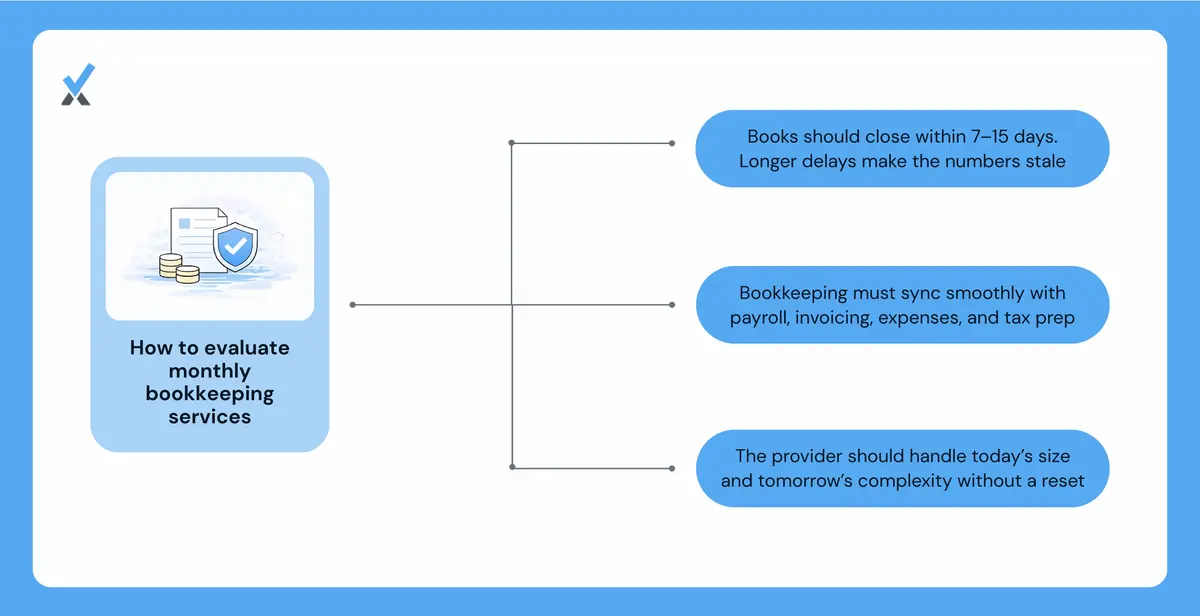
Firms evaluating providers should weigh these four factors beyond price.
-
Close timeline matters for decision-making. Ask how quickly books will be finalized after month-end. Seven to fifteen days is reasonable. Thirty days defeats much of the purpose of the monthly service.
-
Communication cadence should match a firm's preferences. Some firms want a monthly call reviewing results. Others prefer written summaries. The provider's standard approach should work for how the firm likes to consume financial information.
-
Integration capability affects overall efficiency. Bookkeeping should connect cleanly with payroll, invoicing, expense management, and, eventually, tax preparation. Ask how the provider works with existing tools and what handoffs look like.
-
Scalability ensures the relationship can grow with the firm. A provider perfect for a five-person firm may not handle the complexity at twenty. Understand their typical client size and whether they support firms at the firm's growth trajectory.
How should a firm make the shift to consistent monthly bookkeeping?
If books are currently behind, the first step is catching up. This may require a one-time project to bring everything up to date before establishing the monthly rhythm.
Once current, the ongoing investment in monthly bookkeeping services typically ranges from $300 to $1,500 monthly, depending on transaction volume and complexity. For professional service firms, this investment pays for itself through reduced year-end fees, better decision-making, and the elimination of catch-up chaos.
The goal is not bookkeeping for its own sake. The goal is financial confidence: knowing where the business stands, trusting the numbers, and making decisions based on reliable current data rather than outdated guesses.
Consistency creates that confidence. Monthly cadence delivers that consistency. And subscription bookkeeping, delivered with an expert-led, AI-powered, human-in-the-loop process, makes it sustainable.
| Metric | Sporadic bookkeeping | Monthly bookkeeping |
|---|---|---|
| Time to reconstruct 3 months | Days, often under deadline pressure | Not applicable, never accumulates |
| Error detection window | Months, often at year-end | Weeks, at the next close |
| Quarterly tax estimate accuracy | Guesswork or last-minute scramble | Based on current actual data |
| Year-end close effort | Major catch-up project | One more routine monthly close |
| Typical monthly cost | Variable, hourly, unpredictable | $300 to $1,500, fixed fee |
How long does it take to catch up if books are already behind?
It depends on how far behind and how many transactions are involved, but most catch-up projects for a few months of backlog take one to three weeks of dedicated work. Firms should treat this as a one-time project, separate from the ongoing monthly service, so the two do not get confused in scope or pricing.
Is monthly bookkeeping worth it for a very small firm?
Usually yes, even below five employees, since the fixed monthly fee is often close to what a few hours of catch-up chaos would cost anyway. The main question is transaction volume: firms with very few transactions each month may be able to stretch to a bi-monthly cadence instead.
What happens if a firm outgrows its bookkeeping provider?
Reputable subscription providers are built to scale with a client rather than force a switch, but if a firm's complexity does outpace its provider, the transition works best when initiated proactively during a routine review rather than after service quality has already slipped.
Financial confidence comes from knowing the numbers are current, not from scrambling to reconstruct them under deadline pressure, which is exactly what an expert-led, AI-powered, human-in-the-loop monthly close is built to deliver.
See how Numetix bookkeeping services keep a monthly close on schedule, built specifically for professional services firms.
Numetix is an AI-first accounting firm. AI runs the bookkeeping, tax, payroll, and reporting workflow. Industry experts handle the judgment, month-end close, review, and advisory. We serve founder-led service firms across law, consulting, IT, healthcare, creative, and nonprofit. Headquartered in California, serving clients nationwide.
Suggested Readings
What CO-197 denial code means (authorization absent)
What CO-50 denial code means (medical necessity)
Cause marketing and commercial co-ventures explained
See what Numetix can do for you
Learn how the Numetix Portal streamlines communication, offers valuable insights, and saves you time so you can focus on growing your business.